Table of Contents

Technical Installation Requirements

Engineering Standards for Reliable Stainless Steel Piping Systems

Minimum Spacing Requirements

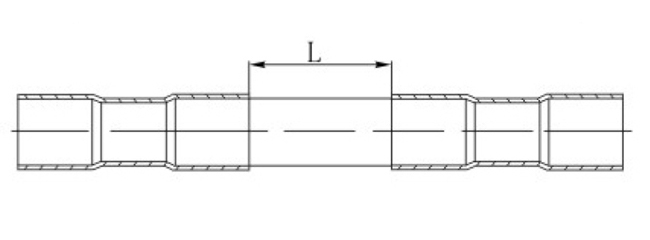
During press connections, minor deformation occurs at pipe joints. Maintaining proper spacing between connections is essential for system integrity.

Basic Handling Principles

Technical diagram showing minimum required distances between straight pipe couplings for different diameter sizes (DN15-DN100) to accommodate connection deformation.
Nominal Diameter(DN)Minimum Spacing L(mm)
15-2520
32-5040
65-10060

Elbow Combination Safety Dimensions

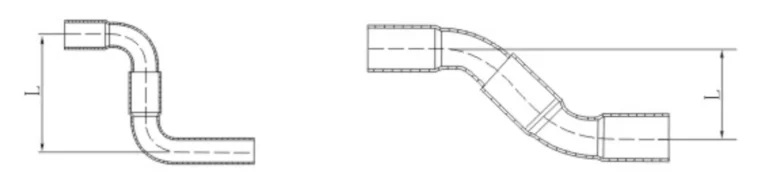
Technical drawing displaying safe installation dimensions for 45-degree and 90-degree elbow combinations across DN15 to DN100 pipe sizes.
DN1520253240506580100
45°L(mm)48566590107118233270320
90°L(mm)546482104126140263305355

Pipe Supports and Hangers

  • Stainless Steel Brackets (with nuts)

  • Stainless Steel Rod-type Pipe Clamps

  • Stainless Steel Single Clamps

Gas Pipeline Compensation

Expansion Calculation

ΔL = α * L * ΔT
Where:
α - Linear expansion coefficient (stainless steel: 0.0173 mm/m·°C)
L - Pipe length between fixed supports (meters)
ΔT - Temperature differential (°C)

Compensation Methods

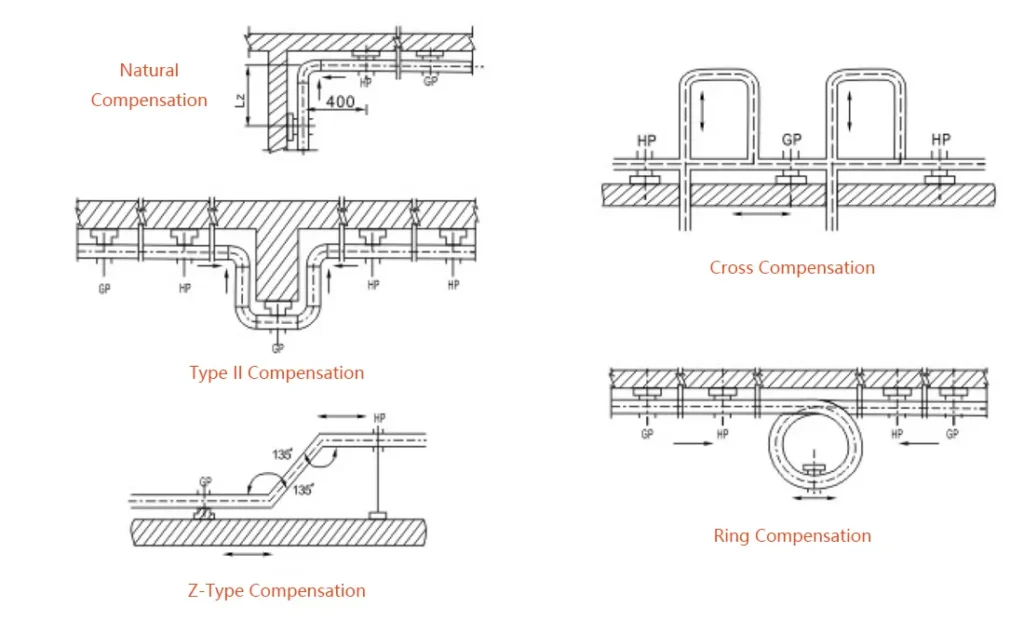
  • Natural Compensation: Free arm length calculation

  • Type II Compensation: U-shaped expansion loops

  • Z-Type Compensation: Offset expansion configuration

  • Cross Compensation: Multi-directional expansion handling

  • Ring Compensation: Circular expansion loops

  • Bellows Expansion Joints: For DN32 and larger pipes

Comprehensive diagram illustrating five thermal expansion compensation methods: Natural Compensation, Type II, Z-Type, Cross Compensation, and Ring Compensation for stainless steel pipelines.

Application Guidelines

  • Type II or bellows compensators preferred for gas mains and high-rise buildings

  • Natural, Type II, and Z-type compensation can be installed horizontally or vertically

  • Bellows expansion joints recommended for DN32 and larger pipelines

Pipeline Installation Specifications

Penetration Requirements

When gas pipelines pass through trenches, building foundations, walls, and floors:

  • Must be installed within sleeves/casings, preferably coaxial

  • No connection joints permitted within sleeve sections

  • Wall, floor, and embedded sections should have protective coating or plastic coating

  • Annulus between pipe and sleeve filled with flexible, corrosion-resistant waterproof material

  • Space between sleeve and building structure filled with waterproof material

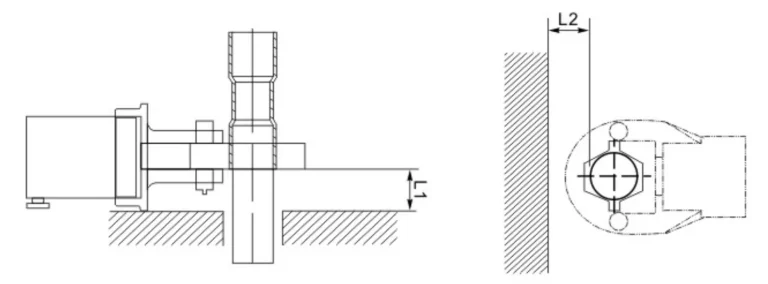
Minimum Sleeve Diameter Requirements

Nominal Diameter(DN)1520253240506580100
L1(mm)48566590107118233270320
L2(mm)546482104126140263305355
Technical illustration showing proper pipeline installation through walls and floors, including sleeve requirements, sealing methods, and clearance specifications.

Important Notice

These technical requirements are minimum standards. Always consult local building codes, project specifications, and engineering requirements. Nonleak recommends professional installation by certified technicians for all piping systems.