
Table of Contents
Pipeline Testing and Acceptance Standards
Strength, Tightness and Safety Checks for Stainless Steel Piping Systems
Pipeline testing and acceptance helps verify the strength, tightness and safety of stainless steel piping systems before commissioning. This page outlines key testing procedures for Nonleak pipeline installations, including pre-testing requirements, testing medium selection, pressure test specifications, acceptance criteria and safety precautions.
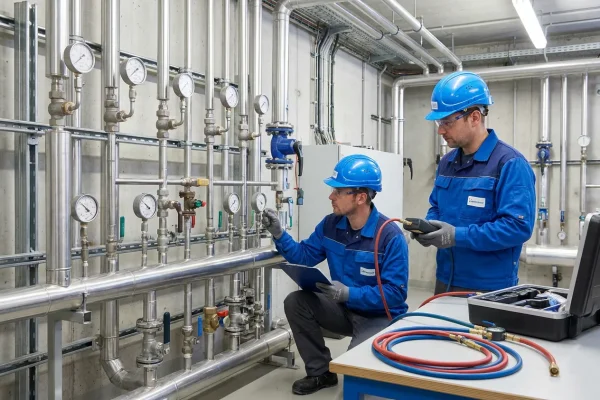
Pipeline Testing and Acceptance Procedures
Before pressure testing starts, the installation team should confirm the test scope, safety plan, system isolation and inspection records.
Pre-Testing Requirements
Test all indoor gas pipelines for strength and tightness after installation.
Technical and supervision managers must approve the test plan and safety measures.
Install all piping in the test scope according to design specifications before testing.
Reinforce pipelines properly before testing.
Isolate non-test systems clearly and keep proper identification records.
Testing Medium & Equipment
Use suitable testing equipment and calibrated gauges to keep pressure readings accurate during the acceptance process.
Test Medium: Use compressed air. Do not use water for gas pipeline testing.
Use pressure gauges within the valid calibration period.
Gauge Range: Select a gauge range of 1.5–2 times the maximum test pressure.
Spring Pressure Gauge Accuracy: Use 0.4 class gauges.
U-Tube Manometer Graduation: Use ≤1 mm graduation.
Testing Responsibility
Clear responsibility helps each party confirm the test result and complete project acceptance without confusion.
The construction contractor conducts the test.
The gas operation enterprise, supervision unit and construction unit should participate.
The construction unit organizes final acceptance according to project type.
Special Requirements
Test buried pipelines before concealment.
For stainless steel systems, use bubble test solution with chloride ion content ≤25×10⁻⁶.
Strength Test Specifications
Strength testing confirms whether the pipeline can withstand the required test pressure before tightness testing begins.
Test Scope Definition
Residential: From inlet pipe valve to gas meter inlet valve (including valves)
Industrial/Commercial: From inlet pipe valve to appliance front valve (including valves)
Pre-valve piping tested together with buried pipelines
Preparation & Pressure Requirements
Purge pipelines clean with air or nitrogen before testing.
Test Pressure: Use 1.5 × design pressure, with a minimum of 0.1 MPa.
Test Duration & Acceptance Criteria
Design pressure ≥10kPa: Maintain pressure for at least 30 minutes, test all joints with bubble solution, and confirm no leakage.
Alternative Method: Maintain pressure for 60 minutes and confirm no pressure drop.
Design pressure <10kPa: Maintain pressure ≥30 minutes, bubble test, no leakage or pressure drop
0.4MPa tests (industrial/commercial): Stop at 1/2 pressure for 15 minutes, bubble check, then continue to full pressure for 60 minutes, no pressure drop
Tightness Test Specifications
After the strength test, tightness testing checks whether the completed pipeline system can hold pressure without leakage during acceptance.
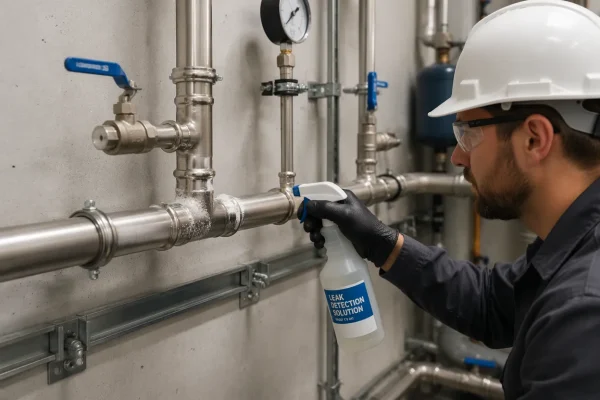
Test Scope & Sequence
Scope: All piping from inlet valve to appliance front valve.
Additional check required for piping between appliance valve and appliance before commissioning.
Conduct the tightness test after the strength test.
Medium Pressure Pipelines
Test pressure: Design pressure (minimum 0.1MPa)
Duration: ≥2 hours
Acceptance Criteria: Test all connections with bubble solution and confirm no leakage or pressure drop.
Low Pressure Pipelines
Test pressure: Design pressure (minimum 5kPa)
Duration:
Residential: ≥15 minutes
Commercial/Industrial: ≥30 minutes
Systems with stainless bellows/plastic-coated pipes: ≥1 hour
Measurement: Use a U-tube manometer.
Also check plastic-coated pipe ends for seepage.
Critical Safety Requirements for Pipeline Testing
Do not use water as the test medium for gas pipeline testing.
Remove or isolate safety relief devices during strength testing.
Isolate all non-test systems properly.
Clean bubble solution promptly after testing.
Use low-chloride bubble solution for stainless steel piping systems.
Related Testing and Installation Resources
For installation dimensions and technical requirements, visit our Technical Documentation page. To prepare compatible installation tools, review our Tool Maintenance page. To choose matching stainless steel pipes and fittings, explore our Stainless Steel Pipes and Stainless Steel Pipe Fittings pages. For general fuel gas piping inspection, testing, leak check and purging references, installers may also review NFPA 54 National Fuel Gas Code information.