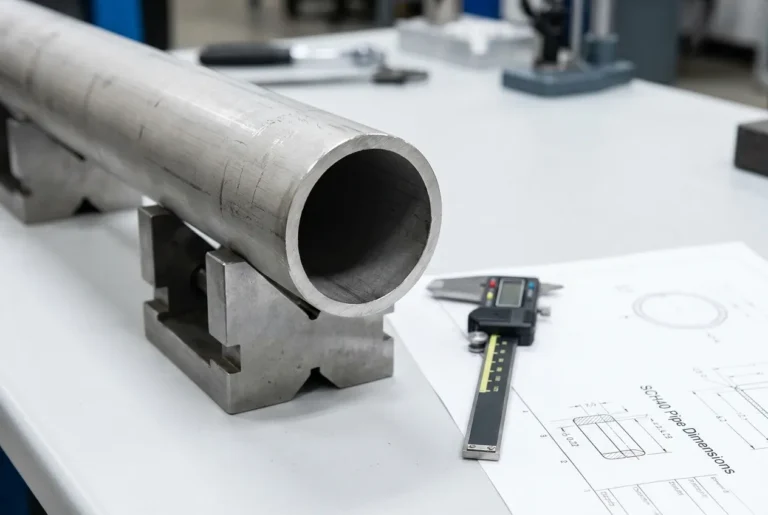
Schedule 40 stainless steel pipe, commonly abbreviated as SCH40 stainless steel pipe, is widely searched by engineers, contractors and buyers who need to confirm pipe dimensions, wall thickness and suitability for a piping project.
Unlike a single fixed thickness, Schedule 40 represents a wall thickness series that changes with nominal pipe size. This means the pipe diameter, applicable dimensional standard and schedule designation must all be checked before a quotation or purchase order is confirmed.
This guide focuses on SCH40 dimensions, how wall thickness changes by size, the distinction between Schedule 40 and Schedule 40S, and how SCH40 compares with the lighter-wall option discussed in our Schedule 10 stainless steel pipe guide.
What Does Schedule 40 Mean?
Schedule 40 is a pipe wall thickness designation used together with a nominal pipe size such as NPS or DN. It does not describe the stainless steel grade, manufacturing process or pressure rating by itself.
For a particular nominal pipe size, the dimensional table establishes the outside diameter and corresponding wall thickness. As wall thickness increases, the available internal diameter normally decreases when the outside diameter remains the same.
This distinction is important because two stainless steel pipes may have the same nominal size and outside diameter but different internal diameters, weights and wall thicknesses.
If you need to decode NPS, DN, outside diameter and inside diameter before comparing wall thickness, review our guide to stainless steel pipe sizes and dimensions.
Schedule 40 Stainless Steel Pipe Dimensions
The following schedule 40 stainless steel pipe dimensions include nominal size, outside diameter and wall thickness. Before using the table for design or procurement, confirm whether the project specification requires SCH40 or SCH40S.
| Nominal Pipe Size Inches | Nominal Diameter | Outside Diameter | Wall Thickness (mm) | |
|---|---|---|---|---|
| in | mm | |||
| 1/8″ | DN6 | 0.405 | 10.29 | 1.73 |
| 1/4″ | DN8 | 0.540 | 13.72 | 2.24 |
| 3/8″ | DN10 | 0.675 | 17.15 | 2.31 |
| 1/2″ | DN15 | 0.840 | 21.34 | 2.77 |
| 3/4″ | DN20 | 1.050 | 26.67 | 2.87 |
| 1″ | DN25 | 1.315 | 33.40 | 3.38 |
| 1-1/4″ | DN32 | 1.660 | 42.16 | 3.56 |
| 1-1/2″ | DN40 | 1.900 | 48.26 | 3.68 |
| 2″ | DN50 | 2.375 | 60.33 | 3.91 |
| 2-1/2″ | DN65 | 2.875 | 73.03 | 5.16 |
| 3″ | DN80 | 3.500 | 88.90 | 5.49 |
| 3-1/2″ | DN90 | 4.000 | 101.60 | 5.74 |
| 4″ | DN100 | 4.500 | 114.30 | 6.02 |
| 5″ | DN125 | 5.563 | 141.30 | 6.60 |
| 6″ | DN150 | 6.625 | 168.28 | 7.10 |
| 8″ | DN200 | 8.625 | 219.08 | 8.18 |
| 10″ | DN250 | 10.750 | 273.05 | 9.27 |
| 12″ | DN300 | 12.750 | 323.85 | 10.31 |
| 16″ | DN400 | 16.000 | 406.40 | 12.70 |
| 20″ | DN500 | 20.000 | 508.00 | 15.09 |
| 24″ | DN600 | 24.000 | 609.60 | 17.48 |
| 32″ | DN800 | 32.000 | 812.80 | 17.48 |
| 36″ | DN900 | 36.000 | 914.40 | 19.05 |
Dimension note: Use one verified dimensional source throughout the table. Do not combine SCH40 and SCH40S values without checking the applicable project standard.
How SCH40 Wall Thickness Changes by Pipe Size
SCH40 is not one universal wall thickness. A small-diameter pipe and a large-diameter pipe with the same schedule designation can have different wall thickness values.
As a result, buyers should not request only “Schedule 40 pipe” without also providing the required nominal pipe size. A complete specification should normally identify the nominal size, material grade, schedule designation, manufacturing requirements and required length.
Wall thickness can influence several practical factors:
- Pipe weight per unit length
- Available internal flow area
- Handling and installation requirements
- Compatibility with fittings and equipment
- Welding, forming or joining requirements
- Project engineering calculations
Schedule alone should not be treated as a complete pressure rating. Operating pressure, temperature, material properties, corrosion conditions and the applicable piping code must also be considered.
SCH40 vs SCH10: Key Differences
For the same nominal pipe size and dimensional series, SCH40 generally has a heavier wall than SCH10. This difference affects more than pipe weight; it can also change the internal flow area, handling requirements and fitting selection.
| Comparison | SCH10 | SCH40 |
|---|---|---|
| Typical wall relationship | Thinner wall | Heavier wall |
| Pipe weight | Generally lighter | Generally heavier |
| Internal diameter | Usually larger for the same NPS and OD | Usually smaller for the same NPS and OD |
| Handling | May be easier to transport and install | May require additional handling consideration |
| Selection basis | Project design and lighter-wall requirements | Project design and heavier-wall requirements |
Neither schedule is automatically the better choice. The correct option depends on the complete design conditions rather than the schedule number alone.
Schedule 40 vs Schedule 40S
The terms Schedule 40 and Schedule 40S are sometimes used interchangeably in commercial discussions, but they should not automatically be treated as identical technical designations.
The “S” suffix is used in the stainless steel pipe dimensional series to distinguish it from the corresponding pipe schedule designations in another dimensional series. Some nominal sizes may share the same wall thickness, while certain sizes can differ.
For this reason, drawings, quotations and purchase orders should clearly state:
- The required nominal pipe size
- Whether the designation is SCH40 or SCH40S
- The required outside diameter
- The required wall thickness
- The applicable dimensional standard
For an official reference, review the ASME B36.19M stainless steel pipe standard page.
Where Schedule 40 Pipe Is Commonly Used
Stainless steel Schedule 40 pipe may be specified in projects that need corrosion-resistant piping combined with a defined heavier-wall dimension. The actual suitability must still be confirmed through engineering review.
Potential project areas include:
- Industrial utility piping
- Process water pipelines
- Mechanical and HVAC systems
- Pump and equipment connections
- Commercial building service piping
- Factory pipeline upgrades
- Systems with project-specific wall thickness requirements
Material grade is another important consideration. Stainless steel 304 and 316L may be selected for different service environments, but material grade and pipe schedule solve different specification requirements.

How to Confirm the Right Pipe Specification
A complete pipe inquiry should contain more information than the words “SCH40 stainless steel pipe.” Supplying complete technical information reduces the risk of dimension or material mismatches.
| Specification Item | Information to Confirm |
|---|---|
| Nominal size | NPS, DN and required outside diameter |
| Schedule | SCH40 or SCH40S |
| Wall thickness | Required value in inches or millimeters |
| Material grade | 304, 316L or another specified grade |
| Pipe construction | Welded or seamless, where required |
| Service conditions | Medium, pressure, temperature and installation environment |
| Connection method | Welded, press-fit, threaded or another approved system |
Nonleak supplies stainless steel pipes and matching stainless steel pipe fittings for water, HVAC and industrial piping projects.
Additional product and installation references can be found in our Technical Documentation section.
Download the Full Pipe Schedule Table
For additional schedule and wall thickness references, download the full stainless steel pipe schedule table.
The downloadable table should be treated as a general dimensional reference. Final dimensions must be checked against the approved project specification before ordering.
If you want to compare SCH 40 with other common wall-thickness series before downloading the full table, use our pipe schedule chart. The guide places SCH 10, SCH 40 and SCH 80 in one NPS-based comparison and explains how schedule, wall thickness and inside diameter relate.
Questions Buyers Often Ask About SCH40
Does SCH40 have the same wall thickness in every pipe size?
No. Wall thickness changes according to nominal pipe size. The schedule designation must always be used together with the required NPS or DN.
Does Schedule 40 define the stainless steel grade?
No. Schedule describes a dimensional wall thickness series. The stainless steel grade, such as 304 or 316L, must be specified separately.
Is SCH40 always suitable for higher pressure than SCH10?
A heavier wall may be one factor in the engineering design, but schedule alone is not a complete pressure rating. Material, temperature, manufacturing requirements, corrosion conditions, joining method and piping code must also be reviewed.
Can SCH40 and SCH40S be substituted for each other?
They should not be substituted without confirming the nominal size, actual wall thickness, dimensional standard and project requirements.
Discuss Your Pipe Requirements with Nonleak
To request Schedule 40 stainless steel pipe, provide the required nominal size, material grade, schedule designation, wall thickness, length and applicable standard. Contact Nonleak with your project specification or pipe schedule for product selection support.