Choosing between a concentric reducer vs eccentric reducer is not only a matter of product shape. The reducer geometry affects pipe centerline alignment, installation elevation, drainage, possible vapour-pocket locations and the way a size transition fits into the overall piping layout.
Both types connect pipes with different diameters, but they should not automatically be treated as interchangeable. The correct choice depends on pipe orientation, conveyed medium, equipment layout, flow conditions and the approved piping design.
This guide explains the main differences and provides a practical selection checklist for stainless steel butt-weld piping projects.
Why Reducer Geometry Matters
A pipe reducer creates a transition between a larger pipe and a smaller pipe. Although both reducer types perform this basic function, their external and internal geometry position the two pipe sizes differently.
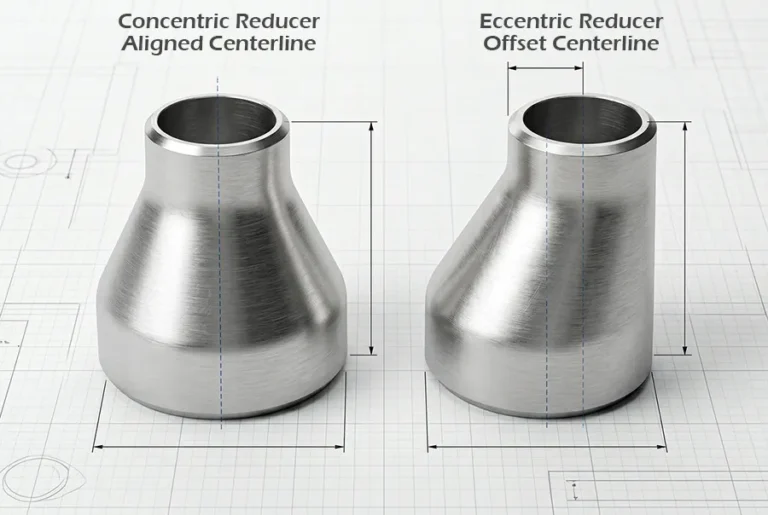
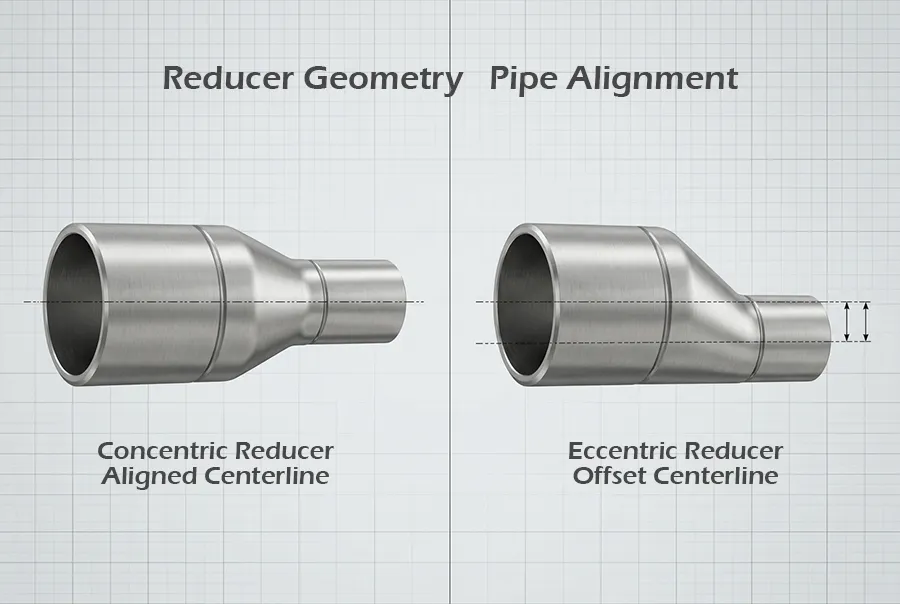
A concentric reducer keeps the large and small pipe openings on one common centerline. An eccentric reducer offsets the smaller opening and provides one side that remains comparatively straight or flat.
This difference affects whether the pipeline remains centered or whether the top or bottom elevation can be maintained through the transition.
Concentric Reducer vs Eccentric Reducer at a Glance
The following comparison summarizes the principal differences between a concentric reducer vs eccentric reducer.
| Comparison Factor | Concentric Reducer | Eccentric Reducer |
|---|---|---|
| Centerline | Large and small ends share one centerline | Large and small ends have offset centerlines |
| External shape | Symmetrical tapered profile | Asymmetrical profile with one flatter side |
| Pipeline elevation | Changes the top and bottom elevations evenly | Can help maintain either the top or bottom pipe elevation |
| Common layout | Vertical lines and centered transitions | Horizontal lines and elevation-sensitive transitions |
| Pump connections | May be used where the approved equipment layout requires a centered transition | Frequently considered for horizontal suction arrangements |
| Orientation requirement | Generally rotationally symmetrical | Flat-side orientation must be confirmed |
This table is a general selection guide. The final fitting type and orientation must follow the project piping design, equipment-manufacturer instructions and applicable engineering requirements.
How a Concentric Reducer Works
A concentric reducer has a symmetrical tapered body. The center of the large opening aligns with the center of the smaller opening, allowing the connected pipes to remain on the same axis.
This geometry is commonly useful where:
- The pipe centerline should remain aligned
- The piping transition is installed vertically
- Top-of-pipe or bottom-of-pipe elevation is not the controlling layout requirement
- A centered connection is required by the equipment or piping arrangement
- The surrounding space allows the pipe elevation to change on both sides of the centerline
A concentric reducer should not be selected only because it appears more symmetrical. The installer must still confirm the larger size, smaller size, wall thickness, reducer length, material and weld-end preparation.
How an Eccentric Reducer Works
An eccentric reducer positions the smaller opening away from the center of the larger opening. One side of the fitting forms a more continuous flat line, while the opposite side creates the tapered transition.
This geometry can be useful where:
- The top of the pipeline needs to remain at a consistent elevation
- The bottom of the pipeline needs to remain at a consistent elevation
- A horizontal transition must avoid an unwanted high or low point
- The pipe is installed on a rack or near a fixed supporting surface
- The equipment connection is offset from the incoming pipe centerline
Because the product is asymmetrical, its rotational orientation is part of the installation decision. An eccentric reducer should not be welded into place before the required flat-side position has been confirmed.
Selecting a Reducer by Pipe Orientation and Layout
| Pipeline Condition | Typical Starting Point | What Must Be Confirmed |
|---|---|---|
| Vertical size transition | Concentric reducer | Centerline, available space and equipment connection |
| Horizontal transition with no fixed elevation requirement | Either type may be evaluated | Flow condition, support arrangement and project drawing |
| Horizontal liquid line with a possible high-point pocket | Eccentric reducer may be appropriate | Flat-side orientation and complete pipeline profile |
| Pipe supported on a rack with bottom elevation to be maintained | Eccentric reducer may be appropriate | Bottom-flat orientation, supports and drainage |
| Centered equipment connection | Concentric reducer may be appropriate | Equipment nozzle and approved piping drawing |
| Offset equipment connection | Eccentric reducer may be appropriate | Nozzle elevation, orientation and installation clearance |
When comparing concentric reducer vs eccentric reducer options, the pipeline layout should be reviewed as a complete route. A reducer that appears correct in isolation may create an unwanted high point, low point or misalignment after the adjoining pipes and equipment are installed.
What About Reducers in Pump Suction Piping?
Eccentric reducers are frequently considered for horizontal pump suction piping because their flat-side geometry can help avoid an unintended high point in certain liquid-service arrangements.
However, an eccentric reducer should not be described as a universal solution for pump cavitation. Pump performance also depends on suction pressure, available net positive suction head, pipe velocity, straight-pipe length, fittings near the inlet, valve position, fluid temperature and the pump manufacturer’s requirements.
The correct reducer type, orientation and distance from the pump inlet must therefore be confirmed using the approved pump and piping documentation.
A concentric reducer may still be used where the equipment manufacturer or project engineer requires a centered transition, including some vertical or specially arranged connections.
Flat-on-Top vs Flat-on-Bottom Orientation
The flat side of an eccentric reducer may be installed in different orientations depending on the service and piping objective.
Flat-on-Top
A flat-on-top arrangement is commonly evaluated when the design objective is to avoid creating a high point where air or vapour could collect in a horizontal liquid line.
Flat-on-Bottom
A flat-on-bottom arrangement may be evaluated when the bottom elevation must remain consistent, such as a pipeline supported on a rack or a layout with specific drainage requirements.
Other Orientations
An eccentric reducer can also be rotated to meet a side-offset equipment connection. The correct position should be shown on the piping drawing and checked before welding.
Do not use a universal rule that every eccentric reducer must always be installed flat-on-top or always flat-on-bottom. The conveyed phase, equipment arrangement, drainage requirement and project specification determine the correct orientation.
Flow, Pressure and Installation Considerations
Neither reducer type should automatically be described as having better flow performance in every system. The hydraulic effect depends on the size ratio, transition length, flow direction, fluid properties, velocity and surrounding piping geometry.
Important installation considerations include:
- Flow direction: Confirm whether the fitting is operating as a reducer or an expander.
- Size ratio: Large diameter changes may require additional hydraulic review.
- Weld alignment: The pipe and fitting ends must be aligned according to the welding procedure.
- Internal mismatch: Wall thickness and internal bore differences must be checked.
- Support position: Heavy fittings, valves and equipment connections may require additional support.
- Inspection access: Leave sufficient space for welding, examination and maintenance.
The reducer alone does not define the allowable working pressure of the piping system. Material, wall thickness, temperature, joint design, welding procedure and the applicable piping code must also be considered.
Dimensions, Materials and Applicable Standards
Factory-made wrought butt-welding reducers may be specified according to ASME B16.9 where that standard applies.
The standard and product specification should be used to confirm:
- Large-end outside diameter
- Small-end outside diameter
- End-to-end reducer length
- Dimensional tolerances
- Wall-thickness requirements
- Weld-end preparation
- Testing and marking requirements
For a practical dimensional explanation, review the Nonleak stainless steel pipe dimensions guide.
Material grade should be selected according to the conveyed medium, operating environment, corrosion conditions and project specification. The pipe, reducer and welding consumables should be reviewed as one compatible joint system.
Nonleak supplies a combined stainless steel butt-weld pipe reducer range with concentric and eccentric configurations. Available materials, dimensions, wall thicknesses and documentation should be confirmed for each quotation.
Reducer Selection Checklist
| Selection Question | Information to Confirm |
|---|---|
| What are the two pipe sizes? | Large-end NPS/DN and small-end NPS/DN |
| How is the pipe installed? | Horizontal, vertical or angled layout |
| Must the centerline remain aligned? | Select a concentric configuration where appropriate |
| Must the top or bottom elevation remain constant? | Evaluate an eccentric configuration and orientation |
| Is the reducer close to a pump or equipment nozzle? | Check the equipment-manufacturer and piping requirements |
| What is the conveyed medium? | Liquid, gas, vapour, slurry or multiphase service |
| What wall thickness is required? | Schedule or actual wall thickness at both ends |
| What material is required? | Stainless steel grade and material specification |
| What standard applies? | ASME, EN, DIN, GB or project-specific requirement |
| What inspection documents are required? | Material records, dimensional reports and requested NDT |
What to Include in a Reducer RFQ
A complete reducer quotation request should include:
| RFQ Item | Example Information |
|---|---|
| Reducer type | Concentric or eccentric |
| Large-end size | NPS, DN and outside diameter |
| Small-end size | NPS, DN and outside diameter |
| Wall thickness | Schedule or actual thickness |
| Material | Required stainless steel grade |
| Applicable standard | Dimensional and material standards |
| Construction | Seamless or welded, where specified |
| Orientation | Flat-on-top, flat-on-bottom or side offset for eccentric type |
| Surface condition | Pickled, passivated, polished or project-specific finish |
| Inspection | Required documentation and examination |
| Quantity | Quantity for each size and type |
Providing a piping drawing is particularly helpful for eccentric reducers because the required orientation may not be clear from the size description alone.
Frequently Asked Questions
Which reducer is normally used in a vertical pipe?
A concentric reducer is often the initial choice for a vertical pipeline because it maintains the pipe centerline. The final choice should still follow the equipment arrangement and approved piping drawing.
Is an eccentric reducer always required at a pump suction?
No universal rule applies to every pump installation. Eccentric reducers are frequently used in horizontal suction arrangements, but the reducer type, orientation and inlet layout must follow the pump manufacturer and project-engineering requirements.
Can an eccentric reducer be rotated?
Yes. Its rotational position determines where the flat side and offset are located. The required orientation should be marked or shown on the installation drawing before welding.
Does a reducer prevent cavitation?
A reducer alone cannot guarantee cavitation prevention. Pump suction conditions, available pressure, fluid temperature, velocity, piping geometry and equipment requirements must all be evaluated.
Can one reducer be used in the reverse direction?
A reducer may function as an expander when the flow direction is reversed, but the hydraulic effect, orientation and project requirements should be reviewed before selection.
Confirm the Right Reducer for Your Project
The correct choice between a concentric reducer vs eccentric reducer depends on more than the two pipe diameters. Centerline alignment, pipe orientation, equipment position, fluid service, wall thickness and installation elevation should all be confirmed.
Review the Nonleak concentric and eccentric stainless steel reducer range, explore our butt-weld fittings, or contact Nonleak with your sizes, material, wall thickness, standard, quantity and piping drawing.