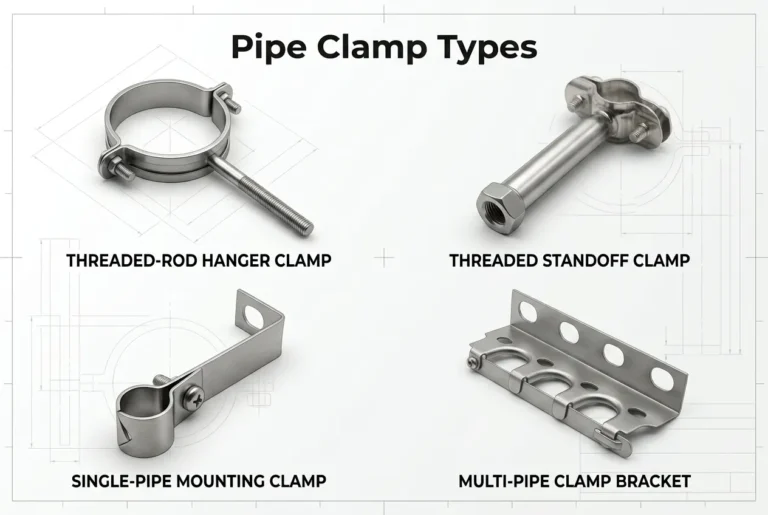
Different pipe clamp types are used to suspend, position, support and organize stainless steel piping. The correct configuration depends on whether the pipe is mounted from above, fixed against a surface, installed with additional clearance or arranged alongside several parallel pipes.
A clamp should not be selected only because its nominal size appears to match the pipe. The mounting direction, pipe outside diameter, filled pipe weight, surrounding structure and installation environment must also be considered.
This guide compares four clamp configurations available in the Nonleak product range and explains where each type may be used.
Why Pipe Support Selection Matters
A pipe support transfers the pipe and its operating loads to the building or supporting structure. The clamp or bracket also helps maintain the intended pipeline position and alignment.
An unsuitable mounting configuration may create poor alignment, insufficient clearance or an installation that is difficult to inspect and maintain. For this reason, the clamp type should be selected together with the pipe layout rather than treated as an unrelated accessory.
The products discussed here are intended for common building and mechanical piping layouts. Engineered spring supports, seismic restraints, vibration-control devices and other specialist support systems are outside the scope of this article.
Four Pipe Clamp Types for Stainless Steel Piping
The Nonleak stainless steel pipe clamps and mounting brackets range includes four main configurations.
| Clamp Type | Primary Installation Purpose | Typical Configuration |
|---|---|---|
| Threaded-Rod Pipe Hanger Clamp | Suspending or supporting a pipe from above | Circular clamp with an extended mounting rod |
| Threaded Standoff Pipe Clamp | Holding a pipe away from a surface or structure | Pipe clamp with an extended threaded mounting end |
| Single-Pipe Mounting Clamp | Mounting one pipe to a wall or structural surface | One pipe position with a fixing bracket |
| Multi-Pipe Clamp Bracket | Organizing several parallel pipes | One mounting base with several pipe positions |
These products are part of the Nonleak Pipeline Accessories range.
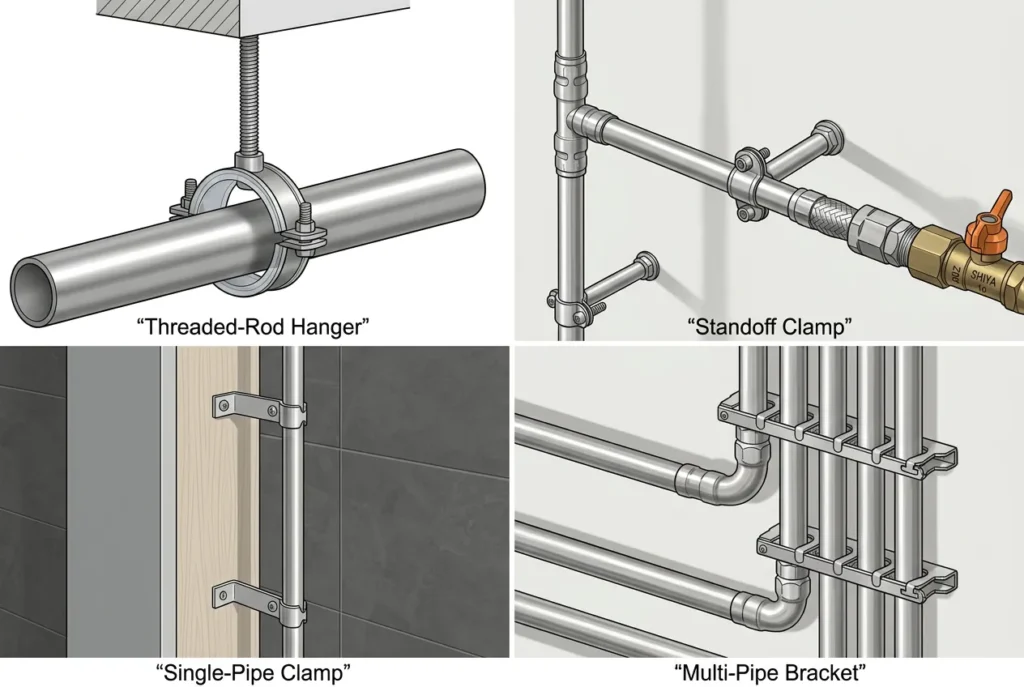
Threaded-Rod Hanger Clamps for Suspended Pipes
A threaded-rod pipe hanger clamp is used where a pipe must be supported from a ceiling, beam or another approved overhead mounting point.
The circular clamp surrounds the pipe, while the extended rod connects the clamp to the supporting structure. This arrangement is suitable for suspended horizontal pipework and other installations where mounting from above is required.
- Best suited to: Suspended pipe installations
- Available range: Selected sizes from DN15 to DN50
- Selection points: Pipe diameter, support height, mounting connection and expected load
- Check before ordering: Rod dimensions and required fixing method
The hanger clamp should not be assumed to include every ceiling fixing or structural attachment required for the complete installation. The full mounting assembly should be confirmed for the project.
Threaded Standoff Clamps for Added Clearance
A threaded standoff pipe clamp holds the pipe away from a wall, frame or other mounting surface. The extended body creates clearance behind the pipeline and provides a threaded connection to the supporting structure.
This configuration may be useful where the pipe must avoid direct contact with a surface, pass around nearby building services or remain accessible for cleaning and inspection.
- Best suited to: Wall, frame or structure-mounted piping requiring clearance
- Available range: Selected sizes from DN15 to DN100
- Selection points: Pipe diameter, required offset and mounting-thread configuration
- Check before ordering: Actual thread, support-body length and mounting method
The standoff length should be based on the actual pipe layout rather than selected only from the nominal pipe size.
Single-Pipe Mounting Clamps
A single-pipe mounting clamp provides one pipe-holding position and an extended bracket for fixing the assembly to a wall or another suitable surface.
The current Nonleak configuration supports DN15 pipe and is available with two bracket lengths:
- 45 mm
- 75 mm
The shorter option is suitable where limited clearance is required, while the longer configuration creates additional distance between the pipeline and mounting surface.
Before selection, confirm that the stated bracket length is suitable for the required wall clearance and that the mounting hole matches the intended fixing method.
Multi-Pipe Clamp Brackets
A multi-pipe clamp bracket organizes several parallel pipes on one mounting base. This helps create a cleaner installation where multiple water, HVAC or building-service pipelines follow the same route.
The product range includes brackets with one to seven pipe positions.
| Number of Pipe Positions | Available Nominal Sizes | Typical Use |
|---|---|---|
| 1–6 positions | DN15 and DN20 | Parallel small-diameter pipe layouts |
| 7 positions | DN15 only | High-density DN15 pipe arrangement |
The seven-position version should not be specified for DN20 unless a corresponding approved product configuration is available.
Multi-pipe brackets are particularly useful where consistent pipe spacing and an organized appearance are required.
How to Choose a Clamp by Installation Layout
The following selection table provides a practical starting point.
| Installation Requirement | Suggested Clamp Configuration |
|---|---|
| Pipe suspended from an overhead structure | Threaded-rod pipe hanger clamp |
| Pipe mounted with additional distance from a wall or frame | Threaded standoff pipe clamp |
| One DN15 pipe fixed to a surface | Single-pipe mounting clamp |
| Several DN15 or DN20 pipes installed in parallel | Multi-pipe clamp bracket |
This table explains the general purpose of the four configurations. It does not replace project-specific support calculations or local installation requirements.
Selection Factors Beyond Pipe Diameter
Although nominal diameter is an important starting point, selecting between different types of pipe clamps requires additional project information.
Pipe Outside Diameter
The clamp opening must match the actual pipe outside diameter. NPS, DN and outside diameter are related but are not always identical measurements.
For an explanation of these terms, review the Nonleak stainless steel pipe dimensions guide.
Installation Direction
Confirm whether the pipe is installed horizontally, vertically, against a wall, beneath a ceiling or on a separate supporting frame.
Pipe and Fluid Weight
The completed support must account for the pipe, the conveyed medium and any additional components installed near the support point.
Valves and Concentrated Loads
Valves, strainers, flanges and equipment connections can create concentrated loads that may require additional support rather than relying on a nearby small pipe clamp.
Temperature and Movement
Temperature changes may cause pipeline expansion or contraction. The complete support arrangement should follow the approved piping design and should not unintentionally prevent required movement.
Mounting Surface
A clamp is only one part of the support assembly. The wall, ceiling, frame, fastener and threaded connection must also be suitable for the installation.
Environment and Material Compatibility
Confirm the required stainless steel grade, corrosion environment, exposure conditions and compatibility between the pipe, clamp and mounting hardware.
Common Pipe Clamp Selection Mistakes
Selecting Only by DN
DN is a nominal designation. Confirm the corresponding pipe outside diameter before ordering a clamp.
Assuming Every Clamp Includes the Full Mounting Assembly
Some products may require separate threaded rods, anchors, nuts, bolts or structural attachments.
Using a Multi-Pipe Bracket for an Unsupported Size
The number of positions and supported nominal sizes must both be confirmed. For example, the current seven-position bracket is limited to DN15.
Ignoring Clearance
For wall-mounted installations, confirm that enough clearance remains for fittings, pressing tools, insulation, inspection and maintenance.
Using Universal Spacing Values
Pipe support spacing should not be copied from a generic table without checking pipe material, diameter, orientation, operating conditions and applicable project requirements.
Expecting a Small Clamp to Carry Nearby Equipment
Pumps, valves and other heavy inline components may require their own support arrangement.
What to Include in a Pipe Clamp RFQ
A clear request for quotation should include the following information:
| RFQ Item | Information Required |
|---|---|
| Clamp type | Hanger, standoff, single-pipe or multi-pipe bracket |
| Nominal pipe size | DN and/or NPS |
| Pipe outside diameter | Actual dimension in millimeters or inches |
| Number of pipes | One pipe or required multi-pipe positions |
| Mounting direction | Wall, ceiling, frame, horizontal or vertical installation |
| Required clearance | Bracket or standoff length |
| Mounting connection | Thread, hole size or approved fixing method |
| Material | Required stainless steel grade |
| Project conditions | Medium, temperature, indoor/outdoor environment and supporting structure |
| Quantity | Required quantity for each type and size |
Providing these details allows the supplier to confirm whether a standard product is suitable or whether additional mounting components are required.
Related pipe and installation information is available in the Nonleak Technical Documentation.
Find the Right Pipe Support for Your Project
The correct pipe clamp types depend on how the stainless steel pipeline is mounted, how many pipes share the route and what clearance is required around the installation.
Review the complete stainless steel pipe clamps and mounting brackets product range or contact Nonleak with your pipe dimensions, installation drawing and mounting requirements.