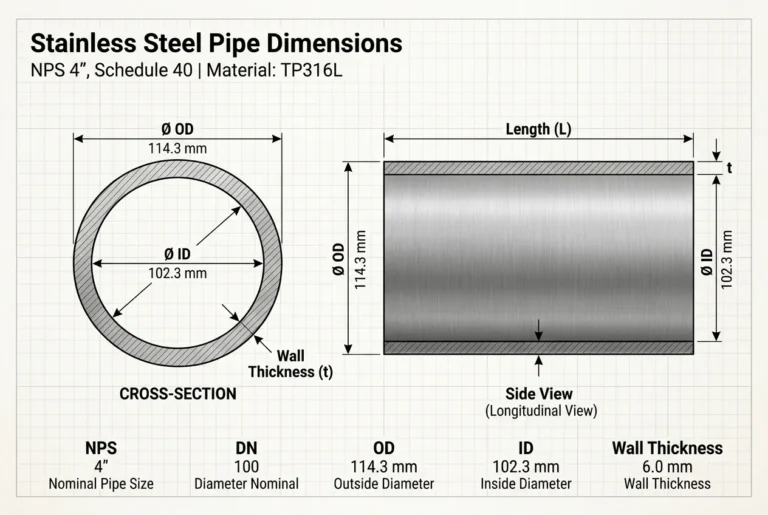
Stainless steel pipe dimensions can be confusing because the nominal size printed in a specification does not always equal the pipe’s actual outside diameter. A complete pipe description may include NPS, DN, outside diameter, wall thickness and a schedule designation.
These values describe different parts of the pipe size system. Understanding how they relate helps engineers, contractors and buyers avoid ordering the correct nominal size with the wrong wall thickness, internal diameter or connection requirements.
This guide explains how to read stainless steel pipe sizes and how to use the dimensional information when preparing drawings, quotations and purchase orders.
Why Pipe Dimensions Are Often Misunderstood
A pipe may be described as 1-inch, DN25 or Schedule 10, but these terms do not all describe the same physical measurement.
The nominal size identifies a standardized pipe category. Outside diameter is the actual measurement across the outside of the pipe. Wall thickness determines how much metal separates the outside surface from the internal flow area, while the schedule identifies a wall thickness series.
This means two pipes can share the same nominal size and outside diameter but have different wall thicknesses and inside diameters.
NPS, DN, OD and ID Explained
| Term | Full Name | What It Describes |
|---|---|---|
| NPS | Nominal Pipe Size | A standardized inch-based pipe size designation. It is not always the actual outside diameter. |
| DN | Diamètre Nominal / Nominal Diameter | A metric nominal designation corresponding to the general NPS size range. It is not necessarily an exact millimeter measurement. |
| OD | Outside Diameter | The actual measured diameter across the outside of the pipe. |
| ID | Inside Diameter | The approximate internal flow diameter after wall thickness is deducted. |
| Schedule | Pipe Schedule | A wall thickness series used together with the nominal pipe size. |
The basic dimensional relationship can be expressed as:
Inside Diameter = Outside Diameter − (2 × Wall Thickness)
The actual value should still be confirmed from the applicable standard and approved product specification.
For a schedule-specific reference, our Schedule 5 pipe guide explains common wall thicknesses, approximate inside diameters and why Schedule 5 and Schedule 5S should be checked against the applicable dimensional standard.
For the official dimensional standard reference, review the ASME B36.19M stainless steel pipe standard page.
Stainless Steel Pipe Sizes and Dimensions Chart: NPS, DN & OD
For a quick stainless steel pipe size lookup, start with the NPS or DN and then confirm the actual outside diameter (OD). For a given nominal pipe size, the outside diameter remains fixed within the applicable dimensional system, while the wall thickness and approximate inside diameter change with the selected schedule.
The chart below provides common stainless steel pipe sizes by NPS, DN and outside diameter. If you also need schedule-specific wall thickness, use the linked pipe schedule chart and confirm the applicable dimensional standard before finalizing a specification or RFQ.
| Nominal Pipe Size | Nominal Diameter | Outside Diameter (in) | Outside Diameter (mm) |
|---|---|---|---|
| 1/2″ | DN15 | 0.840 | 21.34 |
| 3/4″ | DN20 | 1.050 | 26.67 |
| 1″ | DN25 | 1.315 | 33.40 |
| 1-1/4″ | DN32 | 1.660 | 42.16 |
| 1-1/2″ | DN40 | 1.900 | 48.26 |
| 2″ | DN50 | 2.375 | 60.33 |
| 2-1/2″ | DN65 | 2.875 | 73.03 |
| 3″ | DN80 | 3.500 | 88.90 |
| 4″ | DN100 | 4.500 | 114.30 |
| 5″ | DN125 | 5.563 | 141.30 |
| 6″ | DN150 | 6.625 | 168.28 |
| 8″ | DN200 | 8.625 | 219.08 |
| 10″ | DN250 | 10.750 | 273.05 |
| 12″ | DN300 | 12.750 | 323.85 |
Dimension note: This table is a general dimensional reference. Confirm the required material, dimensional standard, schedule and wall thickness before using the values for procurement or engineering calculations.
Why Outside Diameter Does Not Match Nominal Size
NPS and DN are standardized nominal designations rather than direct measurements of outside diameter. For example, a 1-inch NPS pipe does not have an outside diameter of exactly 1 inch.
This system allows pipes, fittings, flanges and valves within the same nominal size family to be selected using a standardized designation. However, actual dimensional compatibility must still be verified.
When ordering stainless steel pipes, buyers should provide both the nominal size and the required schedule or wall thickness rather than relying on the nominal name alone.
How Pipe Schedule Changes Wall Thickness and Inside Diameter
Pipe schedule identifies a wall thickness series. For the same nominal pipe size and dimensional system, changing the schedule normally changes wall thickness while the outside diameter remains associated with the nominal size table.
A heavier wall reduces the available internal diameter. This can affect:
- Internal flow area
- Pipe weight per unit length
- Material consumption
- Handling and installation requirements
- Compatibility with certain joining methods
- Engineering pressure and temperature calculations
Schedule alone should not be treated as a complete pressure rating. Material properties, temperature, corrosion allowance, manufacturing requirements and the applicable piping code must also be reviewed.
If your main task is to compare wall thickness across schedule series rather than decode NPS and OD terminology, use the dedicated pipe schedule chart. It compares common schedules in one table while this page remains focused on NPS, DN, OD, ID and pipe-versus-tube dimensions.
Comparing SCH10 and SCH40 Dimensions
SCH10 generally represents a lighter-wall option than SCH40 for the same nominal pipe size and applicable dimensional series. The change in wall thickness also changes the approximate internal diameter and pipe weight.
| Dimension Factor | SCH10 | SCH40 |
|---|---|---|
| Wall relationship | Generally thinner | Generally heavier |
| Approximate inside diameter | Usually larger for the same NPS and OD | Usually smaller for the same NPS and OD |
| Pipe weight | Generally lighter | Generally heavier |
| Selection basis | Project design and lighter-wall requirements | Project design and heavier-wall requirements |
For detailed wall thickness values, review the Schedule 10 stainless steel pipe guide and the Schedule 40 stainless steel pipe dimensions guide.
The “S” suffix used in stainless steel pipe schedules should also be checked. SCH40 and SCH40S, for example, should not automatically be treated as interchangeable for every nominal size.
Stainless Steel Pipe Size vs Tube Size
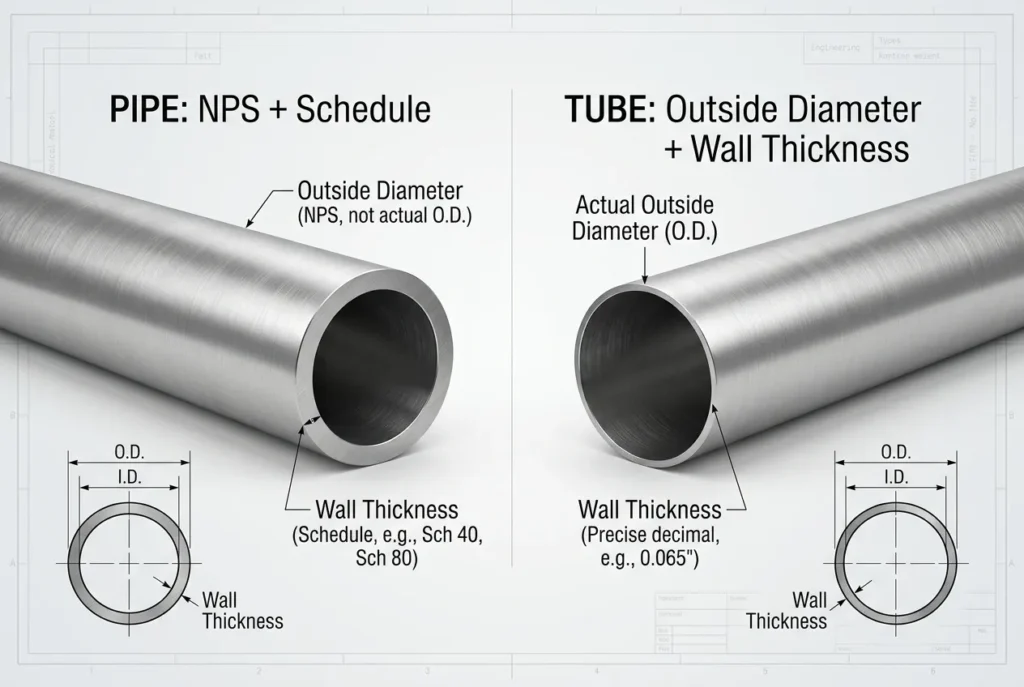
Pipe and tube are both tubular products, but their dimensional descriptions are commonly handled differently.
| Comparison | Pipe | Tube |
|---|---|---|
| Common size description | NPS or DN plus schedule | Actual outside diameter plus wall thickness |
| Nominal size | May not equal the measured outside diameter | Outside diameter is commonly stated directly |
| Typical specification | 2″ NPS, SCH10S or SCH40S | 50.8 mm OD × specified wall thickness |
| Selection priority | Nominal system compatibility and schedule | Exact outside diameter and wall thickness |
This distinction is particularly important when selecting stainless steel pipe fittings. A fitting designed for one pipe outside diameter may not be compatible with a tube described using a different dimensional system.
What to Include in a Pipe Specification or RFQ
A quotation request should contain enough information to identify the pipe without relying on one size term.
| Specification Item | Information to Provide |
|---|---|
| Nominal size | NPS and/or DN |
| Outside diameter | Required value in inches or millimeters |
| Wall thickness | Schedule designation or actual thickness |
| Material grade | 304, 316L or another specified grade |
| Pipe construction | Welded or seamless, where required |
| Length | Standard or project-specific pipe length |
| Surface and finish | Required surface condition or treatment |
| Applicable standard | Dimensional, material and project standards |
| Connection method | Press-fit, welded, threaded or another approved method |
If the project requires a specific manufacturing route, review our seamless vs welded pipe comparison before finalizing the RFQ.
Providing these details helps the supplier confirm the pipe, matching fittings and installation system before quotation.
Additional product and installation information is available in Nonleak Technical Documentation.
Download the Full Pipe Schedule Table
For additional wall thickness and schedule references, download the full stainless steel pipe schedule table.
The downloadable document should be treated as a general dimensional reference. Final values must be checked against the approved project specification and applicable standard.
Confirm Your Pipe Dimensions with Nonleak
When requesting stainless steel pipe dimensions, provide the required NPS or DN, outside diameter, schedule or wall thickness, stainless steel grade and applicable standard.