ASME B16.9 is one of the principal standards used when specifying factory-made wrought butt-weld fittings for pressure piping systems. It addresses fitting dimensions, tolerances, ratings, testing and markings, but it does not by itself define the stainless steel grade, pipe wall thickness, welding procedure or complete piping-system design.
For buyers, engineers and project contractors, writing only “ASME B16.9 fitting” on an inquiry is therefore not enough. The fitting type, nominal size, wall thickness, material specification, construction, end preparation, required documentation and applicable standard edition must also be confirmed.
This guide explains the scope of ASME B16.9, the common fitting types associated with it, how it works with ASTM A403/A403M, ASME B16.25 and ASME B36.19M, and what information should be included in a complete butt-weld fitting request for quotation.
Important: This article is a practical purchasing guide and does not replace the official standard, an applicable ASME B31 piping code, approved drawings or project-specific engineering requirements.
Why ASME B16.9 Matters Before You Order
Butt-weld fittings may appear straightforward, but a short product description can leave several important details unresolved. An elbow may be 45 degrees, 90 degrees or a return bend. It may use a long-radius or short-radius geometry. A tee may be equal or reducing, while a reducer may be concentric or eccentric.
These differences affect center-to-end dimensions, end-to-end length, pipe alignment, available installation space and compatibility with the connected pipe. A recognized dimensional standard helps the manufacturer, supplier, purchaser and inspector work from the same reference.
ASME B16.9 is particularly important because it establishes a common dimensional framework for factory-made wrought buttwelding fittings. It can therefore support consistent specification, comparison, inspection and installation planning.
However, dimensional conformity is only one part of the purchasing decision. A complete order must also identify the material specification, grade, wall thickness, construction, weld-end requirements, inspection scope and documentation.
What Does ASME B16.9 Cover?
The official ASME scope covers factory-made wrought buttwelding fittings from NPS 1/2 through NPS 48, corresponding to DN15 through DN1200. It applies to fittings of any producible wall thickness and addresses overall dimensions, dimensional tolerances, ratings, testing and product markings.
At the time of publication, the current edition listed by ASME is ASME B16.9-2024. A project may still specify a previous edition, so the required edition should always be confirmed from the purchase order, piping specification or approved project documents.
The published scope also explains that low-pressure corrosion-resistant buttwelding fittings are not covered by this standard and refers users to MSS SP-43 for that product category. Short-radius elbows and returns, which were historically addressed separately, are now included within B16.9.
Products outside NPS 1/2–48 should not automatically be described as ASME B16.9 fittings. Smaller, larger or non-standard products may instead follow another recognized standard, an approved fabrication drawing or a customer-specific dimensional requirement.
Nonleak supplies stainless steel butt-weld fittings according to applicable standards and project requirements. The available commercial range may include products governed by ASME, GB, DIN, EN or project-specific drawings, so each quoted item should be matched to the correct standard rather than grouped under one designation.
Which Butt-Weld Fittings Are Commonly Specified?
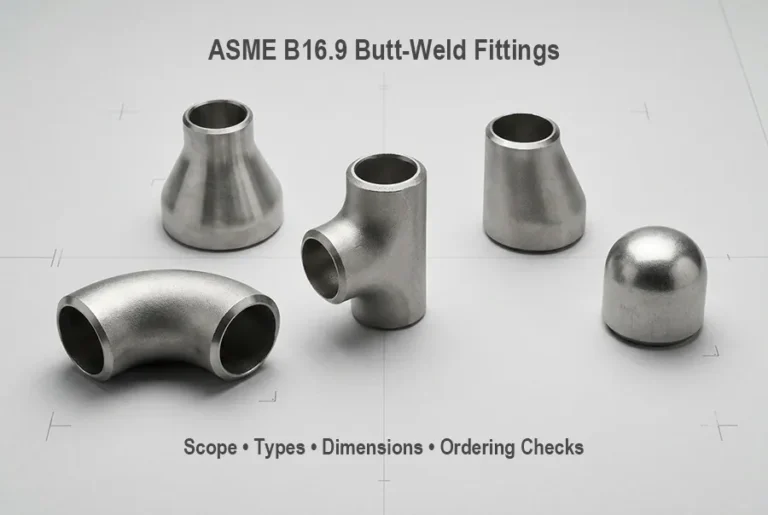
ASME B16.9 is commonly referenced for elbows, tees, crosses, reducers, caps, stub ends and return bends. The exact configuration must still be stated clearly because the product name alone does not define all required dimensions.
| Fitting type | Primary function | Details to confirm |
|---|---|---|
| Elbow | Changes pipeline direction | Angle, long or short radius, size, wall thickness and center-to-end dimension |
| Tee | Creates a 90-degree branch | Equal or reducing type, run size, branch size and center-to-end dimensions |
| Cross | Creates four-way branch connections | Equal or reducing configuration and the size of every connection end |
| Reducer | Connects different pipe sizes | Concentric or eccentric geometry, large end, small end, length and orientation |
| Pipe cap | Provides permanent pipe-end closure | Nominal size, wall thickness, cap height, material and end preparation |
| Stub end | Works with a lap-joint flange | Stub-end type, length, lap dimensions, pipe size and matching flange |
| Return bend | Changes flow direction by 180 degrees | Long or short radius, center-to-center dimension, size and wall thickness |
For individual product selection, review Nonleak’s equal and reducing butt-weld tees, concentric and eccentric reducers and butt-weld pipe caps.
What ASME B16.9 Does Not Specify
A frequent purchasing mistake is treating ASME B16.9 as a complete product specification. In reality, it does not independently select every technical requirement needed for a finished stainless steel fitting.
ASME B16.9 does not by itself determine:
- The stainless steel material grade
- The applicable ASTM material specification
- The required pipe Schedule or actual wall thickness
- The project design pressure and design temperature
- The welding procedure or welder qualification
- The required percentage or method of nondestructive examination
- The required material certificate or inspection document
- The surface treatment, pickling, passivation or polishing requirement
- The corrosion allowance or suitability for a particular medium
- The complete field installation and system-testing procedure
This separation also applies to welding documentation. ASME B16.9 does not qualify the production welding procedure or the welder. If the project uses controlled butt-weld fabrication, review the WPS, PQR and welder-qualification requirements for butt-weld pipe separately from the fitting dimensional standard.
For example, an ASME B16.9 reducer is not automatically an ASTM A403 WP316L fitting. The dimensional standard and the material specification must be stated separately.
Similarly, a reference to Schedule 40 does not by itself establish the allowable working pressure of the fitting or piping system. Material strength, temperature, wall thickness, design code, joint quality and other engineering factors must also be considered.
ASME B16.9 vs ASTM A403, ASME B16.25 and ASME B36.19M
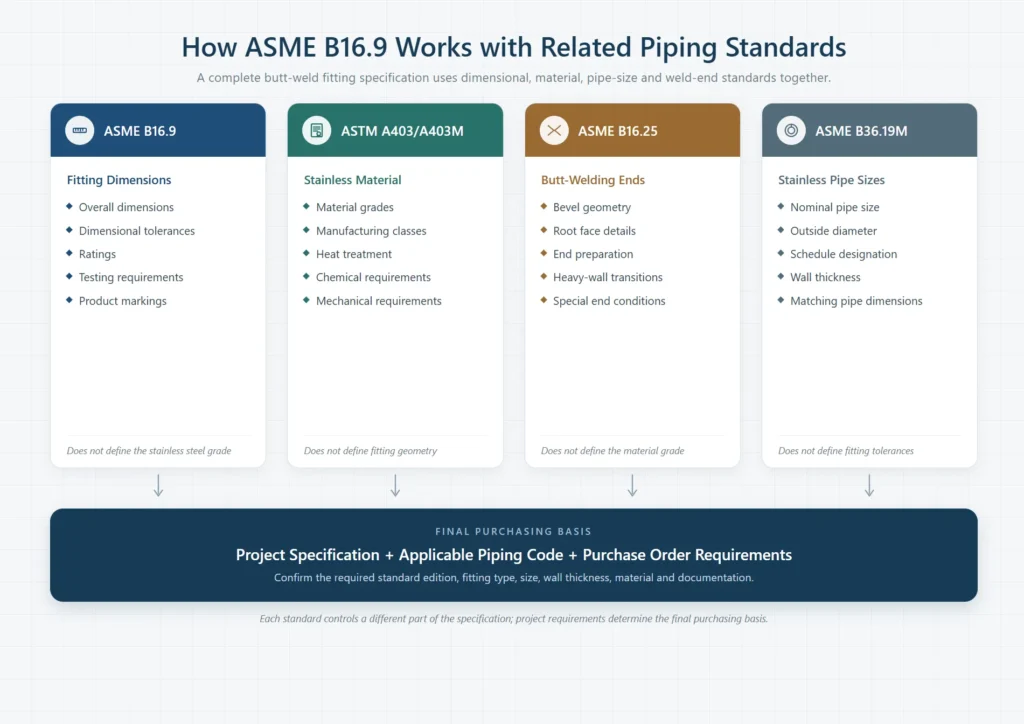
A complete stainless steel butt-weld fitting specification normally relies on several standards. ASME B16.9 addresses fitting geometry and dimensional requirements, while separate standards control the material, butt-welding ends and matching stainless steel pipe dimensions.
| Standard or document | Primary responsibility | What the buyer should verify |
|---|---|---|
| ASME B16.9 | Fitting dimensions, tolerances, ratings, testing and markings | Fitting type, size, configuration and required edition |
| ASTM A403/A403M | Wrought austenitic stainless steel material, manufacture, heat treatment and material testing | Material grade, class, construction and documentation |
| ASME B16.25 | Butt-welding end preparation, bevels and heavy-wall transitions | Standard bevel or special end-preparation requirement |
| ASME B36.19M | Dimensions of welded and seamless wrought stainless steel pipe | NPS, outside diameter, Schedule designation and wall thickness |
| Applicable piping code | Overall design, fabrication, examination, testing and service requirements | The correct B31 code or other applicable project code |
| Project specification and PO | Final material, inspection, documentation and commercial requirements | Edition, special requirements, quantities and approved deviations |
If you need the bigger picture behind this standards matrix, read our ASTM vs ASME guide for a project-level explanation of how material and product specifications, component standards, dimensional standards and piping codes work together.
The official ASME B16.9 standard overview should be used to confirm its current scope and edition. Material requirements can be reviewed through the official ASTM A403/A403M specification page, while weld-end preparation is addressed by ASME B16.25.
How to Read Butt-Weld Fitting Dimensions
A dimensional table should be read together with the fitting drawing and its symbol definitions. The same letter may represent a different feature on an elbow, tee, reducer or cap, so buyers should not transfer one product’s dimension labels to another product without checking the relevant drawing.
Common dimensional terms include:
- NPS or DN: The nominal connection size, not necessarily the exact measured diameter.
- Outside diameter at bevel: The outside diameter at the welding end that must match the connected pipe.
- Center-to-end dimension: The distance from a fitting centerline or intersection point to its welding end.
- Center-to-center dimension: Commonly used for return bends and similar geometries.
- End-to-end length: The overall axial length between two connection ends.
- Run and outlet dimensions: Used for tees and crosses to identify the main line and branch.
- Large-end and small-end dimensions: Used for concentric and eccentric reducers.
- Nominal wall thickness or Schedule: The thickness series that must be coordinated with the connected pipe.
Because NPS and DN are nominal designations, they should not be treated as direct measurements. Review our stainless steel pipe dimensions guide for an explanation of NPS, DN, outside diameter and wall thickness.
For stainless steel piping, ASME B36.19M uses the “S” suffix for Schedule designations such as 10S, 40S and 80S. Some stainless steel pipe sizes and wall thicknesses differ from corresponding values in ASME B36.10M, so the applicable pipe standard must be confirmed rather than assumed.
What to Check for Elbows, Tees, Reducers and Caps
Elbows: Angle, Radius and Center-to-End Dimension
An elbow inquiry should state the angle, nominal size, wall thickness, material and radius type. A 90-degree long-radius elbow is not dimensionally interchangeable with a 90-degree short-radius elbow. The center-to-end dimension and available installation space will be different.
For return bends, confirm whether a long-radius or short-radius configuration is required and verify the center-to-center and end dimensions shown on the approved drawing.
Tees and Crosses: Run and Branch Dimensions
For an equal tee, the run and branch use the same nominal size. For a reducing tee, the inquiry must identify both the main run size and the smaller outlet size. Writing only “4-inch reducing tee” is incomplete because the branch size remains unknown.
Cross fittings require the same level of detail. Every connection end should be identified, especially when a reducing configuration is requested.
Reducers: Large End, Small End and Geometry
A reducer inquiry must identify the large end, small end, wall thickness and geometry. Concentric reducers maintain one common centerline, while eccentric reducers create an offset transition with one straight side.
The correct choice depends on the piping orientation, equipment connection, drainage or venting objectives, internal alignment and project design. Review the concentric reducer vs eccentric reducer selection guide for a detailed comparison.
Caps and Stub Ends: Closure and Flange Interface Checks
For a pipe cap, confirm nominal size, wall thickness, material and overall height. For a stub end, also identify the required type, lap dimensions, overall length and the lap-joint flange with which it will be used.
Stub-end and flange compatibility should be reviewed as one interface. Selecting each component independently without confirming the lap geometry can create assembly or alignment problems.
For a detailed explanation of this two-piece interface, see our stub end flange guide, including lap joint flange compatibility, stub-end types, patterns and RFQ checks.
Tolerances, Testing and Markings
Dimensional tolerances help determine whether a fitting’s outside diameter, alignment, end dimensions and overall geometry remain within the limits required by the applicable standard. The exact checks depend on the fitting type and size.
ASME B16.9 also addresses testing and markings within its scope, but this does not mean that every fitting receives the same project-specific examination. The required material verification, penetrant testing, radiography, ultrasonic examination or other inspection must be stated in the order when it exceeds the base product requirements.
A fitting marking should remain consistent with the applicable standard, material specification and purchase order. Depending on the product and project, the marking information may include:
- Manufacturer or supplier identification
- Material grade
- Nominal size
- Wall-thickness or Schedule designation
- Applicable standard
- Heat or traceability identification
- Additional project marking where required
The purchaser should define whether material test certificates, dimensional reports, inspection records, drawings or other documents must be submitted before shipment. Nonleak can coordinate dimensional checks, material verification and project documentation according to confirmed requirements. Review our technical documentation and quality control process for related support information.
Common ASME B16.9 Specification Mistakes
| Incomplete description | Why it is insufficient | Information to add |
|---|---|---|
| ASME B16.9 elbow | The angle, radius, size and wall thickness are missing | 45° or 90°, LR or SR, NPS/DN, Schedule and material |
| 316 reducer | The complete grade, end sizes and geometry are unknown | Material specification, grade, large end, small end and concentric/eccentric type |
| 4-inch tee | It does not identify whether the outlet is equal or reducing | Run size, branch size, wall thickness and material |
| Schedule 40 fitting | Schedule does not define the product type, size or material | Fitting type, NPS, material specification, standard and end preparation |
| ASME stainless fitting | The ASME standard and ASTM material specification are not identified | ASME B16.9, the required edition, ASTM specification and material grade |
| Class 300 butt-weld fitting | A flange-style class description does not complete a B16.9 fitting specification | Design conditions, material, size, wall thickness and applicable piping code |
Buyer and RFQ Checklist
Before sending an inquiry, provide enough information for the supplier to identify the correct fitting and verify whether the requested construction, material and inspection documents are available.
| RFQ field | Information to provide |
|---|---|
| Fitting type | Elbow, tee, cross, reducer, cap, stub end or return bend |
| Configuration | LR/SR, equal/reducing, concentric/eccentric or other required geometry |
| Connection sizes | NPS or DN for every fitting end |
| Wall thickness | Schedule designation or actual wall thickness |
| Material | ASTM specification, material grade and any supplementary requirements |
| Construction | Seamless or welded where the project requires a specific construction |
| Standard and edition | ASME B16.9 edition and other applicable standards |
| End preparation | Standard bevel or approved special weld-end detail |
| Surface requirement | Mill finish, pickled, passivated, polished or project-specific finish |
| Inspection and NDE | Required method, extent, acceptance criteria and third-party witness points |
| Documentation | Material certificate, dimensional report, drawings and inspection records |
| Quantity | Quantity for each type, size, wall thickness and material |
For non-standard dimensions, special wall thicknesses or project-specific inspection requirements, include the approved drawing or relevant specification section with the inquiry. This reduces clarification time and helps prevent incorrect assumptions during quotation.
Frequently Asked Questions
What is ASME B16.9?
ASME B16.9 is a dimensional and product standard for factory-made wrought buttwelding fittings. Its public scope includes overall dimensions, tolerances, ratings, testing and markings for sizes NPS 1/2 through NPS 48, or DN15 through DN1200.
Which fittings are covered by ASME B16.9?
The standard is commonly used for factory-made wrought elbows, returns, tees, crosses, reducers, caps, stub ends and related buttwelding fitting configurations. The applicable product table, drawing and scope should be checked for the specific fitting being ordered.
Does ASME B16.9 specify stainless steel grades?
No. ASME B16.9 does not independently select the stainless steel grade. Wrought austenitic stainless steel fittings are commonly specified with ASTM A403/A403M, while other materials require their corresponding material specifications.
What is the difference between ASME B16.9 and ASTM A403?
ASME B16.9 primarily addresses fitting geometry, dimensions, tolerances, ratings, testing and markings. ASTM A403/A403M addresses wrought austenitic stainless steel material, manufacture, grades, heat treatment and material-related testing for pressure piping fittings.
Does ASME B16.9 specify pipe Schedule?
The standard accommodates fittings of producible wall thicknesses, but the purchaser must identify the required Schedule or actual wall thickness. Matching stainless steel pipe dimensions are commonly referenced through ASME B36.19M or another applicable pipe standard.
Are all butt-weld fittings from DN10 to DN2000 covered by ASME B16.9?
No. The official ASME B16.9 scope is NPS 1/2 through NPS 48, corresponding to DN15 through DN1200. Products outside that range require another applicable standard, an approved drawing or a project-specific dimensional specification.
Is an ASME B16.9 fitting automatically suitable for every pressure system?
No. Dimensional conformity does not independently establish suitability for every medium, temperature or pressure. The material, wall thickness, piping code, design conditions, welding requirements and project specification must be evaluated together.
Confirm Your Butt-Weld Fitting Requirements
An ASME B16.9 reference is an important starting point, but a complete fitting specification must also identify the fitting type, size, wall thickness, material grade, construction, weld-end requirement, inspection documents and required standard edition.
Explore Nonleak’s stainless steel butt-weld fittings, review our technical documentation, or contact Nonleak with your fitting list, sizes, material requirements, quantities and project specifications.
Recommended RFQ information: Fitting type and configuration · NPS/DN · Schedule or wall thickness · ASTM material and grade · ASME B16.9 edition · End preparation · Inspection documents · Quantity