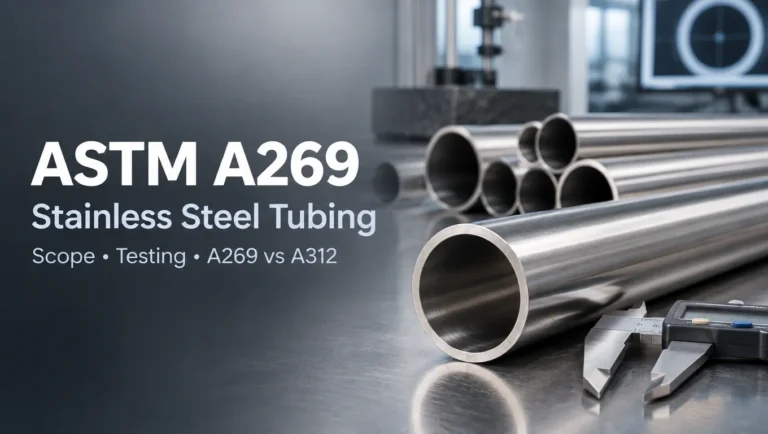
ASTM A269 is a widely referenced specification for seamless and welded austenitic stainless steel tubing used in general service. For engineers and buyers, however, the standard number alone is not a complete tubing specification. A purchase description still needs to identify the required grade, dimensions, manufacturing route, length, testing, documentation and any project-specific requirements.
ASTM currently lists ASTM A269/A269M-25 as the active edition at the time this guide was prepared. The edition required by the contract, project specification or approved documentation should always take precedence.
Quick answer: ASTM A269/A269M covers nominal-wall-thickness seamless and welded austenitic stainless steel tubing for general corrosion-resisting and low- or high-temperature service. It establishes product requirements such as material, heat treatment, testing, workmanship and related acceptance provisions, but it does not by itself define a complete piping-system design, pressure rating or project RFQ.
What Is ASTM A269?
ASTM A269/A269M is a product specification for austenitic stainless steel tubing. Its formal scope is general-service tubing rather than one single end-use industry.
This distinction matters because ASTM A269 is often associated with instrumentation tubing, utility tubing or small-bore stainless steel systems in the market. Those are important applications, but they should not be treated as the complete definition of the standard.
A project may reference ASTM A269 as one layer of its tubing requirement while separate drawings, piping codes, owner specifications or application standards define the actual service conditions, dimensional controls, connections, surface finish, inspection and system acceptance.
For a broader explanation of how product specifications, dimensional requirements, piping codes and project documents work together, see our ASTM vs ASME guide for piping projects.
What Does ASTM A269 Cover?
From a procurement perspective, ASTM A269 provides a controlled framework for covered stainless steel tubing rather than simply identifying a stainless steel grade.
| Area | What ASTM A269 Helps Define | What the Buyer Still Needs to Confirm |
|---|---|---|
| Product form | Seamless and welded austenitic stainless steel tubing within the specification scope | The required manufacturing route if the project restricts it |
| Material | Covered stainless steel grades and applicable chemical requirements | The exact grade required by the project |
| Heat treatment | Heat-treated material requirements within the specification | Any additional project-specific condition or documentation requirement |
| Dimensions | Requirements and tolerances applicable to covered tubing | Required OD, nominal wall thickness, length and any tighter project tolerances |
| Mechanical testing | Applicable mechanical and technological tests within the specification | Any supplementary or project-specific examination |
| Integrity testing | Hydrostatic or nondestructive electric testing provisions within the specification | Any additional acceptance criteria or records required by the project |
| Documentation | Product identification and specification-based documentation framework | MTR, traceability, third-party inspection or additional turnover documents |
The important purchasing lesson is that ASTM A269 is the product specification, not the complete project specification.
Common Stainless Steel Grades Used with ASTM A269
ASTM A269 covers multiple austenitic stainless steel grades. In commercial stainless tubing, 304/304L and 316/316L are among the grade families buyers commonly encounter.
The standard designation and the material grade should still be stated separately. Writing only “ASTM A269 tubing” does not tell the supplier whether the project requires 304L, 316L or another permitted grade.
Likewise, a grade such as 316L should not be interpreted as a guarantee of corrosion resistance in every environment. Material selection still depends on the actual medium, temperature, contaminants, fabrication condition, cleaning requirements and project design basis.
ASTM A269 Seamless vs Welded Tubing
ASTM A269 covers both seamless and welded austenitic stainless steel tubing. The existence of both manufacturing routes is important because “ASTM A269” alone does not necessarily tell a supplier which route the purchaser wants.
Seamless tubing is manufactured without a longitudinal weld seam. Welded tubing is formed and joined with a longitudinal weld during manufacture.
Neither construction should be treated as automatically superior for every project. The correct route depends on the purchase specification, dimensional requirements, service conditions, inspection requirements, availability and project documentation.
If a project requires seamless construction, welded construction or a particular weld condition, that requirement should be stated explicitly in the RFQ or purchase order rather than assumed from the ASTM number.
For a broader explanation of manufacturing-route selection, see our seamless vs welded pipe selection guide. Keep in mind that pipe and tubing remain different product forms, so the dimensional and product-standard requirements must still be checked separately.
How Is ASTM A269 Tubing Sized?
One of the most useful distinctions for buyers is the way tubing is described. ASTM A269 tubing is commonly ordered using the required outside diameter (OD) and nominal wall thickness, together with the grade and other purchase requirements.
For example, a complete tubing inquiry should make the dimensional requirement explicit rather than simply stating “1-inch stainless tube.” The supplier needs to know whether that number refers to the actual outside diameter, another project-defined dimension or a nominal pipe designation from a different product system.
This becomes especially important when a project contains both tube and pipe. Similar-looking stainless steel products can use different dimensional conventions, connection systems and product standards.
Heat Treatment, Testing and Inspection Under ASTM A269
ASTM A269 is more than a dimensional description. The specification includes requirements related to heat-treated condition, chemical composition, mechanical testing and tube integrity.
The ASTM summary identifies mechanical test requirements such as flaring, flange, hardness and reverse-flattening tests as applicable within the specification. It also requires each tube to be subjected to a nondestructive electric test or hydrostatic test within the standard framework.
That does not mean every project has an identical inspection package. Supplementary requirements and additional project testing may need to be stated in the order. Additional requirements can also arise from the governing piping code, owner specification or application-specific documentation.
When procurement requires additional PMI, special NDE records, third-party witnessing, enhanced traceability or another project-specific inspection, those items should be identified before quotation rather than assumed to be automatically included.
For the broader supplier-side inspection framework, review our quality control information and technical documentation.
ASTM A269 vs ASTM A312: Tube vs Pipe
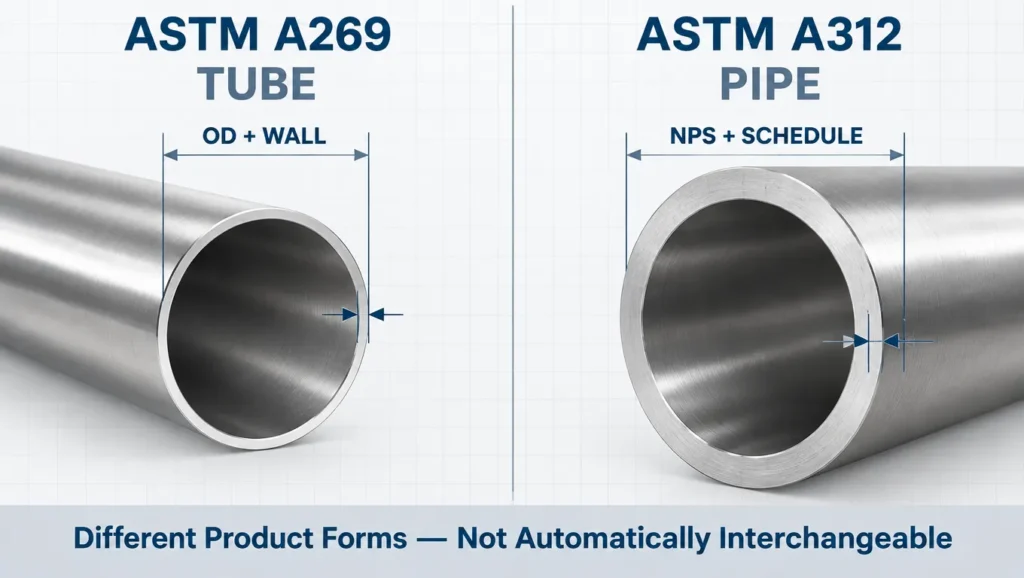
ASTM A269 and ASTM A312 can both appear in stainless steel projects, and both can involve familiar austenitic stainless grades. However, they apply to different product forms and should not be treated as interchangeable designations.
| Comparison | ASTM A269 | ASTM A312 |
|---|---|---|
| Primary product form | Stainless steel tubing | Stainless steel pipe |
| Typical dimensional description | Actual OD + nominal wall thickness | NPS + Schedule or specified pipe wall |
| Manufacturing routes | Seamless or welded within the specification scope | Seamless, straight-seam welded and heavily cold-worked welded pipe within the specification scope |
| General specification role | General-service austenitic stainless tubing product requirements | Austenitic stainless steel pipe product requirements for high-temperature and general corrosive service |
| Pressure meaning | The ASTM designation alone is not a complete allowable-pressure rating | The ASTM designation or Schedule alone is not a complete allowable-pressure rating |
| Procurement rule | State grade, OD, wall, route and project requirements | State grade, NPS, Schedule/wall, dimensional standard, route and project requirements |
The practical distinction is therefore not “low pressure versus high pressure.” The safer question is: does the project require tubing or pipe, and which product specification, dimensions, code and project requirements apply?
For the pipe side of this relationship, see our ASTM A312 stainless steel pipe guide.
Need Help Confirming ASTM A269 or ASTM A312 Before Quotation?
Send the required product form, grade, dimensions, manufacturing route, service information and project documentation. We can help review whether the RFQ inputs clearly identify tubing or pipe before quotation.
Does ASTM A269 Define a Pressure Rating?
No. ASTM A269 is a tubing product specification; the designation itself should not be converted into a universal PSI or bar rating.
Allowable operating conditions depend on the complete engineering basis, which can include material properties at design temperature, actual dimensions and manufacturing tolerances, applicable design equations, corrosion or erosion allowance, fittings and connections, external loads, fabrication, examination and the governing piping code or project specification.
For that reason, statements such as “ASTM A269 tubing is low pressure” or “ASTM A269 equals a specific pressure rating” should be avoided unless the full design basis has been established.
ASTM A269 vs ASTM A270 and ASTM A213
ASTM A269 is also frequently compared with other tubing specifications, but the standard number should follow the actual product and service requirement.
| Standard | Primary Product / Scope Direction | Key Procurement Distinction |
|---|---|---|
| ASTM A269/A269M | Seamless and welded austenitic stainless steel tubing for general service | Do not assume sanitary finish, heat-exchanger duty or system design requirements from A269 alone |
| ASTM A270/A270M | Stainless steel sanitary tubing | Used where sanitary-product requirements and special surface finishes within its scope are required |
| ASTM A213/A213M | Seamless boiler, superheater and heat-exchanger tubes | Application-specific tube specification; it should not be replaced by A269 simply because the material grade appears similar |
A tube can therefore have a familiar stainless grade and similar physical dimensions while still requiring a different product specification because the service, manufacturing or acceptance requirements are different.
Where Is ASTM A269 Tubing Used?
ASTM A269 is commonly encountered in general-service stainless tubing procurement, including instrumentation, utility, process and fabrication applications where the project specification selects this product standard.
However, the word “instrumentation” should not be treated as a substitute for the standard scope. Instrumentation systems may impose tighter dimensional controls, surface requirements, cleanliness rules, fitting compatibility, examination or documentation beyond the base ASTM product specification.
The same applies to hygienic applications. If the project requires sanitary tube surface conditions, cleanability or hygienic fabrication criteria, those requirements need to come from the applicable sanitary standard and project documents rather than from ASTM A269 alone.
For a broader application-oriented discussion, see our guide to thin wall stainless tube in modern piping systems.
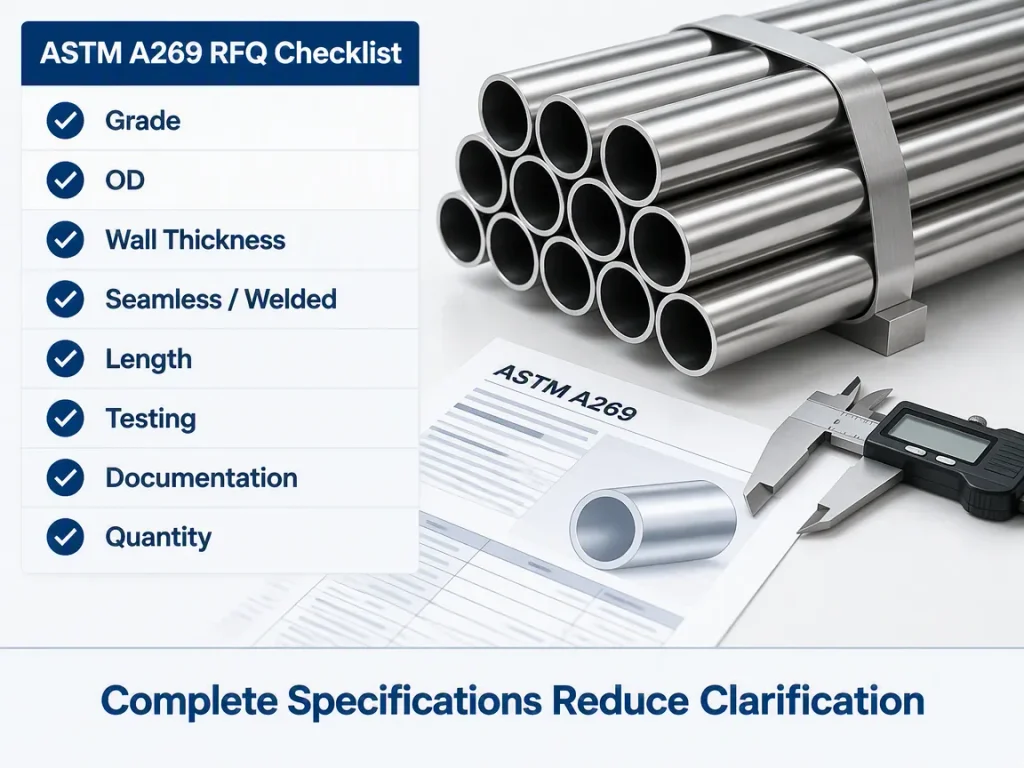
What Should Be Included in an ASTM A269 Tubing RFQ?
A clear ASTM A269 inquiry should let the supplier identify the exact tubing requirement without having to infer the product form, dimensions or project options.
| RFQ Item | Information to Provide |
|---|---|
| Product specification | ASTM A269/A269M and the project-required edition |
| Material grade | Exact stainless steel grade required by the project |
| Manufacturing route | Seamless or welded where the project restricts the route |
| Outside diameter | Required tube OD and units |
| Wall thickness | Required nominal wall thickness and units |
| Length | Random, fixed or cut length as required |
| End condition | Plain, cut, prepared or project-specific end requirement |
| Surface requirement | Standard finish or project-specific surface requirement where applicable |
| Testing / inspection | Base specification requirements plus any supplementary NDE, PMI, witness or third-party requirements |
| Documentation | MTR, traceability, inspection records and project turnover documents as required |
| Service / project basis | Application, governing code and relevant service information needed for technical review |
| Quantity | Total length, pieces or project BOM quantity |
Stating these details early reduces clarification cycles and makes it easier to compare quotations on the same technical basis.
Common ASTM A269 Specification Mistakes
- Ordering by the standard number alone. ASTM A269 does not identify the required grade, OD, wall thickness, manufacturing route, length or project options by itself.
- Calling A269 tubing “A312 pipe.” Tube and pipe are different product forms and use different specification and sizing conventions.
- Assuming seamless is always better. The manufacturing route should follow the project requirement rather than a generic quality ranking.
- Treating A269 as a pressure class. Allowable pressure requires the complete design and code context.
- Assuming A269 automatically means sanitary tubing. Sanitary applications can require a different tubing standard and additional surface or fabrication requirements.
- Assuming all extra testing is automatically included. Supplementary or project-specific inspection should be stated in the RFQ and purchase order.
- Using an online table as the controlled project specification. The applicable ASTM edition, governing code and approved project documents remain the controlling references.
ASTM A269 FAQ
What does ASTM A269 mean?
ASTM A269/A269M is a specification for seamless and welded austenitic stainless steel tubing for general service. It defines product requirements for covered tubing but does not replace a complete project specification or piping design code.
Is ASTM A269 pipe or tube?
ASTM A269 is a tubing specification. It should not be used as another name for ASTM A312 stainless steel pipe.
Is ASTM A269 tubing seamless or welded?
ASTM A269 covers both seamless and welded tubing within its scope. If the project requires one manufacturing route specifically, state that requirement in the order.
What is the difference between ASTM A269 and ASTM A312?
ASTM A269 applies to stainless steel tubing, while ASTM A312 applies to austenitic stainless steel pipe. A269 tubing is commonly described by actual OD and wall thickness, whereas A312 pipe is commonly ordered using NPS and Schedule or another specified pipe wall. They are not automatically interchangeable.
Does ASTM A269 have a pressure rating?
No universal pressure rating is created by the ASTM A269 designation alone. Allowable operating conditions depend on the tubing dimensions, material properties, temperature, connection system, design code and project requirements.
Is ASTM A269 the same as ASTM A270?
No. ASTM A269 is a general-service tubing specification. ASTM A270 addresses stainless steel sanitary tubing within its scope and includes sanitary-use and surface-finish requirements that should not be assumed from A269 alone.
Is ASTM A269 the same as ASTM A213?
No. ASTM A213 covers seamless ferritic and austenitic alloy-steel boiler, superheater and heat-exchanger tubes. The correct standard should follow the required product and service rather than simply matching a stainless steel grade.
What should I specify when ordering ASTM A269 tubing?
At minimum, identify the required specification and edition, material grade, seamless or welded route where required, OD, wall thickness, length, quantity, testing, documentation and applicable project requirements.
Preparing an ASTM A269 Stainless Steel Tubing RFQ?
Send the required grade, OD, wall thickness, seamless or welded requirement, length, quantity, inspection scope, documentation requirements and relevant project specification. Our team can review the purchasing inputs and help clarify the tubing requirement before quotation.
Technical note: This article is a general technical and procurement guide. It does not reproduce or replace the controlled ASTM standard, a governing piping code, owner specification or approved project engineering documents. Standard editions, material selection, dimensions, testing, allowable design conditions and final engineering approval should follow the requirements applicable to the actual project.