Pipe vs tube sounds like a simple terminology question, but the difference can affect whether a pipe, tube, fitting or installation tool matches the project. A buyer may ask for a “1-inch stainless steel pipe” while a drawing specifies a “1-inch OD stainless tube.” Those descriptions can refer to different physical outside diameters, even before wall thickness or material standards are considered.
For stainless steel piping projects, the useful comparison is not which name sounds stronger. It is how the product is sized, which specification controls it, what connection it must fit and what the purchaser needs to verify. This guide focuses on those decisions, with examples relevant to industrial piping and building-services systems.
Pipe vs Tube: What Is the Main Difference?
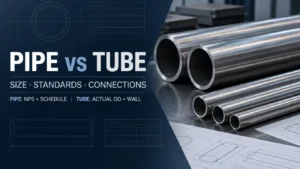
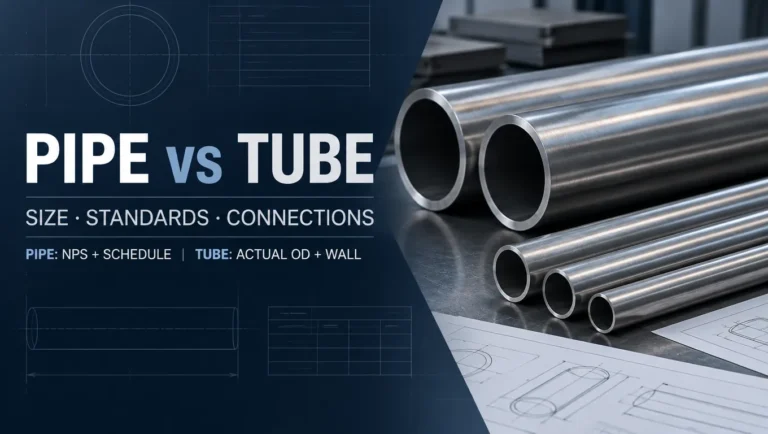
Quick answer: In many standardized piping applications, pipe is specified using a nominal pipe size (NPS or a corresponding DN designation) plus a wall-thickness schedule. Tube is commonly ordered using its actual outside diameter (OD) and nominal wall thickness. These are common ordering conventions, not universal definitions: product standards and engineered systems may use other size descriptions. The actual OD, wall, tolerance and fitting interface must be confirmed from the applicable technical documents.
| Comparison point | Pipe | Tube / tubing |
|---|---|---|
| Common size language | NPS or DN, with schedule or specified wall | Actual OD plus specified wall thickness |
| What “1 inch” can mean | Nominal pipe size, not necessarily 1.000-inch OD | Often a specified 1.000-inch outside diameter |
| Wall description | Schedule designation or actual wall required by the order | Specified wall in inches or millimeters, sometimes a gauge convention |
| Example stainless product standard | ASTM A312/A312M for covered austenitic stainless steel pipe | ASTM A269/A269M for covered general-service austenitic stainless tubing |
| Typical applications | Process or building-service piping, depending on the specified system | Instrumentation, heat-transfer or building-service uses, depending on the specified system |
| Connection compatibility | Must be checked against the real OD, wall, tolerances, product approval and fitting or joining-system instructions | |
In everyday language, “pipe” and “tube” may overlap. In a purchase order, they should never replace an actual specification. A product can be round, carry a fluid and still be described as tubing; another tubular product may use a metric system designation. Application alone does not settle its dimensions.
How Are Pipe and Tube Sizes Measured?
Pipe sizing: NPS, DN and Schedule
Nominal Pipe Size (NPS) identifies a standardized pipe-size series. It is not a promise that the outside diameter or inside diameter equals the NPS number. DN is likewise a nominal designation, not an exact outside diameter in millimeters. For a given NPS within the applicable dimensional system, the standardized outside diameter is generally fixed while the wall thickness can vary by schedule. The inside diameter changes accordingly.
For a dedicated lookup of NPS, DN, OD and ID, use the stainless steel pipe dimensions guide. For schedule-specific wall-thickness comparisons, consult the pipe schedule chart and the controlled dimensional standard applicable to the order.
Tube sizing: actual outside diameter and wall
Tubing is commonly ordered using a specified OD and wall thickness, for example “25.4 mm OD × specified wall.” That makes the dimensional requirement more explicit, but the word tube does not guarantee a universal tolerance, grade, pressure capability or intended use. Those requirements belong to the selected tubing specification, project drawing and purchase order.
Why a 1-inch pipe may not fit a 1-inch tube connection
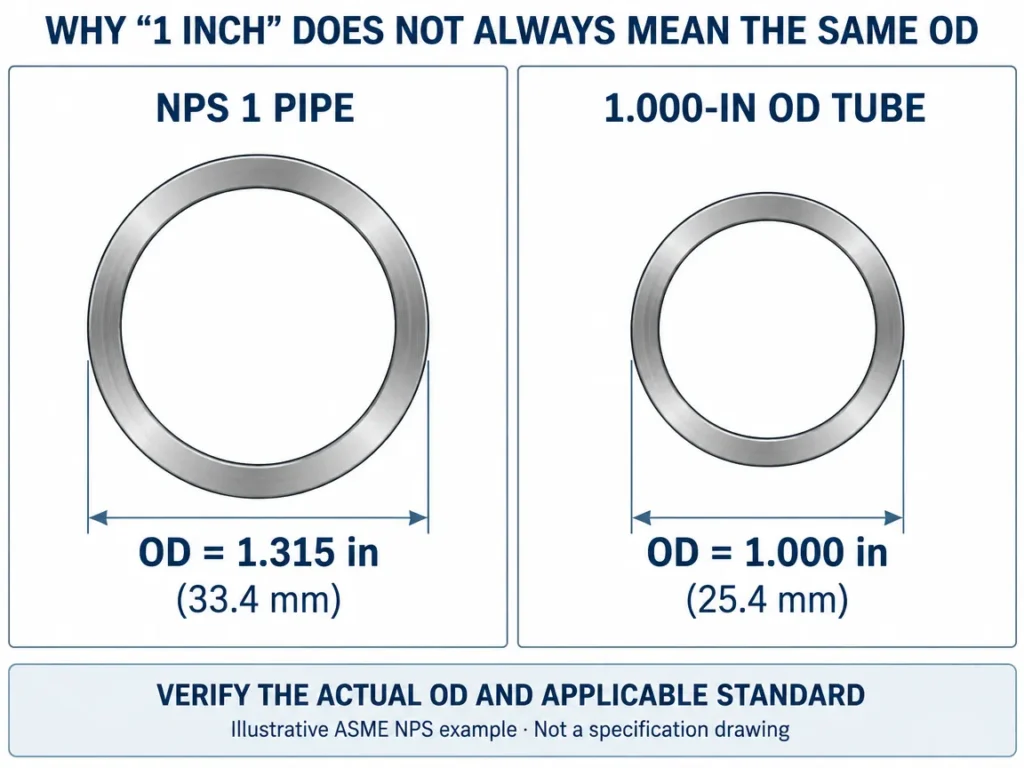
Under common ASME nominal pipe dimensional conventions, an NPS 1 pipe has a nominal OD of 1.315 in (about 33.4 mm). By contrast, a tube specified as 1.000 in OD has a nominal OD of 25.4 mm. The names sound similar; the actual outside diameters are different.
This is an illustrative size-naming comparison, not a universal rule for all national standards or product systems. In an actual project, confirm the product’s governing dimensional standard, its manufacturing tolerance and the approved connection details. Do not treat a matching “1 inch” label as proof of interchangeability.
Is Pipe Schedule the Same as Tube Wall Thickness?
No. A pipe schedule is a standardized designation associated with wall thickness at a given nominal pipe size; the schedule number is not itself a thickness in inches or millimeters. A higher number may indicate a different wall series within a specific dimensional system, but it is not a universal pressure rating.
With tube, buyers more commonly state the nominal wall directly. Neither way of specifying thickness determines the full pressure or temperature rating of a completed assembly. Material properties, actual dimensions, joining details, applicable design code, service conditions and the responsible engineering approval all matter.
Stainless steel pipe orders may reference ASME B36.19, while other projects reference ASME B36.10 or another applicable dimensional system. The “S” suffix in certain stainless pipe schedules also deserves attention. Do not assume similarly named schedules are always interchangeable; verify the specified standard and actual wall before accepting a substitution.
Pipe vs Tube Standards: ASTM A312, ASTM A269 and ASME B36.19
Product specifications and dimensional standards do different jobs. ASTM A312/A312M covers specified austenitic stainless steel pipe, including recognized manufacturing routes and applicable product testing. ASTM A269/A269M covers nominal-wall-thickness seamless and welded austenitic stainless steel tubing for general service. ASME B36.19 addresses dimensions for welded and seamless wrought stainless steel pipe. These designations are useful reference points, but none alone supplies a complete system design.
| Reference | Primary role | What it does not decide by itself |
|---|---|---|
| ASTM A312/A312M | Covered austenitic stainless steel pipe product specification | Complete piping-system design and service approval |
| ASTM A269/A269M | Covered austenitic stainless steel general-service tubing specification | Universal pressure rating or automatic equivalence to A312 pipe |
| ASME B36.19 | Stainless steel pipe dimensional standard | Material grade, project design pressure or fitting approval |
| Project code and documents | Application-specific design, assembly and acceptance requirements | Supplier assumptions about unspecified products or interchangeability |
Use the separate ASTM A312 stainless steel pipe guide for pipe-product requirements and the ASTM A269 tubing guide for the tubing standard. A269 and A312 may involve familiar stainless grades, but a matching alloy name does not authorize substituting one product form or standard for the other.
Is Tube Stronger or More Precise Than Pipe?
There is no universal answer. Tube products are often selected where OD, wall and dimensional control are important for a particular connection or process. Pipe products are often selected as part of standardized piping systems. However, neither “tube” nor “pipe” guarantees better strength, tighter tolerance or greater pressure resistance.
A comparison is only meaningful when the material grade, actual wall thickness, dimensional tolerances, manufacturing route, product standard, heat treatment, required tests and operating conditions are specified. Similarly, a product being “seamless” does not automatically make it suitable for every service: see our seamless vs welded pipe comparison for manufacturing-route considerations.
Why Pipe vs Tube Matters for Press Fittings and Connections
A connection is designed around more than a nominal size label. When a piping project uses a stainless steel press-fit system, the manufacturer-approved outside-diameter series, wall range, fitting geometry, seal material, pressing profile, tooling and intended service all need to match. Products from two different size systems should not be assumed compatible because both are described as “DN25” or “1 inch.”
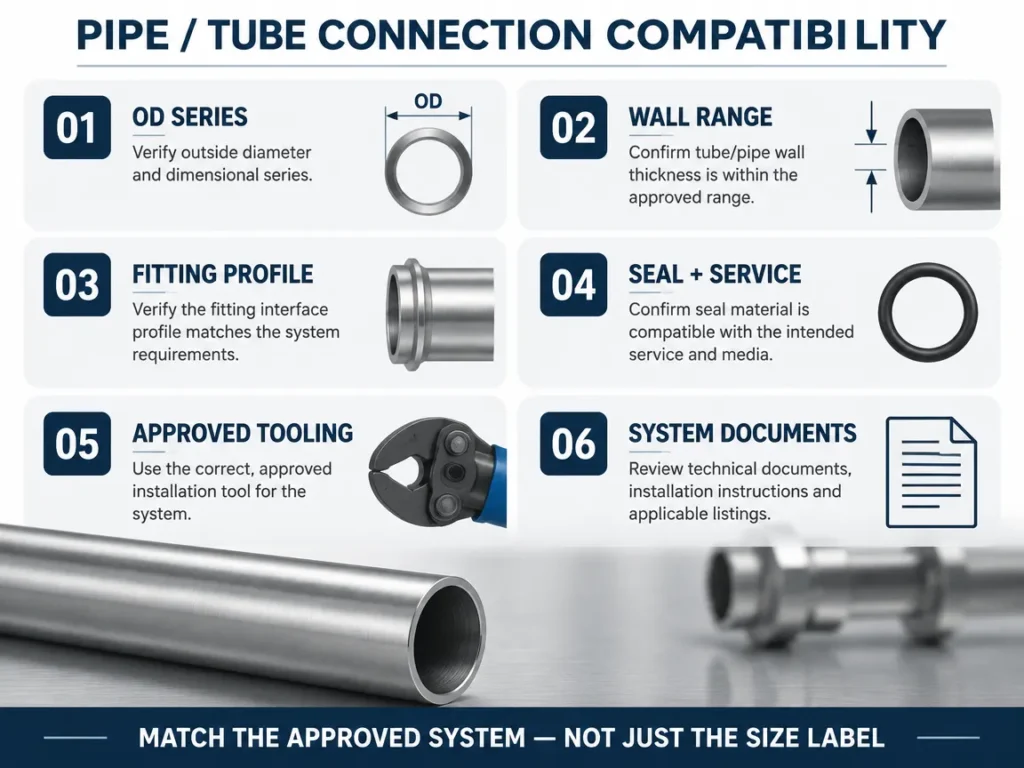
For welded, threaded, mechanical or compression connections, the correct end preparation, joining procedure and approved component combination likewise depend on the applicable specifications. Some building-water stainless tube systems follow metric product/system conventions rather than the industrial NPS-plus-schedule naming used in other piping standards. The drawing, fitting documentation and tested system boundary determine the correct interface.
Nonleak’s stainless steel pipes, stainless steel pipe fittings and technical documentation provide starting points for checking the actual product family. Verify the applicable model, service approval, connection method and available supporting records before specifying a combination. An apparent dimensional match alone is not a system approval.
How Should Buyers Choose Between Pipe and Tube?
Begin with the project requirement, not a general rule that one product is “for pressure” and the other is “for structure.” Pipe and tube can both be used in fluid-handling applications; the correct selection depends on the specification and interfaces. Ask:
- What product form and specification does the design call for? Confirm the ASTM, EN or other governing product reference where applicable.
- Which dimensional system is mandatory? Record NPS/DN and schedule, or actual OD and wall, as the approved documents require.
- How will the product connect? Confirm fitting model, pipe/tube OD, wall range, seal, tooling, joint method and approved use.
- What service conditions and engineering code apply? These determine the design and acceptance basis; the name “pipe” or “tube” does not.
- Which evidence must be provided? Check material certificates, dimension records, inspection and any specific third-party or conformity documents required by the purchase order.
For a project-specific product or dimensional question, request a technical specification review. This is a supplier-side review of the information available for the requested product family, not a substitute for final engineering design or code approval.
Pipe vs Tube RFQ Checklist
To avoid receiving technically different quotations under similar product names, make the RFQ explicit. A useful request typically includes:
| RFQ item | Information to state |
|---|---|
| Product and specification | Pipe or tubing, applicable product standard and required edition |
| Size system | NPS/DN or actual OD, with standard and unit of measure |
| Wall | Specified schedule or actual nominal wall thickness and tolerance where needed |
| Material | Required grade and any supplementary material controls |
| Manufacturing route | Seamless, welded or another permitted route as required |
| Connection | Fitting/system family, joint method, tool/profile and compatible size range |
| Service and design basis | Fluid, temperature, pressure and applicable project code/specification |
| Inspection and documents | Required MTR, traceability, examination, test records or project-specific approvals |
| Delivery | Length, quantity, end preparation, packaging and destination |
Some fields may be defined already by the approved drawing or purchase specification; others must be clarified before a comparable offer can be issued. Avoid assuming that a vendor’s “standard tube” and another vendor’s “standard pipe” refer to the same geometry or conformity package.
Pipe vs Tube FAQ
What is the difference between pipe and tube?
In common industrial ordering practice, pipe is often designated by NPS/DN and schedule, while tube is often designated by actual outside diameter and wall thickness. The relevant product and dimensional standards, not the terms alone, define the requirements.
Is 1-inch pipe the same size as 1-inch tube?
Not necessarily. For example, NPS 1 pipe in a common ASME dimensional series has a nominal OD of 1.315 inches, whereas a tube ordered as 1.000-inch OD is specified with a 1.000-inch nominal outside diameter. Always check the actual dimensions.
Can stainless steel pipe and tubing be used interchangeably?
Do not assume so. Verify the product specifications, actual dimensions, tolerances, joining method, design requirements and approved system documentation. Similar grades or nominal labels are not sufficient evidence.
Does tube always have tighter tolerances than pipe?
No universal rule applies. Certain tubing products are manufactured to tight dimensional requirements, but the acceptance limits must be checked in the applicable specification and purchase order.
Does pipe schedule indicate maximum working pressure?
No. Schedule is a dimensional wall-series designation, not a stand-alone pressure rating. Pressure suitability depends on the full engineering basis, material, dimensions, joint design, temperature and governing code.
Specify the Actual Product, Not Just “Pipe” or “Tube”
The most important pipe-versus-tube decision is usually straightforward: identify the required product standard, actual outside diameter and wall, material grade, joining system and inspection documents before procurement. This turns a vague request into a specification that a supplier and project team can review consistently.
If you are evaluating stainless steel pipe, tubing and matching fittings for an industrial or building-services project, send Nonleak your drawing or RFQ for a product and documentation review. Final material selection, pressure design, system conformity and code compliance remain with the responsible project engineer and approved project requirements.
Standards and Further Reading
- ASTM A312/A312M-25 — Austenitic Stainless Steel Pipe (ASTM International).
- ASTM A269/A269M-25 — General-Service Austenitic Stainless Steel Tubing (ASTM International).
- ASME B36.19 — Wrought Stainless Steel Pipe Dimensions (ASME).
Technical note: The relevant edition required by the contract, project or approved specification controls. This article is general educational and procurement guidance; it does not reproduce controlled standards or provide final engineering approval.