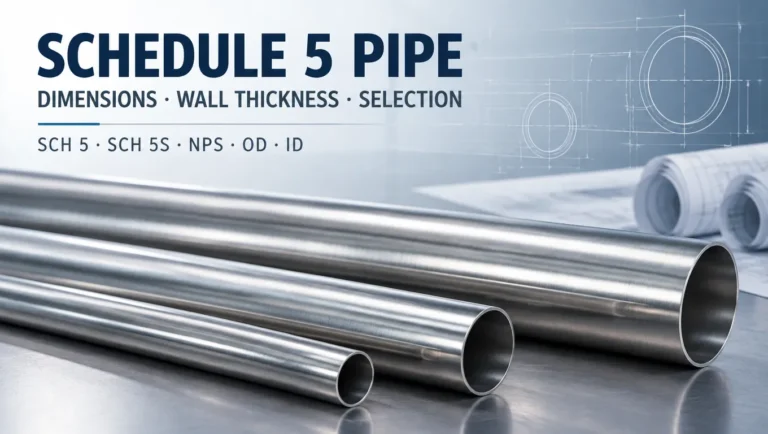
Schedule 5 pipe is a relatively light wall-thickness series used with Nominal Pipe Size (NPS). It is often searched by engineers, contractors and buyers who need to confirm outside diameter, wall thickness, inside diameter and how a lighter pipe wall fits a project specification.
One point needs special attention when stainless steel is involved: Schedule 5 and Schedule 5S are not automatically interchangeable labels. Schedule 5 is associated with the ASME B36.10 dimensional series, while Schedule 5S uses the stainless-steel “S” designation associated with ASME B36.19. Nominal dimensions may coincide at many common sizes, but the purchase order should still identify the required dimensional standard and wall thickness.
Quick answer: for a given NPS in the applicable dimensional series, the outside diameter is fixed while the schedule identifies a nominal wall-thickness series. A lighter wall produces a larger inside diameter than a heavier schedule at the same NPS, but schedule alone is not a pressure rating.
What Is Schedule 5 Pipe?
Schedule 5 is a pipe wall-thickness designation used together with an NPS or DN size. It does not identify the material grade, manufacturing route, joining method or allowable system pressure by itself.
A complete pipe description normally separates several different requirements:
- NPS or DN identifies the nominal pipe size.
- Outside diameter (OD) follows the dimensional series for that nominal size.
- Schedule identifies a nominal wall-thickness series.
- Inside diameter (ID) changes when the wall thickness changes.
- Material grade and product specification define a different part of the pipe requirement.
If you need the broader sizing relationship first, review our stainless steel pipe dimensions guide covering NPS, DN, OD, ID and Schedule. For a cross-schedule comparison, use the pipe schedule chart.
What Does “Schedule 5 Pipe Width” Mean?
“Schedule 5 pipe width” is a common search phrase, but “width” is not the normal engineering field used to specify pipe. In most cases, the user is trying to find one or more of the following dimensions:
- nominal pipe size (NPS) or DN;
- outside diameter (OD);
- nominal wall thickness;
- inside diameter (ID);
- sometimes pipe weight per unit length.
For procurement, do not write only “Schedule 5 pipe width.” State the NPS or DN, the required schedule or nominal wall thickness, the dimensional standard, material specification and any project-specific tolerance or inspection requirement.
Common Schedule 5 Pipe Dimensions
The table below gives a practical subset of commonly referenced Schedule 5 dimensions. Approximate ID is calculated as nominal OD minus twice the nominal wall thickness. It is a general reference rather than a reproduction of a controlled standard table, and manufacturing tolerances are not included in the calculated ID.
| NPS | DN | OD (in) | OD (mm) | Sch 5 Wall (in) | Sch 5 Wall (mm) | Approx. ID (mm) |
|---|---|---|---|---|---|---|
| 1/2″ | DN15 | 0.840 | 21.34 | 0.065 | 1.65 | 18.04 |
| 3/4″ | DN20 | 1.050 | 26.67 | 0.065 | 1.65 | 23.37 |
| 1″ | DN25 | 1.315 | 33.40 | 0.065 | 1.65 | 30.10 |
| 1-1/2″ | DN40 | 1.900 | 48.26 | 0.065 | 1.65 | 44.96 |
| 2″ | DN50 | 2.375 | 60.33 | 0.065 | 1.65 | 57.03 |
| 2-1/2″ | DN65 | 2.875 | 73.03 | 0.083 | 2.11 | 68.81 |
| 3″ | DN80 | 3.500 | 88.90 | 0.083 | 2.11 | 84.68 |
| 4″ | DN100 | 4.500 | 114.30 | 0.083 | 2.11 | 110.08 |
| 6″ | DN150 | 6.625 | 168.28 | 0.109 | 2.77 | 162.74 |
| 8″ | DN200 | 8.625 | 219.08 | 0.109 | 2.77 | 213.54 |
| 10″ | DN250 | 10.750 | 273.05 | 0.134 | 3.40 | 266.25 |
| 12″ | DN300 | 12.750 | 323.85 | 0.156 | 3.96 | 315.93 |
Table note: confirm the project-required edition, dimensional standard, nominal wall thickness and permitted tolerances before design, fabrication or purchase. Do not use a website reference as a substitute for the controlled project document.
How Schedule 5 Changes OD, Wall Thickness and ID
For the same NPS in the applicable dimensional series, changing the schedule changes the nominal wall thickness rather than changing the nominal outside diameter. A thinner wall leaves a larger inside diameter; a thicker wall reduces the available bore.
This can affect:
- flow area and hydraulic calculations;
- pipe weight and support loads;
- handling and fabrication;
- cutting, beveling and welding requirements;
- matching fitting and component wall thickness;
- material quantity and project cost.
Schedule is therefore a dimensional input, not a complete design decision.
Schedule 5 vs Schedule 5S: What Is the Difference?
This distinction is especially important for stainless steel piping.
| Item | Schedule 5 | Schedule 5S |
|---|---|---|
| Common designation | Sch 5 | Sch 5S |
| Dimensional series | ASME B36.10 | ASME B36.19 |
| Primary standard scope | Welded and seamless wrought steel pipe dimensions | Welded and seamless wrought stainless steel pipe dimensions |
| Can nominal walls coincide? | Yes, at many commonly referenced sizes | Yes, at many commonly referenced sizes |
| Procurement rule | Do not rely on the number alone. State the required dimensional standard, NPS and wall thickness. | |
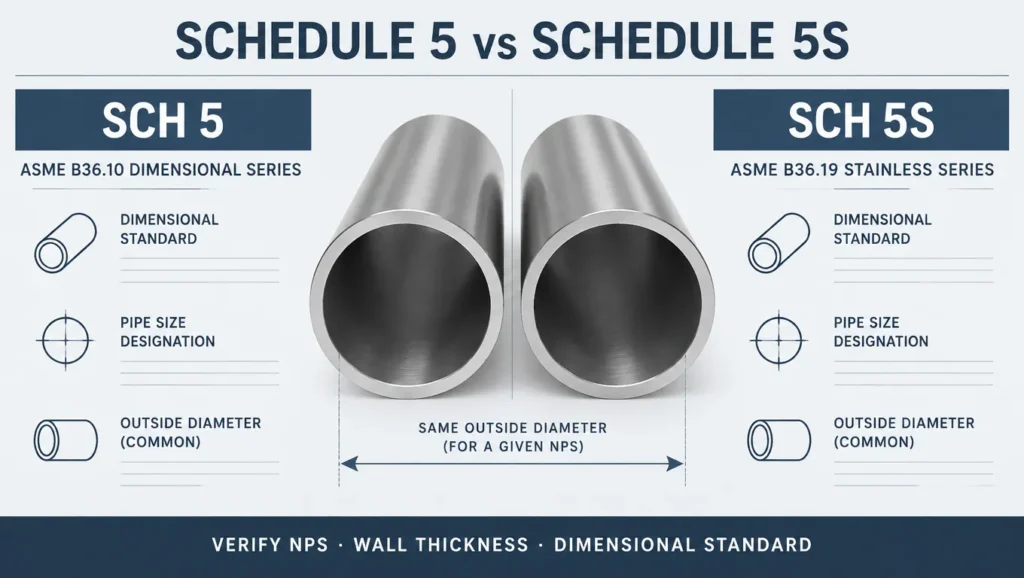
ASME describes the “S” suffix as a way to differentiate the stainless-steel dimensional series in B36.19 from the wrought-steel dimensional series in B36.10. The important procurement point is not that the wall must always be different. The important point is that the designation and controlling dimensional standard should be explicit.
For controlled wording, consult the official ASME B36.10 page and ASME B36.19 stainless steel pipe page.
Can Schedule 5 Pipe Be Stainless Steel?
Yes, stainless steel material can be supplied with wall thicknesses associated with the B36.10 dimensional series where the project specification permits it. ASME also notes that B36.10 includes other pipe thicknesses that are commercially available with stainless steel material.
That is why a buyer should not automatically “correct” every stainless steel Schedule 5 inquiry to Schedule 5S. Instead, confirm:
- the required NPS or DN;
- whether the drawing or specification says Sch 5 or Sch 5S;
- the required nominal wall thickness;
- the controlling dimensional standard;
- the stainless steel product specification and grade.
For stainless steel pipe product requirements, see our ASTM A312 stainless steel pipe guide.
Schedule 5 vs Schedule 10
For the same NPS in the corresponding B36.10 dimensional series, Schedule 5 is generally a lighter wall than Schedule 10. That means the outside diameter remains associated with the nominal size, while Schedule 5 normally leaves a larger inside diameter and uses less metal per unit length.
That does not mean Schedule 5 is automatically the correct choice whenever lower weight or larger bore is preferred. The engineering selection must still satisfy the applicable piping code, design pressure and temperature, material properties, corrosion or erosion allowance, joint design, loads and project specification.
For the next wall series, review our Schedule 10 stainless steel pipe guide. For broader comparisons, use the pipe schedule chart.
Is Schedule 5 a Pressure Rating?
No. Schedule 5 is a wall-thickness designation. It should not be converted into a universal PSI, bar or pressure-class value.
Allowable pressure depends on more than nominal wall thickness, including:
- material grade and allowable stress at design temperature;
- actual wall after manufacturing tolerances;
- pipe size;
- corrosion or erosion allowance;
- manufacturing route and applicable quality factors;
- joining method and joint details;
- fittings, flanges, valves and other system components;
- external loads and installation conditions;
- the equations and limits of the governing piping code.
A statement such as “Schedule 5 equals X PSI” is therefore incomplete without the full design context.
Need to Confirm Schedule 5 or 5S Before Quotation?
Send the NPS/DN, required wall thickness or schedule, material grade, product specification, dimensional standard and project service conditions. We can help review whether the RFQ inputs are complete before quotation.
How Schedule 5 Works with ASTM A312
Pipe schedule and ASTM A312 answer different questions.
- Schedule / ASME dimensional standard: helps define the dimensional series, including nominal outside diameter and wall thickness.
- ASTM A312/A312M: is a stainless steel pipe product specification covering requirements such as grade, manufacturing route, heat treatment, testing, tolerances, workmanship, marking and certification within its scope.
- Governing piping code and project specification: define the system-level design, fabrication, examination, testing and project acceptance requirements.
A purchase description should therefore avoid treating “ASTM A312 Schedule 5” as a complete technical requirement. The buyer should also state the grade, NPS, dimensional standard, manufacturing route where required, length, ends, testing and documentation.
For the broader relationship between product specifications, dimensional standards and piping codes, see our ASTM vs ASME guide for piping projects.
When Might a Project Specify Schedule 5?
A lighter Schedule 5 wall may be considered where the governing design and project specification permit it and where reducing material weight or maintaining a larger internal flow area is useful. Possible project considerations include:
- utility or process lines where the calculated wall requirement is relatively low;
- large-diameter piping where weight and handling have significant project impact;
- fabrication packages where the specified service and code permit a lighter wall;
- systems where internal diameter and flow area are important to hydraulic review;
- projects with a controlled corrosion strategy and no requirement for a heavier allowance.
These are selection contexts, not universal recommendations. A lighter wall should not be chosen only to reduce cost, and a heavier wall should not be chosen only because it “looks safer.” The responsible engineer and project documents must establish the required design basis.
What Should Be Included in a Schedule 5 Pipe RFQ?
A clear RFQ should contain enough information for the supplier and project team to review the same requirement.
| RFQ item | Information to provide |
|---|---|
| Product | Pipe |
| Size | NPS / DN and any project-specific OD control |
| Wall | Sch 5, Sch 5S or specified nominal wall thickness |
| Dimensional standard | Applicable ASME B36 series or project-defined requirement |
| Material | Required stainless steel or other material grade |
| Product specification | ASTM A312/A312M or other specified product standard where applicable |
| Manufacturing route | Welded, seamless or other route if restricted |
| Ends and length | Plain, beveled or other end condition; random/fixed/cut length |
| Service conditions | Medium, design temperature, design pressure and environment |
| Inspection / documents | MTR, traceability, NDE, third-party or project-specific documents |
| Quantity | Pieces, total length or project BOM requirement |
You can also review Nonleak stainless steel pipes and technical documentation when preparing project requirements.
Common Schedule 5 Specification Mistakes
- Using “width” as the only dimension. State NPS/DN, OD and wall thickness as required.
- Treating Schedule 5 and Schedule 5S as automatic synonyms. Confirm the dimensional standard.
- Assuming schedule is a material grade. Material is specified separately.
- Converting Schedule 5 into a universal pressure rating. Pressure capability requires code-based engineering review.
- Using ASTM A312 as the dimensional standard. Product specification and dimensional standard perform different roles.
- Ordering by nominal size alone. Two pipes with the same NPS can have different wall thicknesses and IDs.
- Using a web table as the final controlled document. The project-required standard and specification take precedence.
Schedule 5 Pipe FAQ
What does Schedule 5 mean in pipe?
Schedule 5 identifies a nominal pipe wall-thickness series used together with NPS. It does not identify material grade or allowable system pressure by itself.
What is the wall thickness of 2-inch Schedule 5 pipe?
A commonly referenced NPS 2 Schedule 5 nominal wall is 0.065 in, approximately 1.65 mm, with a nominal OD of 2.375 in (60.33 mm). Confirm the applicable dimensional standard and project requirement before purchase.
What is Schedule 5 pipe width?
“Width” is not the usual pipe specification field. Searchers typically mean outside diameter, wall thickness or inside diameter. A proper order should state NPS or DN plus the required schedule or wall thickness.
Is Schedule 5 the same as Schedule 5S?
No. Schedule 5 and Schedule 5S are different designations associated with different ASME dimensional series. Their nominal dimensions can coincide at many sizes, but the designation and controlling standard should still be stated explicitly.
Can Schedule 5 pipe be stainless steel?
Yes, stainless steel can be supplied in wall thicknesses associated with the B36.10 dimensional series when permitted by the project specification. If the project requires Schedule 5S, identify the B36.19 stainless-steel dimensional series explicitly.
Is Schedule 5 thinner than Schedule 10?
For the same NPS in the corresponding B36.10 dimensional series, Schedule 5 is generally a lighter nominal wall than Schedule 10. The exact values should be checked for the required size and standard.
Does Schedule 5 mean low-pressure pipe?
No. Schedule is a dimensional designation, not a pressure class. The allowable design pressure depends on material, size, actual wall, temperature, tolerances, corrosion allowance, joining details, system components and the governing piping code.
Which ASME standard defines Schedule 5 and Schedule 5S?
Schedule 5 is associated with the ASME B36.10 wrought-steel pipe dimensional series, while Schedule 5S uses the stainless-steel “S” schedule designation associated with ASME B36.19. Use the edition required by the project or contract.
Need Schedule 5 or 5S Stainless Steel Pipe for a Project?
Send your required NPS/DN, schedule or nominal wall thickness, stainless steel grade, dimensional standard, product specification, quantity, service conditions and inspection/documentation requirements. Nonleak can review the RFQ inputs and available pipe options before quotation.
Technical note: This article is a general dimensional and procurement guide. It does not reproduce or replace the controlled text of ASME, ASTM, a governing piping code, approved engineering calculations or the project specification.