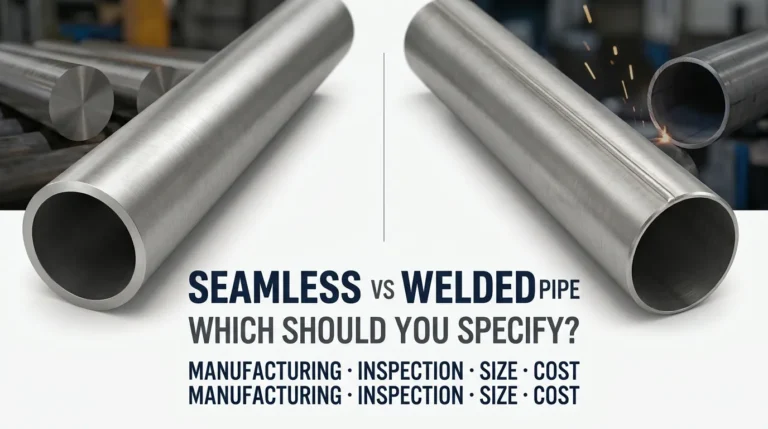
Seamless vs welded pipe is an important selection question when engineers, contractors and buyers prepare a pipe specification or RFQ.
Seamless pipe is manufactured without a longitudinal weld seam, while welded pipe is formed from strip or plate and joined along a seam. Neither type is automatically better for every project.
The correct choice depends on the product specification, material grade, size, wall thickness, design conditions, inspection requirements, availability and project documentation.
This guide explains the practical differences between seamless and welded pipe, with particular attention to stainless steel piping procurement and standards such as ASTM A312.
Seamless vs Welded Pipe: Quick Comparison
| Selection Factor | Seamless Pipe | Welded Pipe |
|---|---|---|
| Manufacturing route | Produced without a longitudinal manufacturing weld seam | Formed from strip or plate and joined along a longitudinal seam |
| Longitudinal seam | None | Present |
| Product specification | Must comply with the specified ASTM, EN, API or other product requirement | Must comply with the specified ASTM, EN, API or other product requirement |
| Size availability | Depends on material, wall thickness, specification and mill capability | Often commercially attractive for broader or larger-diameter production, depending on specification |
| Inspection focus | Material, dimensions, surface, mechanical properties and required product examination | The same general product controls plus weld-related requirements where applicable |
| Pressure suitability | Must be evaluated using the complete design and product specification | Must be evaluated using the complete design and product specification |
| Cost | Depends on grade, size, wall, quantity, availability and project requirements | Can be commercially advantageous in many sizes, but should not be assumed universally cheaper |
| Which is better? | The pipe that satisfies the complete project specification with the required technical and commercial evidence. | |
The manufacturing route is important, but it is only one part of a complete pipe specification.
How Is Seamless Pipe Made?
Seamless pipe is produced without joining two longitudinal edges to create the pipe wall.
A typical manufacturing route starts with a solid billet that is heated and pierced to create a hollow shell. The material is then rolled, sized and processed to achieve the required pipe dimensions and product properties.
The defining feature for the buyer is simple:
there is no longitudinal manufacturing weld seam.
This does not mean that a seamless pipe automatically satisfies every high-pressure, corrosive or critical-service application. The delivered pipe still has to meet the specified material grade, dimensions, heat treatment, mechanical properties, examination, surface condition and project requirements.
How Is Welded Pipe Made?
Welded pipe begins with flat strip, coil or plate that is formed into a cylindrical shape and joined along a longitudinal seam using the manufacturing process required by the applicable product specification.
The exact welding process varies by material, pipe type and standard.
For procurement, the important questions are not simply whether a weld seam exists, but:
- which product specification applies;
- which manufacturing route is permitted;
- how the weld is produced and treated;
- what examination is required;
- what dimensional tolerances apply;
- what documentation is supplied.
A welded pipe produced and inspected to the required specification should not automatically be treated as an inferior substitute for seamless pipe.
Is Seamless Pipe Stronger Than Welded Pipe?
Not as a universal rule.
The absence of a longitudinal weld seam is a real manufacturing difference, but the final mechanical performance of a pipe depends on more than that single feature.
Relevant factors include:
- material grade;
- chemical composition;
- heat treatment;
- outside diameter and wall thickness;
- manufacturing route;
- weld quality where applicable;
- mechanical properties;
- product examination;
- design temperature;
- governing piping code.
For this reason, a purchasing specification should not replace engineering requirements with a general statement such as “seamless is stronger.”
The correct question is whether the proposed pipe satisfies the product specification and the design requirements of the actual system.
Does Seamless Pipe Have a Higher Pressure Rating?
A manufacturing route alone does not create a complete pipe pressure rating.
Allowable piping conditions can depend on:
- material properties at design temperature;
- pipe size;
- actual or nominal wall thickness;
- manufacturing and dimensional tolerances;
- corrosion or erosion allowance;
- applicable quality factors or code rules;
- joining method;
- fittings, valves and other components;
- external loads;
- the governing piping code and project specification.
Seamless construction removes the longitudinal manufacturing seam, which may be important in certain specifications and services. That does not mean every seamless pipe can safely operate at a higher pressure than every welded pipe.
Likewise, welded pipe should not automatically be described as a “low-pressure pipe.”
For dimensional selection, review our stainless steel pipe dimensions guide and pipe schedule chart.
Seamless vs Welded Stainless Steel Pipe Under ASTM A312
For austenitic stainless steel piping, ASTM A312 is an important example of why manufacturing route should not be treated as a simple quality ranking.
ASTM A312/A312M covers several permitted manufacturing routes for covered austenitic stainless steel pipe, including seamless, straight-seam welded and heavily cold-worked welded pipe.
This means an order such as:
ASTM A312/A312M TP316L
does not, by itself, tell the manufacturer whether the purchaser requires seamless or welded construction.
The purchase order should identify the manufacturing route if the project restricts it.
For example:
ASTM A312/A312M TP316L welded stainless steel pipe, NPS 2, Schedule 10S, project-required inspection and documentation.
or:
ASTM A312/A312M TP316L seamless stainless steel pipe, NPS 2, Schedule 10S, project-required inspection and documentation.
These examples illustrate the order structure only. The actual designation, grade, dimensions, examination and code requirements must come from the approved project specification.
For the full product-standard explanation, review our ASTM A312 stainless steel pipe guide.
Size, Wall Thickness and Availability
Pipe manufacturing route can affect commercial availability, especially when size and wall thickness change.
However, universal size limits should be avoided because mill capability, specification, material grade and current market supply vary.
When comparing seamless and welded quotations, confirm the same dimensional basis for both alternatives:
- NPS or DN;
- outside diameter;
- Schedule or specified wall thickness;
- material grade;
- product specification;
- length;
- end condition;
- required tolerances.
Do not compare a seamless quotation and welded quotation if the wall thickness, product standard or inspection level is different.
ASME B36.19 is commonly used as a dimensional reference for welded and seamless wrought stainless steel pipe. The dimensional standard and the product specification perform different roles and should both be identified where applicable.
Inspection and Quality Control
Both seamless and welded pipe require manufacturing and product controls.
The inspection focus may differ because welded pipe includes a longitudinal manufacturing seam, while seamless pipe does not.
Depending on the product specification and purchase order, buyers may need to confirm:
- material test reports;
- heat-number traceability;
- chemical composition;
- mechanical properties;
- dimensional inspection;
- surface condition;
- hydrostatic or nondestructive examination where applicable;
- weld examination where required;
- PMI or corrosion testing where specified;
- third-party inspection;
- additional project documentation.
The manufacturing route should therefore be evaluated together with the required inspection level.
Nonleak’s quality control and testing page provides additional information about manufacturing inspection and traceability for project supply.
Seamless vs Welded Pipe Cost and Lead Time
Welded pipe is often considered for its manufacturing efficiency and commercial availability, while seamless pipe may carry a premium in some grades, sizes and wall-thickness ranges.
But a fixed cost percentage should not be applied across all projects.
The actual quotation depends on:
- material grade;
- pipe diameter;
- wall thickness;
- manufacturing route;
- quantity;
- required length;
- inspection and NDE;
- surface treatment;
- documentation;
- mill availability;
- delivery schedule;
- current raw-material and production conditions.
A lower unit price can also become irrelevant if the proposed manufacturing route does not satisfy the project specification.
For procurement, compliance should therefore be checked before comparing the commercial offer.
Do Not Confuse Welded Pipe with a Butt-Welded Pipe Joint
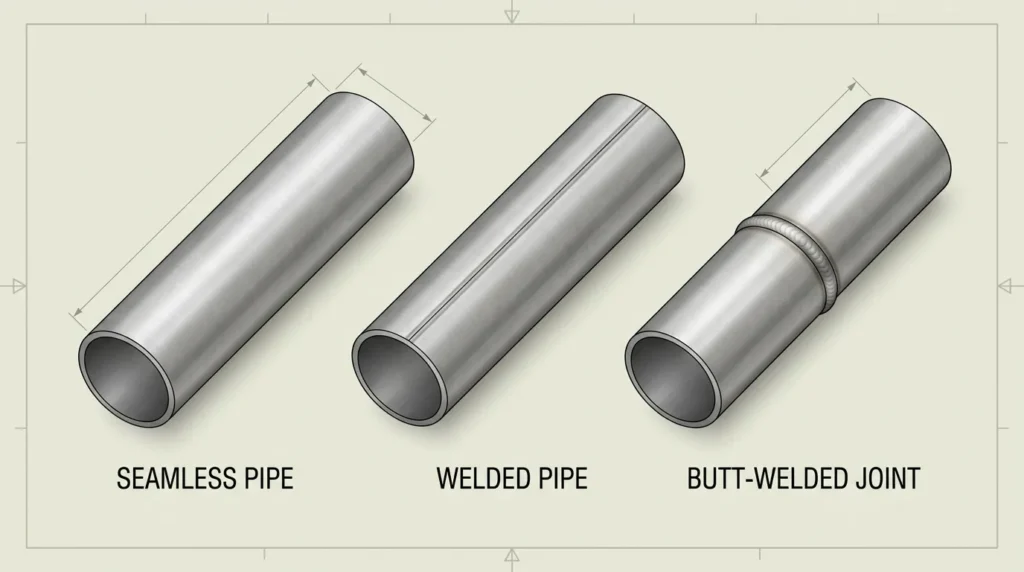
Welded pipe describes how the pipe itself was manufactured.
A butt-welded piping joint describes how two piping components are joined during fabrication or installation.
These are separate questions.
A seamless pipe can still be installed using butt-welded joints.
A welded pipe can also be joined to fittings or other pipe sections using an approved butt-welding procedure.
The longitudinal manufacturing weld in a welded pipe should therefore not be confused with the circumferential field or shop weld used to assemble a piping system.
For fabrication requirements, see our WPS for butt-weld pipe guide.
How to Choose Seamless vs Welded Pipe
A useful selection process is to check the project requirements in a fixed order.
| Selection Step | Question to Confirm |
|---|---|
| 1. Governing specification | Which ASTM, ASME, EN, API or project specification applies? |
| 2. Manufacturing-route requirement | Does the project explicitly require seamless, welded or another route? |
| 3. Material grade | Which stainless steel or steel grade is required? |
| 4. Dimensions | What NPS/DN, OD and Schedule or wall thickness are required? |
| 5. Service conditions | What are the design pressure, temperature, fluid and environment? |
| 6. Examination | What standard and additional inspection requirements apply? |
| 7. Availability | Which compliant manufacturing routes are available in the required size and quantity? |
| 8. Commercial comparison | After technical compliance is confirmed, how do cost and delivery compare? |
If the project specification explicitly states seamless pipe, the supplier should not substitute welded pipe solely because it is available faster or at a lower price.
If the project permits either route, then manufacturing quality, testing, documentation, availability and total procurement cost can be evaluated together.
What to Include in a Seamless or Welded Pipe RFQ
A clear RFQ makes it easier to receive technically comparable quotations.
| RFQ Item | Information to Provide |
|---|---|
| Product | Pipe |
| Product specification | ASTM A312/A312M or other project-required specification |
| Manufacturing route | Seamless, welded or unrestricted where the project permits alternatives |
| Material grade | TP304L, TP316L or other specified grade |
| Size | NPS / DN and any special OD requirement |
| Wall thickness | Schedule designation or actual nominal wall thickness |
| Dimensional standard | Applicable ASME B36 series or project requirement |
| Length | Random, fixed or cut length |
| Ends | Plain, beveled or other required preparation |
| Service conditions | Medium, design pressure, temperature and environment |
| Inspection | Standard examination plus PMI, NDE or third-party inspection where required |
| Documentation | MTR, inspection records, traceability and project documentation |
| Quantity | Total length, number of pieces or project BOM |
For available supply options, review Nonleak’s stainless steel pipes.
Not Sure Whether Your Project Requires Seamless or Welded Pipe?
Send the applicable pipe specification, material grade, NPS or DN, wall thickness, service conditions, quantity and inspection requirements.
Nonleak can help review whether the basic RFQ information is complete before quotation. Final material selection, pressure design and code compliance remain the responsibility of the project engineer or approved project documents.
Seamless vs Welded Pipe FAQ
What is the main difference between seamless and welded pipe?
Seamless pipe is manufactured without a longitudinal weld seam. Welded pipe is formed from strip or plate and joined along a longitudinal manufacturing seam. Both still need to satisfy the applicable product specification and project requirements.
Is seamless pipe always stronger than welded pipe?
No. Manufacturing route is only one factor. Material grade, wall thickness, heat treatment, mechanical properties, weld quality, product examination, temperature and the governing code all affect technical suitability.
Can ASTM A312 stainless steel pipe be welded or seamless?
Yes. ASTM A312/A312M covers seamless, straight-seam welded and heavily cold-worked welded austenitic stainless steel pipe. The purchase order should state the required manufacturing route when the project restricts it.
Can welded stainless steel pipe be used for pressure piping?
Potentially, yes, when the selected product, dimensions, manufacturing route, examination and piping-system design satisfy the applicable specification and governing code. “Welded” alone does not establish or prohibit a particular pressure service.
Is welded pipe always cheaper than seamless pipe?
No universal price difference applies. Welded construction can be commercially advantageous in many cases, but actual cost depends on material, size, wall thickness, quantity, inspection requirements, availability and market conditions.
Is a welded pipe the same as a butt-welded pipe joint?
No. Welded pipe describes the pipe manufacturing route. A butt-welded joint describes how separate piping components are joined during fabrication or installation.
Which should I specify: seamless or welded pipe?
Follow the approved project specification first. If the project allows more than one manufacturing route, compare technical compliance, inspection, availability, delivery and total procurement cost before selecting an option.
Preparing a Stainless Steel Pipe RFQ?
Send the required standard, manufacturing route, stainless steel grade, size, Schedule or wall thickness, quantity, service conditions and documentation requirements.
Technical Note: This article is a general pipe selection and procurement guide. It does not reproduce or replace the controlled text of ASTM, ASME, a governing piping code, approved engineering calculations or the project specification.