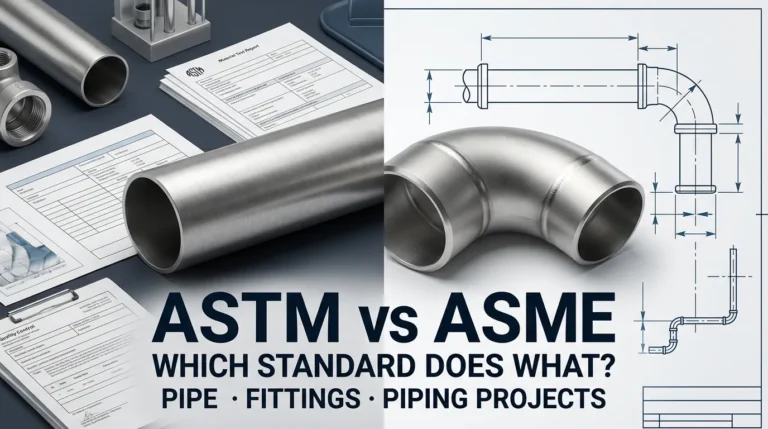
ASTM vs ASME is a common comparison when engineers, contractors, QA/QC teams and buyers need to understand which standards belong in a piping specification.
The short answer is that ASTM and ASME are different standards organizations, and their documents often work together rather than compete with each other.
ASTM International publishes specifications, test methods, practices, guides, classifications, terminology and other technical standards. ASME publishes a broad range of mechanical-engineering codes and standards covering areas such as piping systems, components, dimensions, fabrication, examination, inspection and testing.
For a stainless steel piping project, one document rarely answers every technical question. A pipe may use an ASTM product specification, an ASME dimensional standard and a separate piping code, while the project specification adds its own design, inspection and documentation requirements.
This guide explains the practical difference between ASTM and ASME and how engineers and buyers should use the two standards systems when specifying stainless steel pipe, fittings and complete piping projects.
ASTM vs ASME: What Is the Main Difference?
The most important point is that ASTM vs ASME is usually not an either-or decision.
Both organizations publish technical standards, but different documents answer different engineering and procurement questions.
| Comparison | ASTM | ASME |
|---|---|---|
| Organization | ASTM International | American Society of Mechanical Engineers |
| Standards scope | Specifications, test methods, practices, guides, classifications, terminology and other technical standards | Mechanical-engineering codes and standards covering piping, pressure equipment, components, dimensions, fabrication, inspection, testing and other areas |
| Common piping examples | ASTM A312, ASTM A403 and other product or test specifications | ASME B16.9, ASME B36.19 and applicable ASME B31 piping codes |
| Common procurement role | Often defines product, material, manufacture, testing or acceptance requirements | Often defines component requirements, dimensions or system-level engineering requirements |
| Are they interchangeable? | No | No |
The wording “ASTM covers materials while ASME covers design” is useful only as a very rough introduction. It is too simple to use as a technical rule.
ASTM specifications can address products, manufacture, dimensions, testing and acceptance requirements. ASME standards can also address materials, components, fabrication, examination and testing in addition to design.
The correct question is therefore:
Which document controls which part of this specific piping requirement?
What Does ASTM International Do?
ASTM International develops several types of consensus standards rather than one single category of “material standards.”
These include:
- specifications;
- test methods;
- practices;
- guides;
- classifications;
- terminology standards.
A specification can establish requirements that a material, product, system or service must satisfy. A test method defines a procedure that produces a test result, while a practice or guide serves a different technical role.
For stainless steel piping procurement, two relevant ASTM product specifications already covered in Nonleak’s technical library are ASTM A312 stainless steel pipe and ASTM A403 stainless steel fittings.
ASTM A269/A269M is another product-specification example for austenitic stainless steel tubing. See our ASTM A269 guide for how the tubing scope, testing and ordering requirements fit together.
ASTM A312 applies to covered austenitic stainless steel pipe products, while ASTM A403 applies to wrought austenitic stainless steel piping fittings. They may involve related stainless steel grades, but the product forms and specification requirements are different.
What Does ASME Do?
ASME develops codes and standards across many areas of mechanical engineering.
For piping projects, several ASME families may appear in the same project documentation.
ASME B16 Component Standards
The ASME B16 series includes standards for piping components. For example, ASME B16.9 butt-weld fittings addresses factory-made wrought buttwelding fitting requirements within its scope.
ASME B36 Pipe Dimensional Standards
The ASME B36 series is used for pipe dimensional standardization. For stainless steel pipe, ASME B36.19 is an important reference for dimensions and schedule designations.
ASME B16.5 is another example of an ASME component standard: within its scope, it defines requirements for pipe flanges and flanged fittings, including the rating, dimensional and interface framework. See our ASME B16.5 guide for how flange classes, dimensions, materials and procurement requirements fit together.
If you need to understand NPS, DN, outside diameter, inside diameter and wall thickness first, review our stainless steel pipe dimensions guide.
ASME B31 Piping Codes
ASME B31 piping codes operate at a broader system level. Depending on the applicable code and project, requirements can address materials and components, design, fabrication, assembly, erection, examination, inspection and testing.
This is another reason it is inaccurate to define ASME as “dimensions only.”
The specific code and edition must come from the project specification, governing regulations and engineering design basis rather than being assumed from the product name alone.
ASME standards also extend into assembly practice. For example, ASME PCC-1 provides guidance for pressure-boundary bolted flange joint assembly rather than defining flange material or dimensional requirements.
Why ASTM and ASME Often Appear Together
A piping project needs several different technical questions answered.
One standard number normally does not define all of them.
| Project Question | Typical Reference |
|---|---|
| What stainless steel pipe product requirements apply? | ASTM A312/A312M where specified |
| What wrought austenitic stainless fitting requirements apply? | ASTM A403/A403M where specified |
| What factory-made butt-weld fitting dimensional requirements apply? | ASME B16.9 where applicable |
| What stainless steel pipe dimensional series applies? | ASME B36.19 or the project-required dimensional standard |
| What system-level piping rules apply? | Applicable piping code and project specification |
| What project-specific requirements apply? | Approved drawings, datasheets, specifications, ITP and purchase order |
This is the central relationship between ASTM and ASME in piping procurement:
Different documents can describe different layers of the same pipe, fitting or piping system.
Example 1: ASTM and ASME for Stainless Steel Pipe
Consider an illustrative stainless steel pipe description such as:
ASTM A312/A312M TP316L, NPS 2, Schedule 10S, with the applicable stainless steel pipe dimensional standard and project piping code.
Several different requirements are contained in that description.
ASTM A312/A312M
This identifies the applicable pipe product specification where required by the project.
It addresses requirements associated with the covered stainless steel pipe product, including areas such as material grade, manufacturing route, heat treatment, testing, tolerances, workmanship, marking and certification.
For a detailed product-level explanation, see our ASTM A312 stainless steel pipe guide.
NPS and Schedule
NPS identifies the nominal pipe size, while the Schedule designation identifies a nominal wall-thickness series.
Schedule is not the material grade and is not a universal pressure rating.
Our pipe schedule chart provides a broader dimensional reference for commonly used wall-thickness series.
ASME Pipe Dimensional Standard
The applicable dimensional standard defines the dimensional series used for the specified pipe. For stainless steel piping, ASME B36.19 may be relevant where specified by the project.
Piping Code and Project Specification
The installed piping system still needs its governing design and project requirements.
The pipe product specification does not independently establish the complete allowable system pressure, fabrication procedure, examination program or final project acceptance requirements.
Example 2: ASTM A403 vs ASME B16.9 for Butt-Weld Fittings
The relationship becomes even clearer with stainless steel butt-weld fittings.
A buyer might request a stainless steel 90-degree long-radius elbow. Writing only “ASME B16.9 elbow” does not define the complete product.
ASTM A403/A403M
Where applicable, ASTM A403/A403M defines product and material requirements for wrought austenitic stainless steel piping fittings.
The order may still need to identify the grade and manufacturing class, such as the exact WP-grade designation required by the project.
For fitting-specific guidance, review our ASTM A403 stainless steel fittings guide.
ASME B16.9
ASME B16.9 serves a different role for factory-made wrought buttwelding fittings. Within its scope it addresses areas including dimensions, tolerances, ratings, testing and markings.
That means an ASTM A403 material/product reference does not automatically establish B16.9 dimensional conformity, and a B16.9 reference does not automatically identify the required stainless steel grade.
A more complete fitting inquiry may therefore need to identify:
- fitting type;
- angle, radius or configuration;
- NPS or size combination;
- wall thickness or Schedule;
- ASTM product/material specification;
- material grade and class;
- ASME or project dimensional standard;
- weld-end preparation;
- quantity;
- inspection and documentation requirements;
- required standard editions.
The standards work together because they answer different parts of the same purchasing requirement.
ASTM A vs ASME SA: Are They the Same?
Another common source of confusion is the relationship between ASTM “A” specifications and ASME “SA” specifications.
Some ASTM material specifications are adopted into the ASME Boiler and Pressure Vessel Code material system under an SA- designation.
For example, ASTM A312 and ASME SA-312 are related stainless steel pipe specifications.
However, buyers should not assume that adding the letter “S” automatically makes every ASTM specification identical to an ASME specification in every project or edition.
The practical checks are:
- which designation the project actually requires;
- which edition is contractually applicable;
- whether the governing ASME code imposes additional use requirements;
- what designation and compliance statement appear on the supplied material documentation.
If the project calls for SA-312, the purchase order should not casually replace that requirement with A312 without confirming that the substitution is permitted.
Likewise, similar numbering does not mean the purchaser can ignore the applicable project code or edition.
Does ASTM Replace an ASME Piping Code?
No.
An ASTM product specification can define important product, material, manufacture and testing requirements, but it does not replace the complete piping-system engineering code.
For example, specifying ASTM A312 pipe does not by itself determine:
- the complete system design pressure;
- the complete allowable stress and design basis;
- piping flexibility requirements;
- support and external-load design;
- field fabrication requirements;
- all welding qualification requirements;
- system examination;
- final installed-system testing;
- project approval.
These requirements must be coordinated with the applicable piping code, approved engineering documents and project specification.
Does ASME Replace the ASTM Product Specification?
No.
An ASME component or dimensional standard does not automatically identify the material/product specification needed for the purchased item.
For example:
“ASME B16.9 WP316L elbow”
mixes several pieces of information but still does not clearly state the applicable ASTM fitting specification.
A technical RFQ should keep these responsibilities separate:
Product/material specification + grade + dimensional standard + size + wall + project code + documentation.
This separation reduces the risk that the supplier and buyer interpret the same short description differently.
How Buyers Should Read a Piping Specification
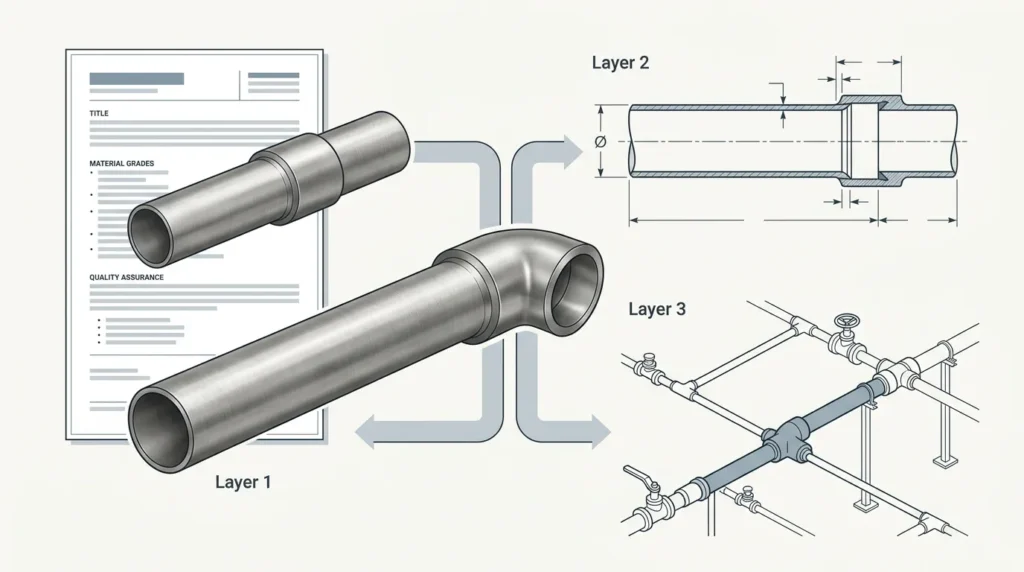
A useful way to review a piping specification is to separate it into four layers.
Layer 1 — Product and Material Requirements
Identify what product is being purchased and which ASTM or other product specification applies.
This layer may define the permitted material grades, manufacturing requirements, testing, workmanship, marking and other product-level requirements.
Layer 2 — Dimensions and Component Requirements
Confirm the applicable dimensional or component standard.
Examples may include pipe dimensional standards or fitting standards such as ASME B16.9 where appropriate.
Layer 3 — Piping-System Code
Identify the governing system-level piping code or other engineering design basis.
This layer determines requirements that cannot be established from a material specification or fitting standard alone.
Layer 4 — Project-Specific Requirements
Finally, check the approved project documents.
They may add or control:
- required standard editions;
- material restrictions;
- design pressure and temperature;
- corrosion allowance;
- inspection and NDE;
- PMI;
- surface treatment;
- traceability;
- third-party inspection;
- documentation;
- packing and identification;
- approved deviations.
Not Sure Which Standards Belong in Your Pipe or Fitting Specification?
Send the product type, material grade, size, wall thickness, applicable project standards and documentation requirements. Nonleak can help review whether the basic quotation information is complete before supply.
Common ASTM vs ASME Specification Mistakes
1. Treating ASTM and ASME as Competing Alternatives
A project frequently needs documents from both organizations. The correct choice depends on what requirement each document is intended to control.
2. Writing Only One Standard Number
A standard number does not necessarily define the product type, grade, dimensions, wall thickness, manufacturing route, project code and required documentation.
3. Treating ASTM as “Material Only”
ASTM standards include more than material specifications. Product specifications can contain manufacturing, dimensional-tolerance, testing, workmanship, marking and certification requirements, while ASTM also publishes test methods, practices, guides and other standard types.
4. Treating ASME as “Design Only”
ASME publishes component standards, dimensional standards and piping codes that can address materials, design, fabrication, inspection and testing depending on the specific document.
5. Mixing Product and Dimensional Standards
ASTM A312 does not replace the applicable pipe dimensional standard. ASTM A403 does not automatically replace ASME B16.9 where both are specified.
6. Writing Only “ASTM 316”
“316” describes a stainless steel grade family, but the buyer still needs the correct product specification.
See our AISI 316 vs ASTM 316 guide for a detailed explanation of grade terminology and product specifications.
7. Ignoring the Required Edition
Standards are revised. If the project contract identifies a particular edition, that edition should be followed unless an approved change is made.
8. Assuming ASTM A and ASME SA References Are Automatically Interchangeable
Related designations should be checked against the governing code, required edition and purchase specification rather than substituted based only on similar numbering.
What Should Be Included in a Pipe or Fitting RFQ?
A complete RFQ helps the manufacturer quote the same technical requirement that the buyer and engineer intended.
| RFQ Item | Information to Provide |
|---|---|
| Product | Pipe, elbow, tee, reducer, cap or other component |
| Product/material specification | Applicable ASTM or project-required specification |
| Grade | Exact required TP, WP or other project designation |
| Size | NPS, DN or required size combination |
| Wall | Schedule or specified nominal wall thickness |
| Dimensional/component standard | Applicable ASME, project standard or approved drawing |
| Connection or end type | Butt weld, press, threaded, plain, beveled or project-specific |
| Manufacturing requirement | Welded, seamless, class or other requirement where applicable |
| Design basis | Applicable piping code and project specification |
| Service conditions | Medium, design pressure, temperature and environment where required |
| Quantity | Pieces, total length or BOM quantity |
| Inspection | Standard inspection plus any additional PMI, NDE or third-party requirements |
| Documentation | MTR, inspection records, traceability and project-required documents |
| Edition | Required standard edition where contract-controlled |
For supporting specification and installation information, review Nonleak’s Technical Documentation.
Commercial product entry points are available through our stainless steel pipes and stainless steel pipe fittings sections.
If the project includes field or shop butt welding, the material and component standards should also be coordinated with the applicable WPS for butt-weld pipe and its qualification basis.
ASTM vs ASME FAQ
What is the main difference between ASTM and ASME?
ASTM and ASME are separate standards organizations. ASTM publishes specifications, test methods, practices, guides and other consensus standards, while ASME publishes mechanical-engineering codes and standards covering piping systems, components, dimensions, fabrication, inspection, testing and other areas. In piping projects, documents from both organizations may be required.
Is ASTM only a material standard?
No. ASTM publishes many material and product specifications, but its standards also include test methods, practices, guides, classifications and terminology. Individual ASTM product specifications may address manufacture, dimensions or tolerances, testing, workmanship and marking as well as material requirements.
Is ASME only a design code?
No. ASME publishes system-level piping codes as well as component and dimensional standards. The scope depends on the specific ASME document being referenced.
Do piping projects use both ASTM and ASME?
Yes, many projects do. A stainless steel pipe may use an ASTM product specification together with an ASME dimensional standard and an applicable piping code, while the project specification adds additional requirements.
Is ASTM A312 the same as ASME B36.19?
No. ASTM A312 is a stainless steel pipe product specification. ASME B36.19 is a dimensional standard for wrought stainless steel pipe. They answer different specification questions.
What is the difference between ASTM A403 and ASME B16.9?
ASTM A403 addresses product and material requirements for wrought austenitic stainless steel piping fittings. ASME B16.9 addresses factory-made wrought buttwelding fitting requirements including dimensions and tolerances within its scope. A project may specify both.
Are ASTM A and ASME SA specifications the same?
Some ASTM material specifications are adopted into the ASME material system under SA designations, but buyers should not assume every related designation or edition is automatically interchangeable. Confirm the exact designation, edition and governing project requirements.
Can I specify a fitting by writing only “ASME B16.9”?
No. The order should also identify the fitting type, size, wall thickness, material/product specification, grade, configuration, end preparation, quantity, inspection and documentation requirements.
Can I specify stainless steel pipe by writing only “ASTM A312”?
No. The purchaser still needs to identify the required grade, NPS or DN, Schedule or wall thickness, manufacturing requirement where applicable, length, ends, quantity and project documentation.
Which standard should be listed first in an RFQ?
There is no universal rule that the ASTM or ASME reference must always appear first. What matters is that the complete product, material, dimensional, code and project requirements are clearly identified and do not conflict.
Preparing a Stainless Steel Piping RFQ?
Send us the required product type, material specification, grade, size, Schedule or wall thickness, dimensional standard, applicable project code, quantity and documentation requirements.
Nonleak can review the basic pipe and fitting specification before quotation and help identify missing procurement information.
Technical Note: This article is a general standards-navigation and procurement guide. It does not reproduce or replace the controlled text of ASTM or ASME standards, the governing piping code, approved engineering calculations, contractual project documents or the project specification. Always use the designation and edition required by the applicable project documents.