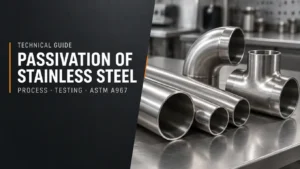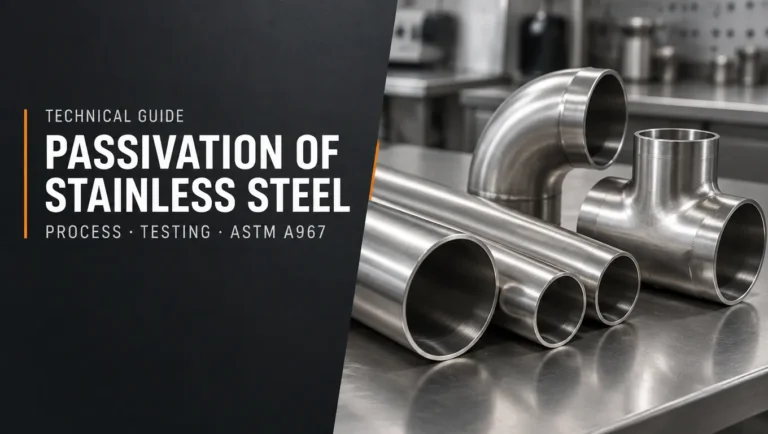
Stainless steel resists corrosion because chromium in the alloy helps form a thin passive surface film. When the surface is clean and exposed to suitable conditions, this film can form naturally. In some applications, however, fabrication, handling, storage, or service requirements make a defined cleaning or chemical passivation treatment necessary.
Passivation of stainless steel is not a universal coating or a guarantee against corrosion. It is a surface-treatment step selected for the material condition, the contaminants present, and the requirements of the purchase order or project specification. Understanding the difference between cleaning, pickling, and passivation helps buyers specify the right process without requesting an unsuitable or unnecessary treatment.
What Is Passivation of Stainless Steel?
Passivation is a treatment intended to promote a passive surface on chemically clean stainless steel and, where applicable, remove surface contaminants such as free iron. The passive film is extremely thin and is not a paint, plating, or thick protective coating. It is associated with the chromium-rich surface chemistry that gives stainless steel its corrosion resistance.
Clean stainless steel can self-passivate in air or other suitable oxygen-containing environments. Chemical passivation may be specified when the fabrication route, handling history, contamination risk, cleanliness requirement, or end use calls for a controlled treatment and verification process.
The word passivated should therefore be read in context. It does not, by itself, identify the exact treatment, prove that every contaminant has been removed, establish a universal corrosion rating, or guarantee performance in every fluid or outdoor environment.
When Is Stainless Steel Passivation Needed?
Whether a component needs chemical passivation depends on its grade, surface condition, manufacturing history, and specified service. A project may call for passivation after machining, grinding, forming, or other fabrication steps where free-iron contamination or surface condition needs to be controlled. It may also define passivation and acceptance testing as part of a cleanliness or quality plan.
Before specifying the treatment, review the actual condition of the surface. Oil, grease, shop dirt, embedded carbon-steel particles, weld scale, and heat tint are not all the same problem and may require different preparation methods.
- Handling or tooling contamination: confirm whether free iron or other residues may have transferred to the stainless surface.
- Machining, grinding, or forming: review whether the process could leave contamination or damage that requires cleaning and a defined surface-restoration step.
- Welded fabrication: inspect the weld and heat-affected area. Visible heat tint or oxide scale may require an appropriate scale-removal process before passivation is considered.
- High-cleanliness applications: define the required cleanliness level and acceptance evidence instead of relying on the word passivation alone.
- Project or customer requirements: follow the applicable purchase order, drawing, controlled standard, and approved procedure.
Not every stainless steel pipe, fitting, or fabricated assembly automatically requires a separate chemical passivation step. The decision should be based on the specified application and surface condition rather than on a blanket rule.
Cleaning vs Pickling vs Passivation
These terms are related but they are not interchangeable. A correct treatment plan identifies the surface problem first and then selects a suitable process.
| Process | Main purpose | Important limitation |
|---|---|---|
| Cleaning | Removes contaminants such as oil, grease, dirt, and residues that interfere with a clean surface. | Cleaning alone does not necessarily remove heat tint, heavy oxide scale, or a chromium-depleted layer. |
| Pickling | Removes oxide scale and other surface layers when required, including weld-related scale and the affected metal layer beneath it. | Pickling is a different, more material-removing process; it can change surface appearance and must be controlled for the alloy and component. |
| Passivation | Promotes formation of the passive film on a chemically clean surface and can help remove free-iron contamination under a suitable process. | It should not be assumed to remove heavy weld scale or replace pickling where scale removal is required. |
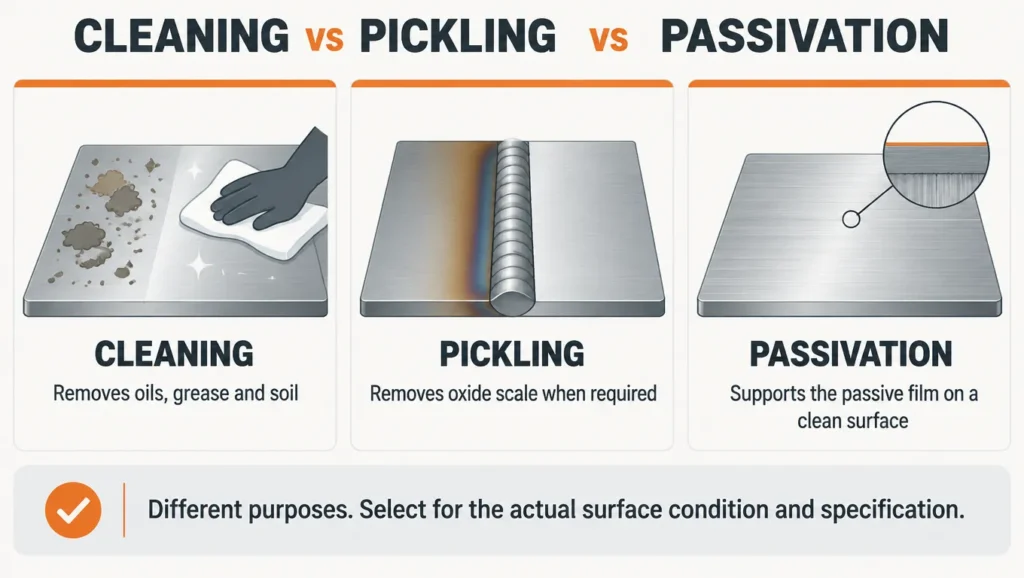
For welded stainless steel, a visual inspection may reveal discoloration, but appearance alone does not establish the condition of the metal beneath the heat tint. Depending on the severity and the applicable specification, suitable pickling or another approved scale-removal method may be needed before a passivation treatment. Mechanical cleaning must also be selected and performed so that it does not introduce contamination or an unsuitable surface finish.
For related corrosion mechanisms, see Nonleak’s guides to pitting corrosion in stainless steel and crevice corrosion. Surface condition is one factor in corrosion performance, alongside alloy selection, temperature, chemistry, geometry, and maintenance.
ASTM A380/A380M vs ASTM A967/A967M
Two commonly referenced ASTM documents address different but related aspects of stainless steel surface preparation and passivation. Always confirm the edition required by the project and consult the controlled standard itself for the complete requirements.
| Document | General role | How to use it in procurement |
|---|---|---|
| ASTM A380/A380M | Practice covering recommendations and precautions for cleaning, descaling, pickling, and passivation of stainless steel parts, assemblies, equipment, and installed systems. | Use it to help define appropriate surface-preparation and cleanliness practices for the actual component or system. |
| ASTM A967/A967M | Specification covering chemical passivation treatments for stainless steel parts, including alternative qualitative tests and acceptance criteria for evaluating treatment effectiveness. | Specify the applicable treatment, test method, acceptance criteria, and lot or sampling requirements rather than simply writing “passivate.” |
These documents are complementary, not interchangeable. ASTM A380/A380M addresses a broader range of cleaning and surface-preparation practices. ASTM A967/A967M focuses on chemical passivation treatments and verification for parts. Neither document should be treated as a universal recommendation that selects the best treatment or acceptance criteria for every alloy and application.
Official references: ASTM A380/A380M-25 and ASTM A967/A967M-25.
Nitric Acid vs Citric Acid Passivation
Nitric-acid and citric-acid treatments are both used for chemical passivation in suitable applications. The correct choice depends on the alloy, surface condition, contaminant, component geometry, process controls, environmental and safety requirements, and the applicable acceptance criteria.
| Consideration | Nitric-acid-based treatment | Citric-acid-based treatment |
|---|---|---|
| General role | Can support passivation and removal of suitable surface iron contamination under a defined procedure. | Can support chemical passivation and iron removal through a different chemistry under a defined procedure. |
| Selection factors | Review alloy compatibility, contamination, process control, worker safety, ventilation, and waste handling. | Review alloy compatibility, contaminant removal, process validation, worker safety, rinsing, and waste handling. |
| Key caution | Strong oxidizing acid chemistry requires appropriate controls and trained personnel. | Often considered a lower-hazard alternative in some contexts, but it is still a chemical process and is not automatically suitable for every component or specification. |
Do not select a treatment only because one acid is described as safer, greener, faster, or more effective. Confirm the specified alloy and component condition, the required outcome, and the acceptance method. Process concentrations, temperatures, exposure times, and rinse requirements must come from the controlled standard and an approved procedure; there is no single recipe that is suitable for every stainless steel product.
What Does Passivation Testing Verify?
Passivation testing is used to evaluate whether the specified treatment has met its defined acceptance criteria. ASTM A967/A967M includes several alternative qualitative test methods, such as water immersion, high humidity, salt spray, copper sulfate, potassium ferricyanide-nitric acid, damp cloth, and boiling water immersion methods. The appropriate method depends on the specification and application.
These tests are not universal substitutes for one another, and not every method is required for every part. The purchase order or approved quality plan should identify the selected test, acceptance criteria, sampling or lot definition, and records required. A test result should be interpreted within the limits of the specified method; it is not a guarantee of corrosion-free service life.
For procurement, ask the supplier to identify the applicable standard edition, treatment procedure, test method, acceptance criteria, inspection frequency, and the documentation that will accompany the lot. If the requirement is important to product acceptance, define it before manufacturing rather than after delivery.
Common Passivation Problems After Fabrication
- Applying passivation over scale: a passivation treatment should not be assumed to remove heavy weld oxide or heat tint. Determine whether scale removal is required first.
- Incomplete pre-cleaning: oils, grease, particles, or other residues can interfere with treatment effectiveness.
- Recontamination after treatment: contact with carbon-steel tools, dirty work surfaces, contaminated rinse water, or unsuitable packaging can undermine the intended result.
- Inadequate rinsing or drying: residual process chemicals can create surface problems. Rinsing, neutralization where specified, and drying must follow the approved procedure.
- Using an unqualified generic recipe: the process must be suitable for the alloy, surface finish, geometry, and acceptance requirements.
- Overstating the result: passivation does not make stainless steel immune to pitting, crevice corrosion, chloride exposure, or every service environment.
Where surface contamination or localized corrosion is a concern, also review corrosion under pipe support. Moisture retention, deposits, crevice geometry, and surface condition can all matter; passivation alone is not a substitute for sound design, cleaning, material selection, and inspection.
Stainless Steel Passivation RFQ Checklist
To make a passivation requirement clear and verifiable, include the following information in the RFQ, purchase order, or project quality plan as applicable:
- Product form and component identification: pipe, fitting, fabricated assembly, or other part.
- Stainless steel grade and material/product specification.
- Surface condition and manufacturing history, including machining, grinding, welding, heat tint, or known contamination.
- Required cleaning, descaling, pickling, and/or passivation steps, as applicable.
- Applicable standard and edition, including any approved supplementary project requirements.
- Specified passivation process or approved procedure, where required by the contract.
- Required test method, acceptance criteria, lot definition, sampling frequency, and responsible inspection party.
- Rinsing, drying, handling, packaging, storage, and protection from recontamination requirements.
- Required inspection reports, certificates, traceability, and nonconformance handling.
- Service environment and any project-specific cleanliness or corrosion-control requirements.
Clear requirements help the manufacturer and purchaser agree on the expected surface condition and the evidence needed to accept the product. They also prevent the term “passivated” from being used as a vague quality claim without a defined process or test.
Frequently Asked Questions
Does all stainless steel need chemical passivation?
No. Clean stainless steel can naturally form a passive film in suitable environments. A separate chemical treatment should be specified when the surface condition, fabrication route, application, or project requirements justify it.
Does passivation remove weld discoloration or heat tint?
Not reliably in every case. Heat tint and oxide scale may require an appropriate scale-removal process, such as pickling or another approved method, before passivation. The correct approach depends on the weld condition, alloy, and specification.
Is pickling the same as passivation?
No. Pickling is used to remove scale and affected surface layers when required. Passivation promotes a passive surface on chemically clean stainless steel and can help remove suitable iron contamination. One process should not be assumed to replace the other.
What is the difference between ASTM A380/A380M and ASTM A967/A967M?
ASTM A380/A380M provides broader practice and precautions for cleaning, descaling, pickling, and passivation. ASTM A967/A967M covers chemical passivation treatments for stainless steel parts and alternative qualitative test methods with acceptance criteria. Confirm the applicable editions and contract requirements.
Does passivation guarantee that stainless steel will not corrode?
No. Corrosion performance still depends on alloy, surface condition, fluid chemistry, chlorides, temperature, geometry, deposits, fabrication, and maintenance. Passivation is one possible surface-treatment measure, not a universal corrosion guarantee.
What should I request from a supplier?
Specify the applicable standard and edition, required treatment, acceptance test and criteria, sampling or lot rules, and documentation. Include the material grade and product condition so the supplier can confirm that the procedure is suitable.
Plan Surface Treatment Requirements Before Procurement
Successful stainless steel passivation starts with the actual surface condition and a clearly defined requirement. Cleaning, pickling, and passivation have different purposes; the right combination depends on the material, fabrication history, intended service, and acceptance criteria.
For stainless steel pipe and fitting projects, share the product form, grade, dimensions, fabrication condition, service environment, and required quality records when requesting a specification review. Nonleak can help review product and documentation requirements for a project RFQ; any passivation service or treatment capability should be confirmed separately for the specific order.
Send a Stainless Steel Pipe or Fitting RFQ
Technical References
- ASTM A380/A380M-25 – Standard Practice for Cleaning, Descaling, Pickling, and Passivation of Stainless Steel Parts, Equipment, and Systems
- ASTM A967/A967M-25 – Standard Specification for Chemical Passivation Treatments for Stainless Steel Parts
- British Stainless Steel Association – Passivation of Stainless Steels
- Australian Stainless Steel Development Association – Pickling and Passivation
This article is general technical and procurement guidance. It does not reproduce the complete requirements of any standard and does not replace the controlled standard, an approved process procedure, or project-specific engineering review. Confirm the applicable standard edition and acceptance requirements for the actual order.