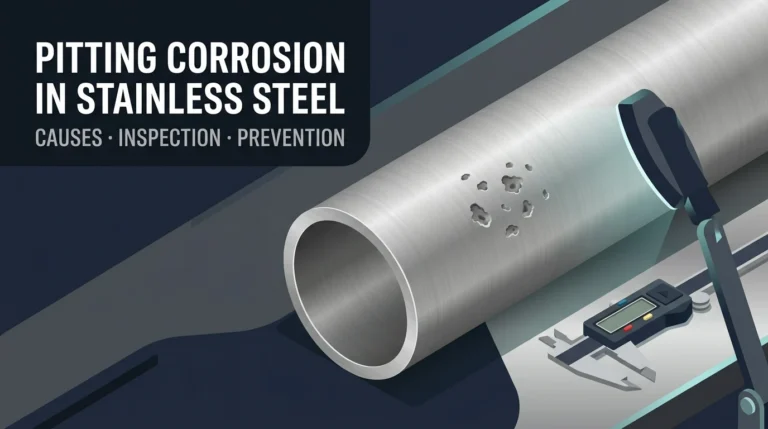
Pitting corrosion in stainless steel is a localized form of attack that can create small surface openings and deeper cavities while much of the surrounding metal still appears sound. Because the visible opening may be much smaller than the damage below it, pitting can be difficult to assess from appearance alone.
Stainless steel normally resists corrosion through a thin, self-repairing passive film. Under unfavorable conditions—especially chloride exposure combined with temperature, deposits, poor drainage, surface damage or an unsuitable material grade—that passive film can break down locally. The result is not uniform thinning across the whole pipe, but concentrated metal loss at individual sites.
This guide explains how pitting starts, how it differs from other corrosion forms, what inspectors should look for and which design, material, fabrication and maintenance decisions can reduce risk in stainless steel piping systems.
What Is Pitting Corrosion?
Pitting is localized corrosion that produces cavities or holes in a limited area. Most of the surface may remain passive while a small active site continues to dissolve. Once a stable pit develops, the chemistry inside the cavity can become more aggressive than the surrounding bulk fluid, allowing the attack to continue below the visible surface.
This makes pitting different from uniform corrosion. With uniform corrosion, metal loss is distributed more broadly and can often be estimated from a general corrosion rate. With pitting, a relatively small total mass loss can still create a deep defect, local wall penetration or a leak path.
Why Stainless Steel Can Still Develop Pits
The word “stainless” does not mean immune to every environment. Stainless steel relies on chromium in the alloy to form a passive surface film. When that film remains stable and can repassivate after minor damage, corrosion resistance is high. When the local environment prevents stable repassivation, localized attack can begin.
Chloride ions are one of the most common triggers. Chlorides may come from process fluids, seawater or coastal exposure, salts, cleaning products, insulation contamination, deposits or residual water. The risk depends on the complete environment—not on chloride concentration alone.
Chlorides can also contribute to a different damage mechanism when a susceptible stainless steel is under tensile stress; see our guide to chloride stress corrosion cracking in stainless steel for the distinction between localized pitting and cracking.
Main Factors That Increase Pitting Risk
| Risk Factor | Why It Matters | What to Confirm |
|---|---|---|
| Chloride exposure | Chlorides can destabilize the passive film and support localized attack. | Fluid chemistry, cleaning chemicals, deposits, external salt exposure and residual rinse water. |
| Higher temperature | Increasing temperature can make localized corrosion more likely in a given chloride environment. | Normal, cleaning, upset and shutdown temperatures. |
| Low pH or aggressive chemistry | Acidic or oxidizing conditions can reduce the ability of the surface to remain passive. | Operating pH, chemical additions, concentration changes and possible contamination. |
| Deposits and stagnant zones | Deposits can create a different local chemistry and restrict flushing or oxygen access. | Drainability, low points, dead legs, sediment, scaling and cleaning effectiveness. |
| Surface damage or contamination | Scratches, embedded iron, weld heat tint and poor post-fabrication cleaning can create vulnerable sites. | Fabrication controls, handling, finishing, cleaning and passivation requirements. |
| Unsuitable alloy selection | Different stainless steel grades provide different resistance to localized corrosion. | Grade, service environment, project code and corrosion assessment. |
How a Pit Initiates and Grows
Pit initiation usually begins at a small local weakness such as an inclusion, damaged surface area, contaminated spot or location where the passive film has become unstable. The affected area becomes anodic relative to the larger surrounding passive surface.
As metal dissolves inside the cavity, the local chemistry changes. The pit can become more acidic and chloride can concentrate within it. These conditions make repassivation more difficult. The attack may then grow inward even though the surrounding stainless steel continues to look intact.
The visible opening does not reliably show the full pit geometry. A narrow opening may lead to a wider or deeper cavity below the surface. For this reason, visual inspection is an important first step but may not be sufficient for determining remaining wall thickness or fitness for service.
Pitting Corrosion vs Crevice Corrosion
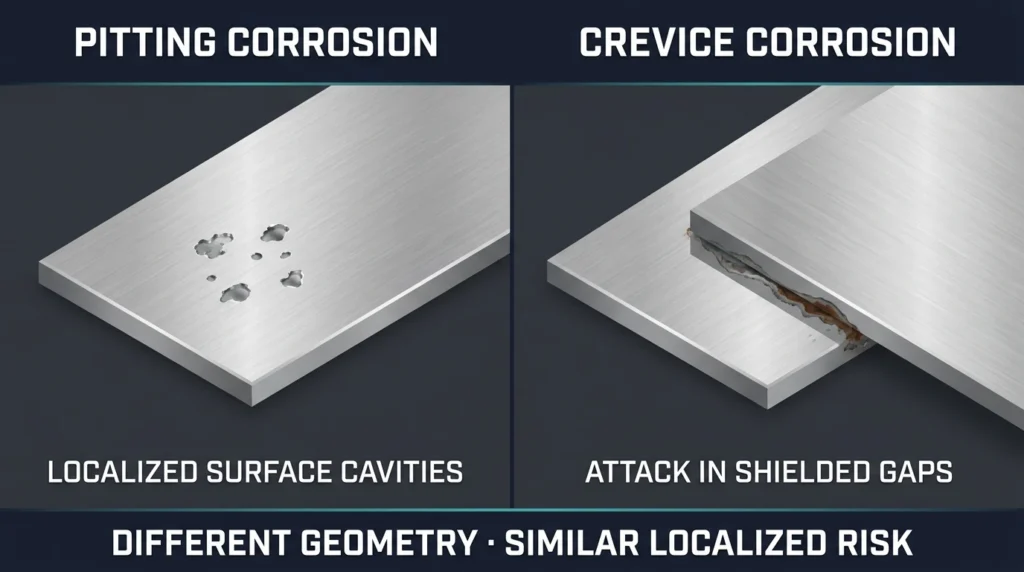
Pitting and crevice corrosion are both forms of localized attack, but the initiating geometry is different.
| Comparison | Pitting Corrosion | Crevice Corrosion |
|---|---|---|
| Typical location | Can initiate on an exposed surface at a vulnerable local site. | Develops in a shielded gap or restricted area. |
| Common geometry | Small surface opening with a cavity below. | Gaskets, lap joints, deposits, clamps, washers and other tight gaps. |
| Inspection challenge | Depth may be greater than the visible opening suggests. | Attack may remain hidden until the joint or obstruction is removed. |
| Prevention emphasis | Material selection, surface condition and environmental control. | Crevice elimination, drainage, sealing strategy and inspection access. |
Pipe-support contact zones can create separate moisture-retention and inspection-access problems. See our guide to corrosion under pipe support for a focused discussion of support interfaces.
Crevice corrosion deserves separate attention because the restricted geometry changes both the local environment and the prevention strategy. See our crevice corrosion in stainless steel guide for piping locations, risk factors, inspection and prevention.
Where Pitting May Occur in Stainless Steel Piping
Potential locations include internal pipe surfaces exposed to chloride-bearing fluids, poorly drained low points, dead legs, areas below deposits, heat-affected or heat-tinted surfaces, externally contaminated surfaces and sections exposed to salt-containing insulation or coastal deposits.
Pitting can also develop after cleaning or commissioning when aggressive chemicals are used at the wrong concentration, temperature or contact time, or when chloride-bearing rinse water is not fully removed. Cleaning procedures should be compatible with the stainless steel grade and the complete piping system.
Does 316L Prevent Pitting?
316 and 316L stainless steels generally provide better resistance to chloride-induced pitting than 304 and 304L because their alloy composition includes molybdenum. However, 316L is not universally immune. A sufficiently aggressive combination of chloride, temperature, acidity, deposits, oxidizers, surface condition and exposure time can still cause localized corrosion.
Grade selection should therefore be based on the actual service environment. For an overview of the two common austenitic grades, read 304 vs 316 stainless steel pipe.
Comparative indicators such as Pitting Resistance Equivalent Number can support preliminary alloy comparisons, but they do not replace service-specific engineering assessment, testing, fabrication requirements or applicable code rules.
How to Identify Possible Pitting
Possible signs include isolated pinholes, small cavities, dark spots, rust-colored deposits, recurring local staining, seepage or unexpected wall-thickness loss. Deposits should not be assumed to be harmless surface dirt, but discoloration alone also does not prove the depth or severity of a pit.
An inspection plan may include:
- Review of process chemistry, temperature history and cleaning records.
- Visual examination after safe cleaning of the surface.
- Mapping of the location, size and distribution of suspected pits.
- Measurement of remaining wall thickness using a suitable method.
- Evaluation of inaccessible internal surfaces or deposit-covered locations.
- Laboratory analysis when the corrosion mechanism is uncertain.
- Engineering review against the applicable code and minimum required wall.
Do not return a damaged component to service based only on cosmetic cleaning. Grinding, blending or polishing can remove evidence while also reducing wall thickness. The disposition should be approved by the responsible engineer or asset owner.
Laboratory Tests and Their Limitations
ASTM G48 provides accelerated ferric-chloride test methods for comparing the pitting and crevice corrosion resistance of stainless steels and related alloys in oxidizing chloride environments. These methods can be useful for ranking materials or assessing the influence of alloy composition, heat treatment and surface finish under the specified test conditions.
However, an accelerated laboratory test is not a universal service-life prediction. Test solution, specimen preparation, temperature and acceptance criteria must match the purpose of the evaluation. The Nickel Institute guide to pitting and crevice corrosion testing provides additional background on comparative test techniques.
How to Reduce Pitting Corrosion Risk
1. Define the Real Service Environment
Record chloride content, temperature, pH, oxidizing conditions, solids, cleaning chemicals, shutdown conditions and possible concentration mechanisms. Normal operating data alone may not represent startup, cleaning, stagnation or upset conditions.
2. Select the Material for the Environment
Choose the stainless steel grade using the complete corrosion assessment rather than a general rule such as “304 for water” or “316 for salt.” More resistant austenitic, duplex or higher-alloy materials may be required in demanding environments, subject to design, fabrication and project requirements.
3. Design for Drainage and Cleaning
Reduce dead legs, low points and deposit traps where practical. Provide access for inspection and cleaning. Ensure that the system can be flushed, drained and dried according to the operating procedure.
4. Control Fabrication and Surface Condition
Use clean tools and handling practices that avoid carbon-steel contamination. Control weld quality and heat tint. Where specified, use suitable post-fabrication cleaning, pickling or passivation procedures and verify that chemical residues are removed.
5. Control Cleaning Chemicals
Confirm chemical compatibility, concentration, temperature and contact time before cleaning stainless steel piping. Avoid uncontrolled use of chloride-containing products. Rinse and drain the system as required by the approved procedure.
6. Monitor High-Risk Locations
Inspection intervals should reflect consequence of failure, environment, material, operating history and accessibility. Recurring deposits, local staining or unexpected wall loss should trigger investigation rather than repeated cosmetic cleaning.
Procurement and RFQ Checklist
When corrosion resistance is important, include more than the words “stainless steel pipe” in the inquiry. A useful RFQ may identify:
- Pipe and fitting product standards.
- Stainless steel grade and any supplementary material requirements.
- Size, schedule or wall thickness.
- Service fluid and expected contaminants.
- Design and cleaning temperatures.
- Chloride, pH and other relevant chemistry data.
- Internal and external environmental exposure.
- Surface finish, fabrication and post-weld cleaning requirements.
- Inspection, testing, traceability and documentation requirements.
- Applicable piping code and owner specification.
Explore Nonleak stainless steel pipes, review our Quality Control approach and consult the Technical Documentation section when preparing project requirements.
Frequently Asked Questions
What is the main cause of pitting corrosion in stainless steel?
Chloride exposure is one of the most common triggers, but risk depends on the combined effects of temperature, pH, oxidizing conditions, deposits, surface condition, alloy grade and exposure time.
Can stainless steel pit in water?
Yes. Water chemistry, chloride concentration, temperature, stagnation, deposits, disinfectants and material grade all influence risk. The word “water” alone is not enough to determine suitability.
Is pitting corrosion the same as rust?
No. Rust-colored deposits may be present, but pitting describes localized cavities and metal loss. Surface staining can also come from contamination and should be investigated before the mechanism is confirmed.
Is 316L completely resistant to pitting?
No. 316L generally has better chloride-pitting resistance than 304L, but it can still pit in sufficiently aggressive conditions.
Can pitting be found by visual inspection?
Visual inspection may identify suspect sites, but it may not reveal the full depth or subsurface shape. Remaining-wall assessment may require additional measurement and engineering evaluation.
Can a pitted pipe be repaired by polishing?
Polishing may remove surface evidence but does not automatically restore lost wall thickness. Repair or replacement decisions should follow an engineering fitness-for-service assessment and applicable code requirements.
What is ASTM G48 used for?
ASTM G48 contains accelerated laboratory methods for comparing pitting and crevice corrosion resistance in oxidizing chloride environments. Results are comparative under the specified conditions and are not a universal prediction of field life.
How can buyers reduce pitting risk before ordering?
Provide the real fluid chemistry, temperature, cleaning conditions, material grade, surface requirements, applicable code and inspection documentation in the RFQ rather than specifying only a generic stainless steel type.
Need Help Reviewing Stainless Steel Pipe Requirements?
Material selection should consider the complete service environment, fabrication route, inspection plan and piping specification. Contact Nonleak with your pipe sizes, grade requirements, service conditions and documentation needs for project-specific product support.