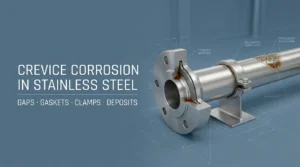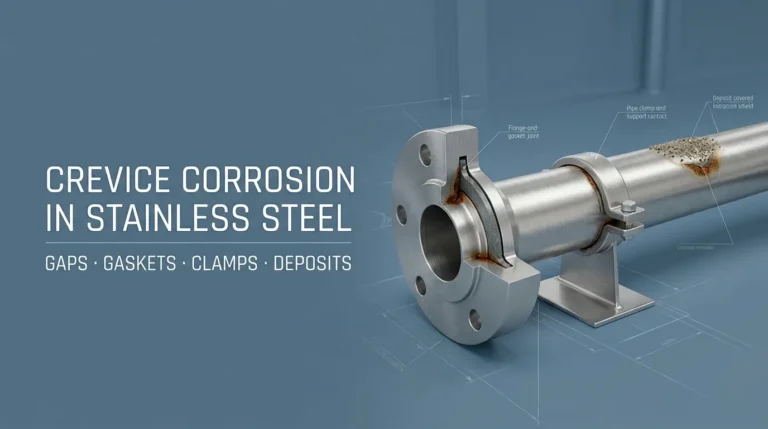
Crevice corrosion is a localized form of corrosion that develops inside a narrow, shielded or poorly flushed area where the local environment becomes more aggressive than the surrounding exposed surface. In stainless steel piping, typical risk locations include gasket interfaces, pipe clamps and supports, deposits, fastener contact areas, overlapping surfaces and other tight geometries that can retain moisture or restrict mass transport.
Stainless steel normally relies on a thin passive film for corrosion resistance. A crevice can create a local environment in which oxygen becomes depleted, acidity increases and chlorides or other aggressive species become concentrated. Once the passive film is destabilized inside that restricted area, localized attack can continue even while the nearby open surface still appears relatively unaffected.
For piping projects, crevice corrosion should therefore not be treated as a simple material-grade problem. Risk depends on the interaction of material, environment, temperature, chloride exposure, geometry, deposits, drainage, fabrication quality, cleaning, inspection access and operating conditions.
Important: This guide provides a general materials, piping-design, procurement and inspection overview. It does not establish a universal chloride limit, safe operating temperature or corrosion allowance, and it does not replace a project-specific corrosion assessment, approved piping design or responsible engineering review.
What Is Crevice Corrosion?
Crevice corrosion is localized attack associated with a narrow or shielded region that contains an electrolyte but does not exchange freely with the surrounding environment. The crevice may be created intentionally by a joint or contact interface, formed during fabrication, or created later by deposits, scale, fouling or other surface coverage.
Typical examples include the space between a flange face and gasket, beneath a washer or bolt head, between a pipe and support, under an adhered deposit, or within an incompletely penetrated weld geometry. The important feature is not simply that two surfaces touch. The geometry must allow a local environment to develop and remain sufficiently different from the open surface.
This is why apparently small details can matter. A stainless steel surface may perform well in open, well-flushed exposure while a nearby shielded area becomes susceptible to localized attack under the same bulk fluid conditions.
How Does Crevice Corrosion Develop in Stainless Steel?
Stainless steel corrosion resistance depends on a stable chromium-rich passive film. On an open surface, the surrounding environment can often support the conditions needed to maintain or restore that film. Inside a tight, stagnant crevice, however, transport between the crevice and the bulk environment is restricted.
A simplified mechanism can be described in stages:
- A restricted zone forms. Fluid or moisture enters a narrow gap, shielded area or deposit-covered region.
- Local mass transport becomes limited. Oxygen replenishment and exchange with the bulk environment become more difficult inside the crevice.
- The local chemistry changes. Reactions inside the crevice can lead to increasing acidity and, when chlorides are present, chloride enrichment.
- The passive film becomes less stable. Once the local environment becomes sufficiently aggressive for the alloy and surface condition, localized depassivation can occur.
- Attack can propagate within the crevice. The open surface may still appear relatively sound while metal loss progresses inside the shielded region.
The practical lesson is that crevice corrosion is governed by the local environment inside the crevice, not only by the chemistry of the bulk water or process fluid.
Why Are Chlorides, Temperature and Stagnation Important?
Localized corrosion of stainless steel is often associated with chloride-containing environments. Chlorides can promote breakdown of the passive film, and a crevice can concentrate aggressive species beyond the level measured in the bulk fluid.
Temperature is also important because localized corrosion resistance generally becomes more demanding as temperature increases. At the same time, stagnant or poorly flushed conditions can encourage persistent local concentration effects and deposit accumulation.
Other factors can also influence risk, including pH, oxidizing conditions, surface finish, fabrication condition, alloy composition, contamination and exposure time. For this reason, a single chloride concentration should not be treated as a universal pass/fail limit for every stainless steel piping application.
Where Does Crevice Corrosion Occur in Stainless Steel Piping?
One of the most useful ways to manage crevice corrosion is to identify where restricted geometries can occur before a system enters service. The table below focuses on piping locations rather than corrosion theory alone.
| Potential Location | Why a Crevice Can Form | What to Inspect | Prevention Priority |
|---|---|---|---|
| Flange and gasket interface | A narrow metal-to-gasket contact region can retain electrolyte and create a shielded local environment. | Facing condition, gasket fit, contamination, leakage evidence and deposit buildup. | Correct interface specification, clean assembly and suitable gasket/joint design. |
| Pipe clamp or support contact | The contact zone can retain moisture, collect salts or deposits and restrict drying and inspection. | Hidden contact surfaces, drainage, contamination, wear and accessibility. | Support geometry, drainage, material/interface review and inspection access. |
| Deposits, scale or fouling | A surface deposit can shield the metal and create a local environment different from the bulk fluid. | Sediment, scale, biological films, cleaning effectiveness and low-flow zones. | Cleanliness, flushing, maintenance and removal of persistent deposits. |
| Fasteners, washers and tight contact areas | Narrow metal-to-metal or metal-to-nonmetal interfaces can create restricted local conditions. | Moisture retention, contamination and attack beneath contact surfaces. | Detail design, fit-up, drainage and maintainability. |
| Overlapping or partially sealed surfaces | Liquid can enter a narrow gap but may not circulate or drain effectively. | Fabrication details, seal quality and trapped liquid. | Eliminate unnecessary overlaps or seal them using an approved design. |
| Incomplete weld penetration or unfavorable weld geometry | Internal recesses can create shielded zones and trap process fluid or deposits. | Weld profile, penetration, undercut, internal surface condition and inspection records. | Qualified fabrication, appropriate weld geometry and inspection. |
| Dead legs and poorly drained areas | Low movement and retained fluid can encourage deposits and persistent local concentration. | Drainability, flushing, sediment and actual operating flow pattern. | System layout, drainage, cleaning and operating practice. |
Under Gaskets and Flange Interfaces
Flanged joints are a classic location for crevice formation because the flange face and gasket create a narrow contact region. The fact that a gasket is electrically insulating does not automatically eliminate crevice corrosion; a metal-to-nonmetal interface can still create the restricted geometry needed for local attack.
Good joint design therefore involves more than simply choosing a corrosion-resistant flange material. Facing condition, gasket fit, cleanliness, assembly quality, leakage control and the actual service environment should be reviewed together.
Under Pipe Clamps and Supports
A pipe-support interface can behave as one type of crevice, particularly when moisture, chlorides or deposits accumulate in a shielded contact zone. However, corrosion under pipe support is a broader support-specific integrity issue that can also involve drainage, wear, material compatibility, insulation, inspection access and other mechanisms.
For that reason, this page treats a support contact as one possible crevice location without replacing the dedicated support-corrosion assessment.
Under Deposits and Fouling
Crevice-like conditions do not always require a manufactured joint. Sediment, scale, process deposits and tightly adhering contamination can shield part of the stainless steel surface from the surrounding environment. The chemistry beneath the deposit may then become more aggressive than the bulk fluid.
Where deposits cannot be eliminated by design, cleaning and inspection frequency become part of the corrosion-control strategy.
At Bolted, Overlapping and Tight Contact Areas
Bolts, washers and overlapping parts can create narrow contact geometries where moisture remains after the exposed surfaces have dried. Outdoor, coastal or washdown environments can be especially demanding when salts repeatedly enter and concentrate in these regions.
Material selection remains important, but the geometry should be reviewed at the same time. Increasing alloy resistance does not turn a poorly drained crevice into a good design detail.
In Stagnant and Poorly Drained Locations
Low-flow or retained-fluid areas can encourage deposits and allow local chemistry to diverge from normal operating conditions. This does not mean that every stagnant zone will experience crevice corrosion, but poor drainage and inadequate cleaning access can increase the number of locations where aggressive local conditions persist.
Crevice Corrosion vs Pitting Corrosion
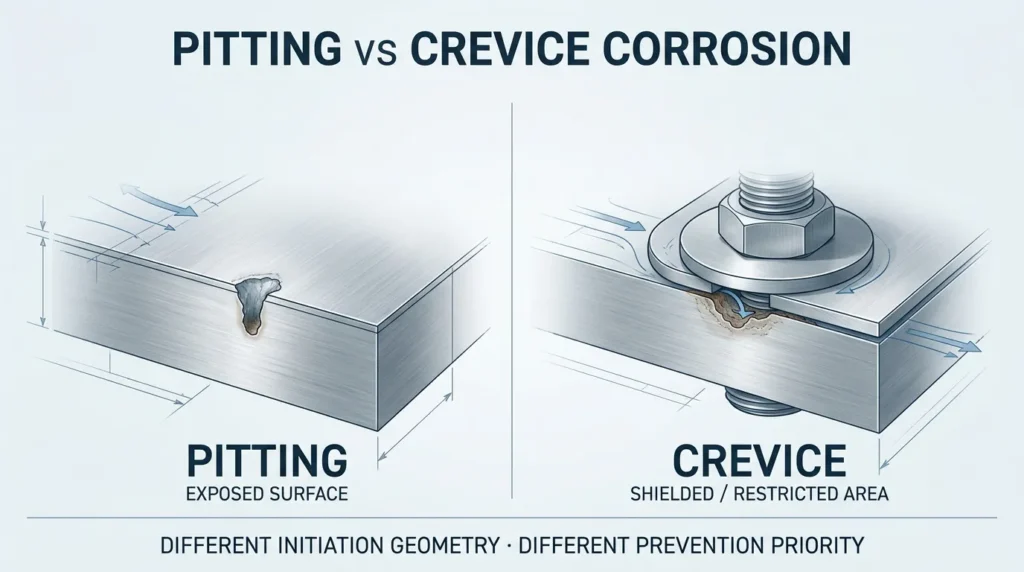
Pitting and crevice corrosion are both localized corrosion mechanisms associated with breakdown of the stainless steel passive film, and both can be promoted by aggressive chloride-containing environments. The main practical distinction is the initiation geometry.
| Factor | Pitting Corrosion | Crevice Corrosion |
|---|---|---|
| Typical location | Openly exposed surface. | Restricted, shielded or poorly flushed area. |
| Crevice geometry required? | No. | Yes, or a crevice-like shielded condition such as a deposit. |
| Typical visual challenge | A small surface opening may conceal deeper attack. | The attack may be hidden beneath a gasket, support, deposit or contact interface. |
| Key prevention emphasis | Environment, alloy resistance, surface condition, cleanliness and inspection. | The same factors plus elimination, sealing or control of crevice geometry and improved drainage/cleaning access. |
| Relationship | Localized passive-film breakdown on an open surface. | Localized passive-film breakdown promoted by a restricted local environment. |
For a dedicated discussion of pits, inspection and material/environmental factors, see our pitting corrosion in stainless steel guide.
Crevice Corrosion vs Corrosion Under Pipe Support
These terms overlap, but they should not be treated as synonyms.
Crevice corrosion describes a localized corrosion mechanism associated with a restricted or shielded environment. Corrosion under pipe support describes the location of damage at or near a pipe-support interface and can involve several contributing factors or mechanisms.
A support contact may create crevice conditions, but a support assessment should also review retained moisture, deposits, external contamination, abrasion, coating damage where applicable, material interfaces, movement, drainage and inspection access.
This separation matters for maintenance and root-cause analysis. Identifying where damage occurred is not automatically the same as identifying the corrosion mechanism.
Does 316 Stainless Steel Prevent Crevice Corrosion?
No stainless steel grade should be described as universally immune to crevice corrosion.
Compared with common 304 grades, 316 stainless steel contains molybdenum and generally offers improved resistance to localized chloride attack in many environments. That can make it a better choice when conditions are more demanding. However, alloy selection cannot be separated from temperature, chloride exposure, fluid chemistry, geometry, deposits, fabrication quality and maintenance.
More highly alloyed stainless steels and duplex grades can provide greater localized-corrosion resistance for severe environments, but the project still needs an appropriate material-selection basis. A higher grade does not justify ignoring an avoidable crevice or poor drainage detail.
For a broader project-level material comparison, see 304 vs 316 stainless steel pipe.
What Factors Increase Crevice Corrosion Risk?
Crevice corrosion is best reviewed as a combination of factors rather than a single threshold.
1. Crevice Geometry
The width, depth, tightness, orientation and accessibility of a crevice influence the local environment that can develop inside it. There is no single universal crevice dimension below which stainless steel is guaranteed to remain safe.
2. Chloride and Other Aggressive Species
Chlorides are a major concern for stainless steel localized corrosion. Sources can include process fluids, water chemistry, coastal salt, deicing salts, cleaning chemicals, deposits and contamination introduced during storage or installation.
3. Temperature
Higher temperature can increase localized-corrosion severity and reduce the margin between service conditions and material resistance. Laboratory critical-temperature methods are useful for comparison, but they should not be converted directly into a universal service limit.
4. Stagnation and Poor Flushing
Restricted movement can promote deposits and allow local concentration to persist. Systems that operate intermittently may need special attention to drainability, flushing and shutdown conditions.
5. Surface Condition and Contamination
Embedded iron, fabrication residue, heat tint, rough surfaces or persistent contamination can reduce the reliability of the corrosion-resistant surface condition. The relevant fabrication and cleaning requirements should be defined by the project rather than assumed from the base alloy alone.
6. Alloy Composition
Chromium, molybdenum and nitrogen are among the alloying elements associated with improved localized-corrosion resistance in stainless steels. Relative alloy rankings can help with screening, but composition-based indices should not replace service-specific material selection.
7. Deposits and Biological Films
Deposits can create shielding even where there is no mechanical joint. In water systems, scale, sediment or biological films may create local conditions that are significantly different from the moving bulk fluid.
How Can Crevice Corrosion Be Prevented?
Prevention is strongest when design, fabrication, commissioning and operation all address the same risk rather than relying on material grade alone.
Reduce Unnecessary Crevices
Where practical, eliminate details that create narrow, stagnant gaps. Avoid partially sealed overlaps, unfavorable contact geometries and fabrication details that can trap liquid. Where a crevice is unavoidable, the joint should be designed and specified deliberately rather than treated as an incidental gap.
Improve Drainage and Cleaning Access
Piping and surrounding details should allow water, cleaning solution and condensation to drain where the service requires it. Areas that cannot be visually inspected or effectively cleaned deserve additional attention during design review.
Control Chloride Contamination and Deposits
Review water chemistry, cleaning chemicals, coastal or external salt exposure, storage practices, installation contamination and process deposits. Keeping the surface clean reduces the chance that deposit-covered areas become hidden crevice sites.
Review Gaskets, Supports and Contact Geometry
Gaskets and pipe supports should be evaluated as interfaces, not merely individual components. Confirm the mating surfaces, fit, drainage, contamination risk and inspection access.
For support selection and installation context, see our guide to pipe clamp types.
Use Qualified Fabrication and Appropriate Weld Geometry
Incomplete penetration, undercut or unfavorable internal profiles can create restricted regions where deposits or process fluid collect. Welding procedures, fabrication workmanship and inspection requirements should be appropriate for the piping code, product and project specification.
Select Material for the Real Environment
The material grade should be selected against realistic exposure conditions, including bulk fluid chemistry, temperature, shutdown conditions, cleaning, external environment and crevice geometry. If the corrosion environment is uncertain or unusually aggressive, project-specific corrosion engineering or testing may be needed.
Plan Inspection and Maintenance Around Hidden Areas
Crevice corrosion often develops where direct visual access is limited. Inspection plans should therefore consider removable clamps, gasket interfaces, supports, deposit-prone regions and other shielded areas based on service risk.
How Is Crevice Corrosion Detected and Inspected?
Inspection begins with understanding where a crevice can exist. An exposed stainless steel surface may appear acceptable while the hidden contact surface is attacked.
Depending on the system and project requirements, inspection may include:
- visual examination after removing accessible clamps, covers or deposits;
- inspection of flange and gasket-contact surfaces during maintenance;
- surface cleaning before evaluating suspected attack;
- dimensional or wall-thickness assessment where metal loss is suspected;
- appropriate NDT selected by the responsible inspection authority;
- review of operating history, leakage, deposit formation and water chemistry;
- material verification where grade or traceability is uncertain.
The selected inspection method should match the component geometry and the type of damage being investigated. A method that is effective for general wall thinning is not automatically sufficient for a small, hidden localized-corrosion site.
For information about Nonleak’s production and inspection framework, see quality control and testing.
What Does ASTM G48 Tell You About Crevice Corrosion?
ASTM G48-25 contains laboratory test methods for comparing the resistance of stainless steels and related alloys to pitting and crevice-corrosion initiation in oxidizing chloride environments using ferric chloride solution.
The standard includes six methods. Method B is a ferric-chloride crevice test, while Methods D and F address critical crevice temperature for defined alloy groups. The methods can be used to compare the effects of alloy composition, heat treatment and surface finish under standardized test conditions.
The important procurement point is what the test does not establish. An ASTM G48 result should not be converted into a universal allowable chloride concentration, guaranteed service life or universal safe operating temperature for a piping system. Laboratory testing is valuable for relative comparison and qualification when correctly specified, but actual service suitability still depends on the project environment and design.
What Is Critical Crevice Temperature (CCT)?
Critical crevice temperature is a laboratory comparison concept used to characterize the temperature at which crevice-corrosion initiation occurs under a defined test method and test environment.
ISO 18089:2015, which ISO has confirmed as current, describes determination of CCT for stainless steels under potentiostatic control. ISO explicitly describes the resulting CCT as a relative index of performance for comparing stainless steel grades and states that the method is not intended to determine the temperature at which crevice corrosion will occur in service.
That distinction is essential. Two alloys can be ranked under the same laboratory method without implying that a project will reproduce the same threshold in real water, process fluid, seawater, cleaning solution or external exposure.
What Should Buyers and Engineers Review in an RFQ?
A corrosion-sensitive piping RFQ should provide enough information for the material and product requirements to be reviewed against the real service environment.
| RFQ / Review Item | Why It Matters for Crevice-Corrosion Risk |
|---|---|
| Product type and material grade | Defines the basic alloy and product being evaluated. |
| Applicable product standard | Clarifies manufacturing, material, testing and documentation requirements. |
| Fluid or service medium | Identifies the actual chemical exposure. |
| Chloride / water-quality information | Helps characterize localized-corrosion severity, but should not be used as a stand-alone threshold. |
| Design and operating temperature | Temperature can significantly affect localized-corrosion resistance. |
| Internal / external exposure | Coastal air, washdown, insulation, condensation or process conditions may create different risks. |
| Connection and gasket details | Identifies intentionally created contact and sealing interfaces. |
| Support / clamp arrangement | Identifies external shielded contact areas and inspection constraints. |
| Drainage and cleaning requirements | Helps assess stagnant zones, deposits and maintenance access. |
| Fabrication / weld requirements | Reduces the risk of unfavorable internal crevice geometry from fabrication. |
| Inspection and documentation | Defines how material, fabrication and product condition will be verified. |
Concerned About Localized Corrosion in a Stainless Steel Piping Specification?
Send the available material grade, service medium, chloride or water-quality information, temperature, installation environment, connection type, gasket or support interface, drawings and project specification. Nonleak can help review whether the basic product and quotation information is complete before supply.
Common Crevice Corrosion Specification Mistakes
1. Assuming Stainless Steel Cannot Corrode
Stainless steel provides strong corrosion resistance in many environments, but it is not universally immune to localized corrosion. Grade selection must match the actual exposure and geometry.
2. Assuming 316 Eliminates Crevice Corrosion
316 generally improves localized-corrosion resistance compared with 304 in many chloride-containing environments, but it can still suffer crevice corrosion under sufficiently aggressive conditions.
3. Treating Bulk Chloride Concentration as the Only Risk Variable
Local chemistry inside a crevice can differ from the bulk fluid. Temperature, geometry, deposits, pH, surface condition, stagnation and alloy composition also matter.
4. Using a Laboratory CCT as a Service Temperature Limit
Critical crevice temperature is method-dependent and is primarily useful as a comparative laboratory value. It should not be copied directly into an operating specification as a universal maximum temperature.
5. Assuming an Insulating Gasket Removes Crevice Risk
Electrical isolation may be relevant to galvanic-corrosion control, but a metal-to-nonmetal contact can still create a crevice geometry. Galvanic isolation and crevice-corrosion prevention are different engineering questions.
6. Inspecting Only the Open Surface
The most important damage may be hidden beneath a gasket, clamp, support, deposit or fastener contact area. Inspection planning should follow the geometry of the risk.
7. Treating Corrosion Under a Support as Automatically Crevice Corrosion
A support contact can create crevice conditions, but support-zone damage can involve several contributing factors. The mechanism should be investigated rather than inferred from location alone.
8. Solving a Geometry Problem Only by Upgrading Alloy Grade
Higher-alloy stainless steel may increase the resistance margin, but avoidable crevices, poor drainage, contamination and inaccessible deposits should still be addressed by design and maintenance.
Crevice Corrosion FAQ
What causes crevice corrosion in stainless steel?
Crevice corrosion develops when a narrow or shielded area creates a local environment more aggressive than the exposed surface. Restricted mass transport, oxygen depletion, acidification and chloride concentration can destabilize the stainless steel passive film and allow localized attack to propagate.
Where does crevice corrosion commonly occur in piping?
Typical locations include flange-gasket interfaces, clamps and supports, fasteners, overlapping surfaces, deposit-covered areas, unfavorable weld geometries and poorly drained or stagnant regions.
What is the difference between pitting and crevice corrosion?
Pitting initiates on an openly exposed surface without requiring a crevice. Crevice corrosion initiates inside a restricted or shielded geometry where the local environment becomes different from the surrounding bulk environment.
Can 316 stainless steel suffer crevice corrosion?
Yes. 316 generally offers better localized-corrosion resistance than 304 in many chloride-containing environments, but it is not immune. Risk still depends on temperature, chloride exposure, crevice geometry, deposits, fabrication and operating conditions.
Can crevice corrosion occur under a gasket?
Yes. A flange-gasket interface is a common example of a crevice because fluid can enter a narrow contact region where exchange with the bulk environment is restricted.
Does an insulating gasket prevent crevice corrosion?
Not automatically. An insulating gasket may be relevant to electrical isolation, but the gasket-to-metal contact can still create a narrow crevice. Crevice geometry and galvanic coupling are separate corrosion considerations.
What is critical crevice temperature?
Critical crevice temperature is a laboratory comparison value determined using a defined test method and environment. It can help rank relative material performance but should not be interpreted as the temperature at which a piping system will necessarily begin to corrode in service.
What does ASTM G48 test?
ASTM G48 contains standardized ferric-chloride laboratory methods for comparing the pitting and crevice-corrosion resistance of stainless steels and related alloys. Different methods address pitting, crevice attack and critical temperatures under defined test conditions.
Review Stainless Steel Piping Requirements Before Procurement
Crevice corrosion is a useful reminder that stainless steel performance depends on more than the grade name. The alloy, service environment, temperature, geometry, fabrication quality, deposits, drainage and maintenance conditions all interact.
For piping projects, the most effective approach is to identify crevice-prone locations before procurement and installation, define material and fabrication requirements clearly, and make hidden interfaces accessible to appropriate inspection and maintenance.
Related Nonleak technical resources include pitting corrosion in stainless steel, corrosion under pipe support, chloride stress corrosion cracking, 304 vs 316 stainless steel pipe, pipe clamp types, quality control and technical installation requirements.
Review Stainless Steel Piping Requirements Before Procurement
Send the pipe or fitting type, material grade, size, service medium, water-quality or chloride information where available, operating temperature, connection method, support or gasket interfaces, applicable standards, drawings, quantity and documentation requirements.
Technical note: Nonleak can support product, material and specification review based on the information supplied. Final corrosion assessment, system design, material suitability, inspection strategy, code compliance and engineering approval remain the responsibility of the project consultant, corrosion specialist or other responsible engineering authority.
Technical References
- ASTM G48-25 — Standard Test Methods for Pitting and Crevice Corrosion Resistance of Stainless Steels and Related Alloys by Use of Ferric Chloride Solution
- ISO 18089:2015 — Determination of the Critical Crevice Temperature (CCT) for Stainless Steels under Potentiostatic Control
- British Stainless Steel Association — Principles and Prevention of Crevice Corrosion
- Australian Stainless Steel Development Association — Crevices and Corrosion
- Specialty Steel Industry of North America — Pitting and Crevice Corrosion