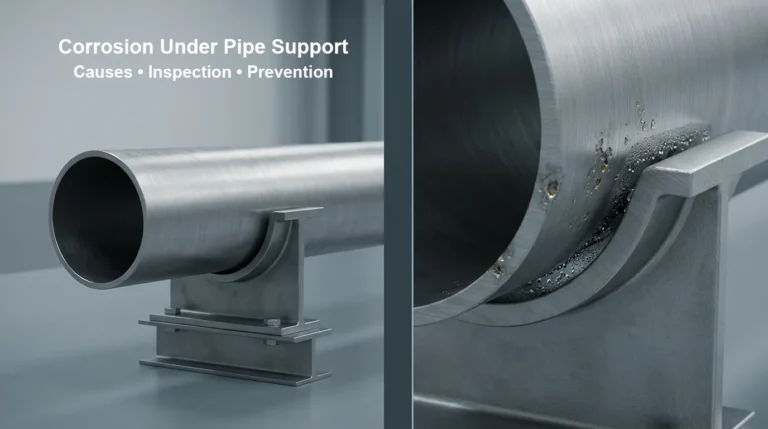
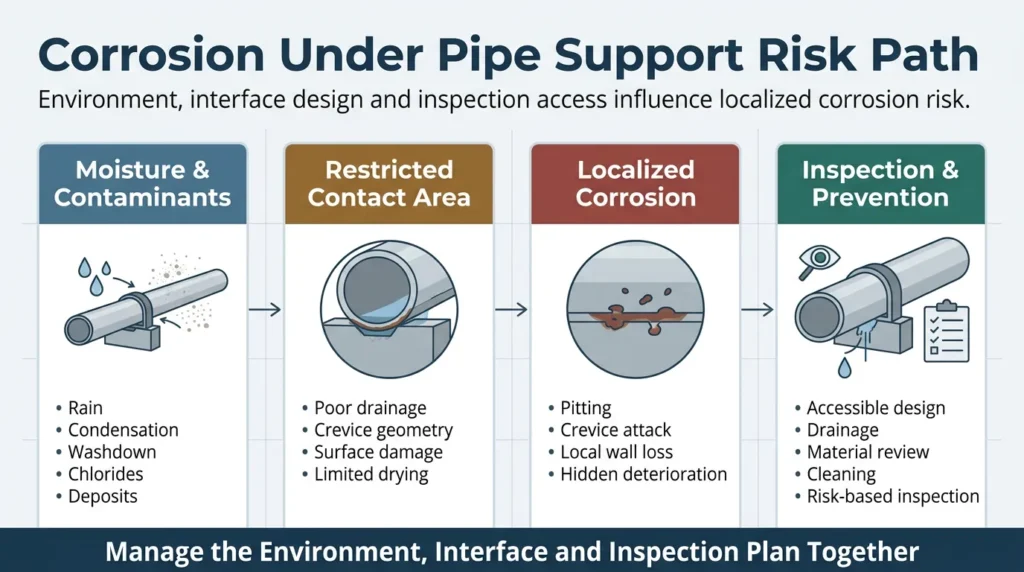
Corrosion under pipe support develops at or near the contact area between a pipe and its supporting component. Because this interface may retain moisture, collect contaminants, damage a protective surface or restrict visual access, localized deterioration can progress while the exposed pipe still appears to be in acceptable condition.
The risk is not limited to carbon steel. Stainless steel piping can also experience localized pitting or crevice corrosion when moisture, chlorides, deposits and confined contact conditions are present at the support interface.
Managing this risk therefore requires more than selecting a corrosion-resistant pipe material. Support geometry, drainage, surface condition, material compatibility, pipe movement, inspection access and maintenance must be considered together.
Important: This article provides a general design, purchasing and inspection overview. It does not replace an approved piping design, corrosion-management plan, inspection procedure or project-specific engineering assessment.
What Is Corrosion Under Pipe Support?
Corrosion under pipe support, often shortened to CUPS, is localized deterioration occurring where a pipe rests on, passes through or is attached to a support. The affected area may be hidden beneath a clamp, saddle, shoe, bracket, trunnion, liner or structural contact point.
Unlike uniform external corrosion, damage at a support interface may be concentrated in a relatively small area. Moisture can remain trapped, deposits can accumulate and ordinary visual inspection may not reveal the condition of the pipe surface beneath the support.
This makes CUPS an asset-integrity concern rather than a purely cosmetic issue. The surrounding pipe may remain clean while the concealed contact area develops localized surface attack or wall loss.
The Association for Materials Protection and Performance is developing a standard practice for a risk-based approach to managing corrosion under pipe supports in marine environments. This reflects the need to assess the environment, support configuration, consequence of failure and inspection accessibility together rather than treating every support location in the same way.
Review the AMPP new standards projects for additional industry context.
Why Pipe-Support Contact Areas Are Vulnerable
A support interface can create a small, sheltered area where conditions differ from those on the open pipe surface. Several mechanisms may act at the same location.
Moisture retention
Rain, condensation, cleaning water, saltwater spray or leakage from nearby equipment may enter the pipe-support contact zone. If the support geometry does not allow drainage and drying, the area may remain wet for much longer than the exposed pipe.
Contaminant accumulation
Dust, salts, chlorides and process deposits can collect in retained water. Repeated wetting and drying may concentrate these contaminants at low points and narrow interfaces.
Restricted oxygen and crevice conditions
A narrow contact area can behave differently from the freely exposed surface. Stainless steel relies on a passive surface film for corrosion resistance, but confined and contaminated conditions can increase the risk of localized attack.
A pipe-support contact zone can act as one type of crevice, but crevice corrosion can also develop beneath gaskets, deposits, fasteners and other shielded interfaces. See our crevice corrosion guide for the broader stainless-steel mechanism and prevention framework.
Surface damage
Installation handling, vibration, thermal movement or repeated rubbing can damage coatings, surface finishes or protective layers. Abrasion may also create locations where moisture and deposits remain concentrated.
Limited inspection access
The most important surface may be hidden by the support itself. An inspector may see staining, deposits or coating damage beside the support without being able to examine the actual contact zone directly.
Can Stainless Steel Corrode Under Pipe Supports?
Stainless steel is corrosion resistant, but it should not be treated as corrosion proof. Its performance depends on the grade, surface condition, temperature, chemical environment, chloride exposure, deposits and support-interface geometry.
Stainless steels can be susceptible to pitting and crevice attack in chloride-bearing conditions. Crevice corrosion occurs in confined spaces or contact areas where access to the surrounding environment is restricted.
At a pipe support, potential contributors include:
- Retained rainwater or condensation
- Marine or coastal salt deposits
- Chloride-containing washdown water
- Deposits that create a confined wet area
- Iron contamination from handling or nearby carbon steel
- Incompatible support or liner materials
- Abrasion caused by vibration or thermal movement
Grade selection still matters, but choosing 316 instead of 304 does not create universal immunity. The complete environment and interface must be reviewed. See our 304 vs 316 stainless steel pipe comparison for a broader material-selection overview.
Where chloride-bearing moisture coincides with a susceptible stainless steel and sustained tensile stress, cracking may also need to be considered separately from pitting or crevice attack; review our chloride stress corrosion cracking guide for that mechanism.
Additional general information is available from the World Stainless corrosion properties guide.
Common Causes of Corrosion Under Pipe Support
| Potential cause | What may happen | Review priority |
|---|---|---|
| Trapped moisture | The contact zone remains wet after the exposed pipe has dried | Drainage, orientation and drying |
| Chloride or salt deposits | Localized corrosion risk may increase as contaminants concentrate | Environment, cleaning and grade selection |
| Crevice geometry | A narrow sheltered interface restricts flushing and drying | Support-interface design |
| Surface or coating damage | The protected surface becomes locally exposed or weakened | Installation, movement and maintenance |
| Dissimilar materials | Galvanic effects may occur when electrically connected metals are exposed to an electrolyte | Material compatibility and moisture control |
| Vibration or thermal movement | Rubbing, coating wear, loosened components or fretting may develop | Support function and expected movement |
| Poor inspection access | Localized deterioration may remain hidden between inspection intervals | Accessibility and inspection planning |
| Blocked drain or weep path | Water cannot leave the support assembly as intended | Installation position and maintenance |
Which Pipe-Support Locations Need More Attention?
Risk varies by environment, support geometry, service conditions and consequence of failure. Locations that commonly justify closer review include:
- Outdoor pipework exposed to rain
- Marine, coastal or salt-laden environments
- Washdown or cleaning areas
- Chilled-water and condensation-prone piping
- Supports beneath leaking equipment or joints
- Supports near chemical or process contamination
- Tight saddles, shoes or clamp interfaces
- Closed or partially closed trunnion supports
- Locations affected by vibration or repeated thermal movement
- Supports with blocked drainage or weep paths
- Interfaces that cannot be examined visually
A UK Health and Safety Executive safety alert described localized corrosion inside closed-end trunnion supports after moisture entered and condensed against the process pipe. The deterioration was not identified through ordinary external observation and eventually resulted in loss of pipe-wall integrity.
The lesson is not that every trunnion or support will fail. It is that hidden support geometry and possible moisture ingress must be included in the inspection strategy. Read the HSE trunnion-support corrosion safety alert for the original case details.
Warning Signs During Inspection
Visible warning signs do not prove the extent of hidden deterioration, but they can help identify locations that require further review.
- Water marks or persistent moisture around the support
- Salt, dirt or process deposits at the contact area
- Rust staining from nearby carbon-steel supports
- Discoloration or roughening of the stainless steel surface
- Pitting visible beside the support edge
- Damaged coating, wrapping or surface finish
- Polished wear marks caused by movement
- Loose, distorted or misaligned clamps
- Cracked, hardened or deteriorated support liners
- Blocked drain or weep openings
- Unexpected local wall-thickness readings
Inspection limitation: A clean exposed surface does not establish the condition of the concealed pipe-support contact area.
Inspection Methods and Their Limitations
The inspection method should match the actual support geometry, pipe material, service conditions and consequence of failure. A risk-based programme may combine several forms of examination.
Visual examination
Visual inspection can identify deposits, moisture, coating damage, movement and staining around accessible support edges. It is useful for screening but cannot confirm the condition of a completely hidden interface.
Thickness measurement
Ultrasonic thickness measurement may help assess accessible areas and establish local wall-thickness trends. Probe access, surface condition, geometry and the precise location of localized pitting can limit the usefulness of individual readings.
Radiographic or other indirect techniques
Some hidden support configurations may be examined using radiographic, profile-based or other qualified nondestructive techniques. Each method has limitations relating to geometry, sensitivity, access, interpretation and the type of deterioration being sought.
Direct examination
Direct access can provide valuable information about the actual pipe surface, but obtaining that access may require changes to the support arrangement.
Safety boundary: Moving, lifting or temporarily supporting an operating pipeline can introduce structural and process risks. Access to a concealed interface must be planned by qualified piping, inspection and operations personnel under an approved procedure.
Inspection findings should be recorded consistently, including support identification, environment, photographs, measured values, method limitations and recommended follow-up actions.
How to Reduce Corrosion Under Pipe Support
Reducing corrosion under pipe support requires a system approach. No single clamp, pad, coating or material can be assumed to eliminate every corrosion mechanism.
Design for drainage and drying
Support geometry should avoid unnecessary water traps and allow rain, condensation or washdown water to drain. Drainage openings must remain functional after installation and should not be blocked by structural steel, debris or later modifications.
Maintain inspection access
High-risk contact areas should be designed so their condition can be assessed. Where direct access is not practical, the inspection plan should identify a suitable alternative technique and its limitations.
Protect the pipe surface
Surface preparation, coatings, wraps and protective systems must be compatible with the pipe material, operating temperature and environment. Damage introduced during installation should be repaired using an approved method.
Review material compatibility
The pipe, clamp, structural support, fasteners, liner and any isolation material should be considered as one interface. Material selection should account for corrosion resistance, water absorption, chemical compatibility, temperature, compression, ageing and expected movement.
Control movement and abrasion
A support must perform its intended structural function. Fixed, guided, sliding and suspended locations behave differently. Excessive restraint or uncontrolled movement may cause rubbing, surface damage and support distortion.
Establish cleaning and inspection priorities
Salt, deposits and standing water should not be allowed to accumulate indefinitely. Inspection frequency and scope should be based on risk, exposure, consequence, previous findings and the limitations of the selected examination method.
Clamp selection should account for the pipe outside diameter, mounting arrangement, support function, environment and inspection access. Nonleak supplies stainless steel pipe clamps for suspended, wall-mounted and structural piping arrangements according to confirmed project requirements.
Selecting Pipe Clamps and Support Interfaces
A pipe clamp should not be selected by nominal pipe size alone. The mounting condition, support function, outside diameter, operating environment and expected movement must also be confirmed.
| RFQ information | What to confirm |
|---|---|
| Pipe size | Actual pipe outside diameter, not only DN or NPS |
| Mounting condition | Suspended, wall-mounted, floor-supported or structural installation |
| Support function | Support, guide, restraint, anchor or clearance requirement |
| Environment | Indoor, outdoor, coastal, marine, washdown or chemical exposure |
| Materials | Pipe, clamp, support, fastener and interface materials |
| Temperature | Operating and ambient temperature affecting liners or coatings |
| Movement | Expected thermal displacement, vibration and sliding requirements |
| Drainage | Whether water can enter, drain and dry at the interface |
| Inspection access | How the hidden surface will be examined during service |
| Engineering loads | Project load, spacing and structural requirements provided by the designer |
Review our guide to pipe clamp types and mounting conditions, explore Nonleak’s stainless steel pipe clamps, or browse our wider range of pipeline accessories for project-specific support and installation requirements.
Common Prevention Mistakes
| Common mistake | Why it may be unreliable |
|---|---|
| Assuming stainless steel cannot corrode | Localized attack can still occur in chloride-containing or confined wet conditions |
| Choosing a clamp by pipe size only | The environment, movement, drainage and support function remain unresolved |
| Using an unverified absorbent liner | It may retain water, age, compress or become chemically incompatible |
| Sealing the interface without reviewing drainage | Water may become trapped behind an incomplete or damaged seal |
| Applying coating over contamination | Poor preparation can reduce coating adhesion and durability |
| Inspecting only exposed pipe surfaces | The highest-risk contact zone may remain hidden |
| Using one fixed interval for every support | Exposure, consequence and previous findings vary across the system |
| Moving an operating pipe without an approved plan | Uncontrolled load transfer may introduce process and structural hazards |
Pipe-Support Corrosion Review Checklist
- Identify the pipe material, outside diameter and wall thickness.
- Confirm whether the pipe is suspended, wall-mounted or supported from structural steel.
- Define the intended support, guide, restraint or movement function.
- Review exposure to rain, condensation, washdown, salts and process contaminants.
- Check whether the contact interface can drain and dry.
- Confirm compatibility of pipe, clamp, liner, fastener and structural materials.
- Review operating temperature and expected thermal movement.
- Identify how the hidden surface will be inspected.
- Record baseline photographs and available measurement data.
- Define cleaning, surface-protection and maintenance requirements.
- Provide project loads, drawings and standards for engineering confirmation.
Frequently Asked Questions
What is corrosion under pipe support?
Corrosion under pipe support is localized deterioration occurring at or close to the contact area between a pipe and a clamp, saddle, shoe, bracket, trunnion or structural support. The damage may remain hidden from normal visual inspection.
What causes corrosion under pipe supports?
Common contributors include trapped moisture, chlorides, deposits, restricted drying, crevice geometry, surface damage, dissimilar materials, vibration and poor inspection access. More than one factor may be present at the same location.
Can stainless steel corrode at a pipe support?
Yes. Stainless steel may experience localized pitting or crevice corrosion under contaminated, chloride-containing or persistently wet interface conditions. Grade selection, temperature, surface condition and support design all influence performance.
Does a rubber or polymer support pad prevent corrosion?
An interface pad may reduce direct contact or abrasion when correctly selected, but it is not automatically a complete corrosion solution. Water absorption, temperature resistance, chemical compatibility, compression, ageing and drainage must be evaluated.
How is corrosion under pipe support inspected?
Inspection may include visual examination, accessible surface checks, ultrasonic measurements, qualified indirect techniques and direct examination where safely achievable. The selected method must suit the geometry and acknowledge its detection limitations.
Can dissimilar-metal supports cause corrosion?
Dissimilar metals can contribute to galvanic corrosion when they are electrically connected and exposed to a conductive electrolyte. Material combinations, contact area, moisture and the service environment must be evaluated together.
How can corrosion under pipe supports be reduced?
Risk can be reduced by improving drainage, controlling contamination, protecting the surface, reviewing material compatibility, managing pipe movement, maintaining inspection access and using a risk-based inspection and maintenance programme.
Review Your Pipe-Support Requirements
Managing pipe-support corrosion begins with understanding the complete interface. Pipe material, outside diameter, mounting condition, support function, environment, drainage, movement and inspection access should be confirmed before selecting a clamp or support arrangement.
Explore Nonleak’s stainless steel pipes, review our stainless steel pipe clamps and pipeline accessories, learn about our quality control process, or contact Nonleak with your pipe sizes, mounting drawings, environmental conditions and project requirements.