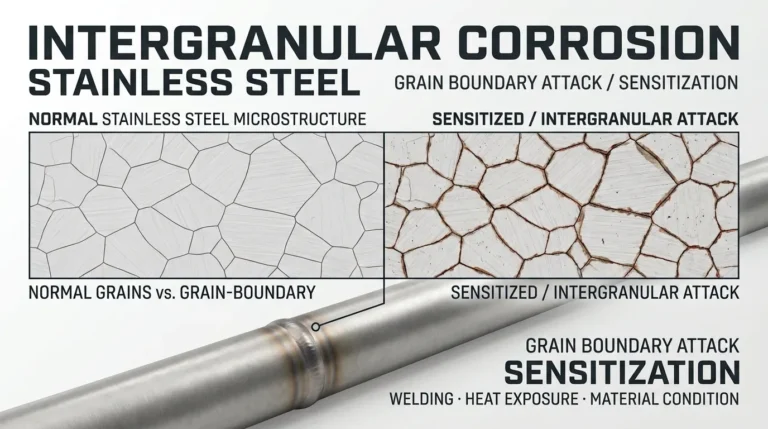
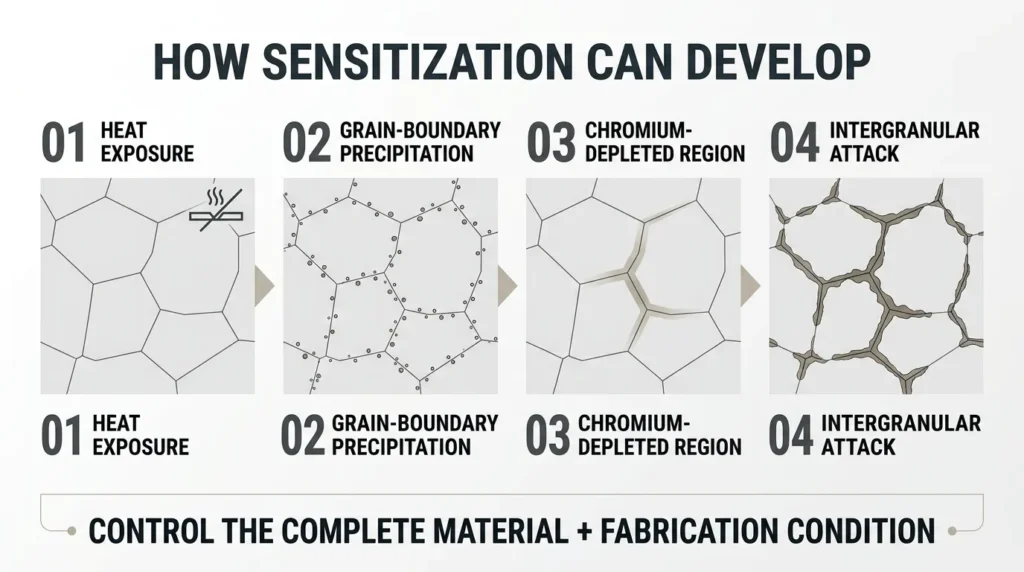
Intergranular corrosion is a localized form of corrosion that preferentially attacks the grain boundaries of a metal. In austenitic stainless steels, the risk is commonly associated with sensitization: a condition in which chromium-rich precipitates form along grain boundaries and leave adjacent regions locally depleted in chromium.
Because stainless steel depends on sufficient chromium to maintain a protective passive film, these locally depleted zones can become more vulnerable to corrosion even when the surrounding surface appears relatively sound.
For piping projects, this matters most when material selection, welding, heat exposure, fabrication history and corrosion testing are considered together. This guide explains how intergranular corrosion develops, why weld heat-affected zones deserve attention, how low-carbon and stabilized grades can reduce susceptibility, and what engineers and buyers should confirm before specifying stainless steel pipe or fittings.
Intergranular Corrosion: Quick Explanation
| Question | Practical Answer |
|---|---|
| Where does attack occur? | Preferentially along grain boundaries. |
| What is a common stainless steel mechanism? | Sensitization associated with chromium carbide precipitation and chromium-depleted regions near grain boundaries. |
| What can trigger sensitization? | Inappropriate heat exposure during welding, hot forming or heat treatment. |
| Does every welded stainless steel joint develop intergranular corrosion? | No. Susceptibility depends on grade, carbon content, thermal history, welding conditions and the service environment. |
| Can low-carbon grades help? | Yes. Low-carbon grades are commonly selected to reduce the tendency for chromium carbide precipitation during welding. |
| How can susceptibility be evaluated? | Project specifications may require recognized test methods such as ASTM A262 for austenitic stainless steels. |
What Is Intergranular Corrosion?
Metal is made up of many individual crystals, or grains. The interfaces between those grains are known as grain boundaries. Intergranular corrosion occurs when corrosion progresses preferentially along these boundaries while much of the grain interior remains comparatively less affected.
In stainless steel, this form of attack is important because the visible surface may not immediately show the full extent of degradation. If corrosion follows a connected network of grain boundaries, the material can lose local integrity without the broad surface loss associated with uniform corrosion.
Intergranular corrosion should therefore be distinguished from corrosion under pipe supports, which describes a location and service condition, and from pitting or crevice corrosion, which follow different localized corrosion mechanisms.
What Is Sensitization in Stainless Steel?
Sensitization is a metallurgical condition in which the thermal history of a stainless steel creates grain-boundary precipitates and adjacent regions with reduced corrosion resistance.
For conventional austenitic stainless steels, a common mechanism involves chromium carbide precipitation at grain boundaries. Chromium is drawn into the carbide particles, leaving nearby regions with less chromium available to maintain the same level of passive-film protection.
ASTM A262 specifically addresses practices for detecting susceptibility to intergranular attack in austenitic stainless steels and identifies intergranular attack associated with chromium carbide precipitation as a central concern of the test methods.
This does not mean that every stainless steel component exposed to heat becomes sensitized. The result depends on the alloy, carbon content, time at temperature, section thickness, welding thermal cycle, prior heat treatment and subsequent processing.
Why Welding Can Increase Intergranular Corrosion Risk
Welding creates a localized thermal cycle. The weld metal melts, while the surrounding heat-affected zone experiences lower but still significant temperatures.
If a susceptible stainless steel remains in a critical temperature range for enough time, grain-boundary precipitation may develop in part of the heat-affected zone. This is one reason why the material grade, welding procedure, heat input and fabrication route all matter when evaluating a welded stainless steel piping system.
For butt-weld piping, this concern should be considered together with material and fitting specifications. A butt-weld fitting may be dimensionally specified to ASME B16.9 while its material requirements are addressed separately, for example through ASTM A403 where applicable. Review our ASME B16.9 butt-weld fittings guide for the distinction between dimensional and material requirements.
Does Intergranular Corrosion Only Occur at Welds?
No. Welding is an important source of thermal exposure, but it is not the only one.
Potential sensitization may also be associated with:
- inappropriate heat treatment;
- hot forming or fabrication at unsuitable temperatures;
- slow cooling through a sensitization range;
- multiple thermal cycles;
- repair welding; and
- service conditions involving prolonged elevated-temperature exposure.
The actual risk must be evaluated from the material condition and fabrication history rather than from the presence or absence of a weld alone.
Intergranular Corrosion vs Pitting Corrosion
| Feature | Intergranular Corrosion | Pitting Corrosion |
|---|---|---|
| Primary attack location | Grain boundaries | Small localized points on the exposed surface |
| Common stainless steel driver | Sensitization / metallurgical changes near grain boundaries | Local passive-film breakdown, often influenced by chlorides and environment |
| Common fabrication relevance | Welding and heat exposure may be important | Surface condition, chloride exposure, deposits and temperature are often important |
| Typical inspection concern | Attack may follow internal grain-boundary paths | Small pits may penetrate deeply relative to their surface opening |
| Prevention focus | Grade, carbon level, thermal history, heat treatment and testing | Environment, grade selection, surface condition, deposits and crevice control |
The two mechanisms can occur in the same overall system, but one should not be used as a substitute explanation for the other. A project with good resistance to pitting is not automatically immune to intergranular attack, and a material with low intergranular susceptibility still needs to be suitable for the actual chloride, temperature and service environment.
How Low-Carbon Grades Help
Low-carbon stainless steel grades such as 304L and 316L are widely used where fabrication includes welding. Lower carbon content reduces the amount of carbon available to form chromium carbides, which in turn reduces the tendency toward sensitization under appropriate fabrication conditions.
This is one reason project specifications frequently distinguish between 304 and 304L, or between 316 and 316L, rather than treating the “L” suffix as an optional description.
However, a low-carbon grade should not be presented as universal immunity. Thermal history, fabrication, surface condition and service environment still need to be considered.
For broader material-selection context, review our guide to 304 vs 316 stainless steel pipe.
What Are Stabilized Stainless Steel Grades?
Another metallurgical approach is stabilization. Stabilized stainless steels use strong carbide-forming elements such as titanium or niobium to preferentially bind carbon, reducing the tendency for chromium carbide precipitation at grain boundaries.
Whether a stabilized grade is appropriate depends on the service, temperature, product specification, fabrication method and project standard. A buyer should not substitute a stabilized grade for a low-carbon grade, or vice versa, without engineering and specification review.
Can Solution Annealing Reduce Susceptibility?
Solution annealing is a heat-treatment route used to dissolve undesirable precipitates and restore a more uniform alloy condition before rapid cooling.
It can be an important part of stainless steel manufacturing and fabrication, but it should not be treated as a generic field repair instruction. The correct heat-treatment procedure depends on the alloy, product form, manufacturing route and governing specification.
For purchased pipe or fittings, the buyer should confirm the heat-treatment condition required by the applicable product specification rather than assume that all stainless products receive the same treatment.
Need Help Reviewing Stainless Steel Material and Fabrication Requirements?
Send Nonleak the product type, material grade, ASTM specification, NPS or DN, wall thickness or Schedule, welding or connection method, service conditions and required inspection documents. For welded piping, include the applicable project specification and any intergranular-corrosion testing requirements.
How ASTM A262 Is Used for Intergranular Corrosion Testing
ASTM A262 provides standard practices for detecting susceptibility to intergranular attack in austenitic stainless steels. Its current public scope includes multiple practices using different screening or corrosion-test approaches.
The standard should not be interpreted as one universal “pass/fail test” for every stainless steel product and every service environment. The appropriate practice must match the grade, product, project requirement and intended evaluation.
ASTM also states that the presence or absence of intergranular attack in A262 testing does not automatically predict resistance to other corrosion mechanisms such as general corrosion, pitting or stress-corrosion cracking.
For a procurement specification, buyers should therefore state the required ASTM A262 practice where applicable rather than simply writing “intergranular corrosion test required.”
Does ASTM A312 Address Intergranular Corrosion?
ASTM A312 is a product specification for austenitic stainless steel pipe. It establishes product requirements for pipe, while a separate intergranular-corrosion test method such as ASTM A262 may be invoked where the purchase specification or project requires it.
This distinction matters because a material product specification and a corrosion test method have different responsibilities.
For pipe procurement, the buyer should identify the correct material grade, manufacturing requirement, size, wall thickness, heat-treatment condition and supplementary inspection or testing requirements. Nonleak’s stainless steel pipes page provides the commercial product entry point for project inquiries.
Does ASTM A403 Address Intergranular Corrosion?
ASTM A403 applies to wrought austenitic stainless steel piping fittings. As with pipe, the project may impose additional corrosion-testing, heat-treatment or documentation requirements beyond the basic product description.
This is especially relevant for welded or fabricated fittings where the manufacturing route and heat-treatment condition can affect the final metallurgical state.
Do not assume that specifying “316L fitting” alone defines every intergranular-corrosion requirement. The complete purchase specification should identify the applicable product standard, grade, construction, heat treatment, dimensional standard and any required supplementary testing.
What Should Buyers Check for Welded Stainless Steel Pipe and Fittings?
| Review Item | Why It Matters |
|---|---|
| Material grade | Carbon level and alloy family influence susceptibility and corrosion performance. |
| Product specification | Defines product-form requirements for pipe, fittings or other components. |
| Manufacturing route | Welded, seamless, formed or fabricated products may follow different thermal histories. |
| Heat treatment | May affect precipitates, microstructure and corrosion susceptibility. |
| Welding procedure | Controls heat input, thermal cycle and fabrication consistency. |
| Repair welding | Additional thermal cycles may require review. |
| Intergranular-corrosion test | Project specifications may require a defined ASTM A262 practice. |
| MTR / traceability | Links delivered material to grade, heat and inspection records. |
| Service environment | Intergranular susceptibility is only one part of overall corrosion suitability. |
Common Specification Mistakes
1. Assuming 316 Automatically Eliminates Intergranular Corrosion
316 contains molybdenum and offers advantages in many corrosive environments, but the 316 designation alone does not eliminate metallurgical sensitization. Carbon content, thermal history and fabrication remain relevant.
2. Treating 304 and 304L as Identical
The low-carbon designation is part of the material grade. If the project requires 304L, it should remain in the RFQ and purchase order.
3. Writing Only “ASTM A262 Test”
ASTM A262 contains several practices. If the project requires testing, the applicable practice and acceptance basis should be clearly identified.
4. Assuming a Welded Joint Is Automatically Sensitized
Welding creates thermal exposure, but susceptibility depends on the grade, heat input, section size, procedure and cooling history. The weld should be evaluated from actual fabrication conditions.
5. Using Intergranular-Corrosion Testing to Predict Every Other Corrosion Mechanism
A test focused on intergranular attack does not establish immunity to pitting, crevice corrosion, general corrosion or stress-corrosion cracking.
6. Ignoring Heat Treatment and Manufacturing Route
Two components with the same nominal grade can have different fabrication histories. Product specification, heat treatment and manufacturing records should be reviewed together.
Intergranular Corrosion Prevention Checklist
A practical project review may include:
- select the material grade required by the service and fabrication method;
- consider low-carbon or stabilized grades where appropriate;
- control welding and fabrication thermal cycles;
- follow the heat-treatment requirements of the applicable product specification;
- avoid unqualified repair heating or welding;
- confirm the required ASTM A262 practice when intergranular testing is specified;
- maintain material traceability;
- review weld procedures and inspection records;
- protect stainless steel surfaces from contamination during fabrication and storage;
- evaluate the complete corrosion environment rather than one mechanism alone.
What Information Should Be Included in an RFQ?
If a project includes intergranular-corrosion requirements, provide enough information for the manufacturer to identify both the product and the required verification.
- Product type: pipe, elbow, tee, reducer, fabricated spool or other component.
- Material grade: for example 304L, 316L or exact project-specified grade.
- Product specification: applicable ASTM / ASME / EN or project standard.
- Size: NPS, DN or OD as applicable.
- Wall thickness: Schedule or actual wall thickness.
- Manufacturing route: welded, seamless, wrought, fabricated or project-defined.
- Heat treatment: project or product-standard requirement.
- Intergranular-corrosion test: applicable ASTM A262 practice where required.
- Service conditions: medium, temperature and other relevant corrosion factors.
- Documentation: MTR, test report, inspection records and third-party requirements.
- Quantity: by product type, size and grade.
For installation and project documentation guidance, review Nonleak’s Technical Documentation and Quality Control resources.
Intergranular Corrosion FAQ
What causes intergranular corrosion in stainless steel?
A common mechanism in austenitic stainless steels is sensitization associated with grain-boundary precipitation and chromium-depleted regions. Thermal exposure during welding, forming or heat treatment can be an important factor.
What is sensitization?
Sensitization is a metallurgical condition in which grain-boundary precipitates and adjacent chromium-depleted regions increase susceptibility to intergranular attack.
Can welding cause intergranular corrosion?
Welding can create a thermal cycle that promotes sensitization in susceptible material. Actual risk depends on material grade, carbon content, welding procedure, heat input, cooling and service conditions.
Does 316L resist intergranular corrosion better than 316?
Low-carbon 316L is commonly selected to reduce the tendency for chromium carbide precipitation during welding. It should still be specified and fabricated according to the applicable product standard and project requirements.
Is 304L immune to intergranular corrosion?
No stainless steel grade should be described as universally immune. 304L reduces sensitization risk through lower carbon content, but fabrication history and service environment still matter.
What is ASTM A262?
ASTM A262 is a set of standard practices for detecting susceptibility to intergranular attack in austenitic stainless steels. Different practices use different screening or corrosion-test methods.
Does passing ASTM A262 mean the material will not pit?
No. ASTM A262 specifically addresses intergranular attack. Its own scope states that the results do not provide a basis for predicting other forms of corrosion such as pitting.
Should every stainless steel pipe be tested to ASTM A262?
Not automatically. Testing should follow the applicable product specification, project requirements, material grade and purchase order.
Request Stainless Steel Material and Corrosion Support
For stainless steel pipe or fitting projects where welding, heat treatment or corrosion susceptibility is important, send the complete specification instead of only a grade name.
Include the product type, material grade, size, wall thickness, product standard, fabrication route, service conditions, test requirements and required documentation. This allows the manufacturer and project team to review the material and verification requirements before quotation.
Need Help Reviewing a Stainless Steel Specification?
Send your pipe or fitting schedule, material grade, standards, fabrication requirements and inspection documents for technical review.
Official Technical References
- ASTM A262 — Standard Practices for Detecting Susceptibility to Intergranular Attack in Austenitic Stainless Steels
- Outokumpu — Stainless Steel Corrosion Resistance and Intergranular Corrosion
Use the standard edition and test practice required by the actual project specification or purchase contract.