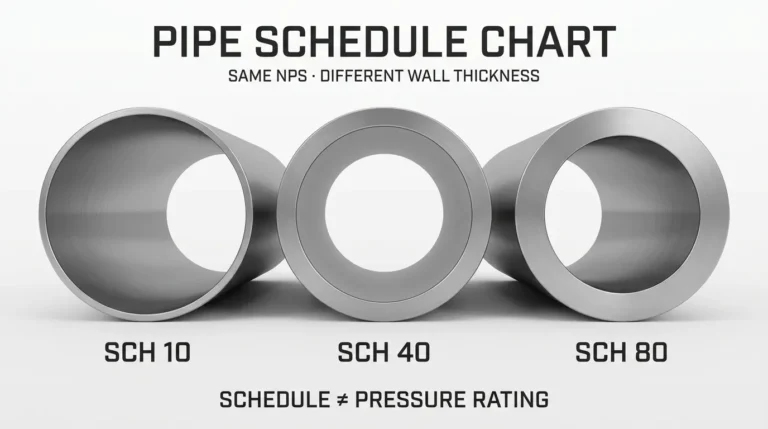
A pipe schedule chart helps engineers, contractors and buyers compare nominal pipe size, outside diameter and wall thickness before a pipe specification or quotation is finalized. The schedule number is not a material grade and it is not a complete pressure rating. It is part of the dimensional description of the pipe and must be used together with the required NPS or DN, dimensional standard, material specification and project design conditions.
This guide provides a practical SCH 10, SCH 40 and SCH 80 comparison for common pipe sizes, then explains how to read the chart, how schedule changes wall thickness and inside diameter, how stainless-steel “S” schedules should be handled, and what information belongs in a complete stainless steel pipe RFQ.
Quick answer: For a given nominal pipe size in the applicable dimensional series, the outside diameter is fixed while the nominal wall thickness changes with schedule. A heavier schedule generally means a thicker wall and a smaller inside diameter. Schedule alone does not establish the allowable pressure of a piping system.
Pipe Schedule Chart
The table below is a practical reference based on Nonleak’s current pipe wall-thickness sheet. It compares common NPS and DN sizes with outside diameter and nominal wall thickness for SCH 10, SCH 40 and SCH 80. Use it for preliminary comparison only; the controlled project specification and applicable dimensional standard take precedence for final procurement.
| NPS | DN | OD (in) | OD (mm) | SCH 10 Wall (mm) | SCH 40 Wall (mm) | SCH 80 Wall (mm) |
|---|---|---|---|---|---|---|
| 1/8″ | DN6 | 0.405 | 10.29 | 1.24 | 1.73 | 2.41 |
| 1/4″ | DN8 | 0.540 | 13.72 | 1.65 | 2.24 | 3.02 |
| 3/8″ | DN10 | 0.675 | 17.15 | 1.65 | 2.31 | 3.20 |
| 1/2″ | DN15 | 0.840 | 21.34 | 2.11 | 2.77 | 3.73 |
| 3/4″ | DN20 | 1.050 | 26.67 | 2.11 | 2.87 | 3.91 |
| 1″ | DN25 | 1.315 | 33.40 | 2.77 | 3.38 | 4.55 |
| 1-1/4″ | DN32 | 1.660 | 42.16 | 2.77 | 3.56 | 4.85 |
| 1-1/2″ | DN40 | 1.900 | 48.26 | 2.77 | 3.68 | 5.08 |
| 2″ | DN50 | 2.375 | 60.33 | 2.77 | 3.91 | 5.54 |
| 2-1/2″ | DN65 | 2.875 | 73.03 | 3.05 | 5.16 | 7.01 |
| 3″ | DN80 | 3.500 | 88.90 | 3.05 | 5.49 | 7.62 |
| 3-1/2″ | DN90 | 4.000 | 101.60 | 3.05 | 5.74 | 8.08 |
| 4″ | DN100 | 4.500 | 114.30 | 3.05 | 6.02 | 8.56 |
| 5″ | DN125 | 5.563 | 141.30 | 3.40 | 6.55 | 9.53 |
| 6″ | DN150 | 6.625 | 168.28 | 3.40 | 7.11 | 10.97 |
| 8″ | DN200 | 8.625 | 219.08 | 3.76 | 8.18 | 12.70 |
| 10″ | DN250 | 10.750 | 273.05 | 4.19 | 9.27 | 15.09 |
| 12″ | DN300 | 12.750 | 323.85 | 4.57 | 10.31 | 17.48 |
Important: The chart above shows SCH 10, SCH 40 and SCH 80 values from the current Nonleak reference sheet. Stainless steel specifications may use schedule designations with an “S” suffix under the stainless steel dimensional series. Do not assume SCH 40 and SCH 40S, or SCH 80 and SCH 80S, are interchangeable at every size. State the applicable dimensional standard and required wall thickness in the purchase order.
For a wider range of schedules, including intermediate and heavier wall series, download the full stainless steel pipe schedule table.
What Does Pipe Schedule Mean?
Pipe schedule is a wall-thickness series used together with nominal pipe size. It does not identify the stainless steel grade, manufacturing route, joining method or complete design pressure.
A practical pipe description therefore uses several pieces of information together:
- NPS or DN identifies the nominal pipe size.
- Outside diameter follows the dimensional series for that nominal size.
- Schedule identifies a nominal wall-thickness series.
- Inside diameter changes as wall thickness changes.
- Material grade and product specification define a different part of the pipe requirement.
This is why “2-inch stainless steel pipe” is not a complete RFQ description. Two pipes can share the same NPS and outside diameter but use different schedules and therefore have different wall thicknesses and inside diameters.
If you need a broader explanation of NPS, DN, OD and ID, review our stainless steel pipe dimensions guide.
How to Read a Pipe Schedule Chart
A pipe schedule chart becomes much easier to use when the specification is checked in a fixed sequence.
- Find the required NPS or DN. Do not start with schedule alone.
- Confirm the outside diameter. This helps verify fitting and system compatibility.
- Move across to the required schedule. Read the nominal wall thickness for that size.
- Confirm whether the project requires a standard schedule or an “S” schedule. The suffix matters in stainless steel specifications.
- Confirm the material/product specification. Schedule does not replace ASTM or another product specification.
- Check the governing project requirements. Pressure, temperature, corrosion allowance, joining method and code requirements must still be reviewed.
A useful purchasing description might identify the pipe as NPS 2, a specified stainless steel grade, a stated schedule or nominal wall thickness, a product specification, required length, end condition and inspection/documentation requirements. The exact order description should follow the project specification rather than a generic example.
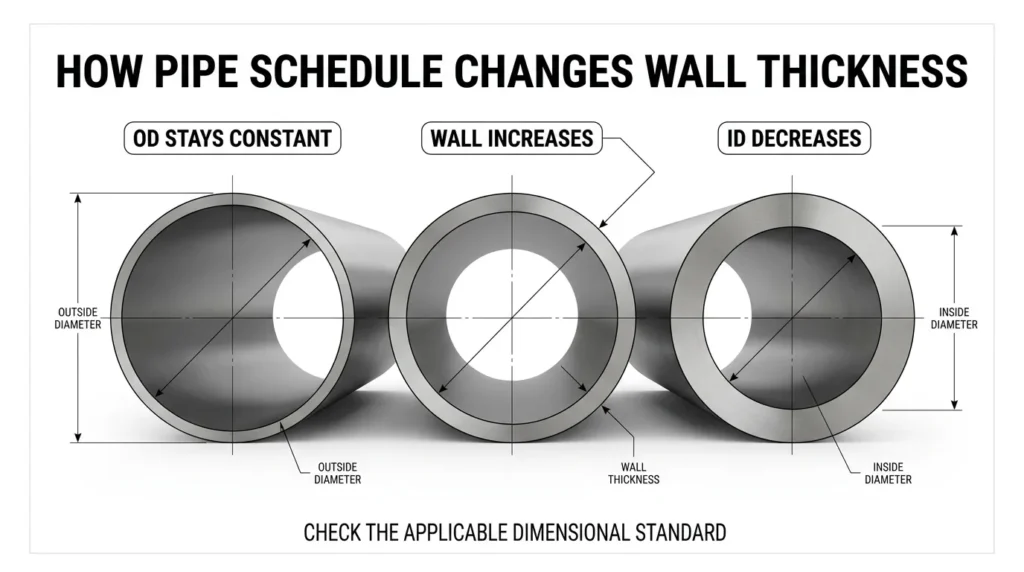
How Pipe Schedule Changes Wall Thickness and Inside Diameter
For the same NPS in the applicable dimensional series, changing the schedule changes the nominal wall thickness rather than changing the outside diameter. As the wall becomes thicker, the available inside diameter becomes smaller.
This relationship is important for more than pipe weight. A change in wall thickness can affect:
- internal flow area;
- pipe weight and handling;
- welding and end-preparation requirements;
- fit-up with specified fittings and components;
- material quantity and project cost;
- engineering calculations under the governing piping code.
Do not use schedule as a shortcut for hydraulic or pressure design. The schedule is only one dimensional input in the complete engineering calculation.
SCH 10 vs SCH 40 vs SCH 80
SCH 10, SCH 40 and SCH 80 are commonly searched because they represent different wall-thickness series. For the same nominal size, SCH 10 is generally lighter-wall than SCH 40, while SCH 80 is heavier-wall than SCH 40 in the corresponding dimensional series.
| Schedule | General role in comparison | Detailed Nonleak guide |
|---|---|---|
| SCH 10 | Lighter-wall option in many common sizes | Schedule 10 stainless steel pipe |
| SCH 40 | Common mid-range wall-thickness reference | Schedule 40 stainless steel pipe |
| SCH 80 | Heavier-wall option in the corresponding series | Schedule 80 stainless steel pipe |
A heavier schedule is not automatically “better.” The correct wall thickness depends on the complete design and procurement requirements. Selecting an unnecessarily heavy wall can increase material weight, fabrication demands and cost without adding value to a system that already meets the required design conditions with a lighter wall.
If your specification calls for a lighter wall series, see our Schedule 5 pipe guide for common dimensions, the meaning of “Schedule 5 pipe width,” and the distinction between Schedule 5 and Schedule 5S.
What About SCH 10S, SCH 40S and SCH 80S?
The “S” suffix is important when stainless steel pipe is specified. ASME B36.19 covers the standardization of dimensions for welded and seamless wrought stainless steel pipe, while ASME B36.10 covers welded and seamless wrought steel pipe dimensions. The schedule values in the two dimensional series can coincide at some sizes and differ at others.
For procurement, avoid treating “SCH 40” and “SCH 40S” or “SCH 80” and “SCH 80S” as automatic synonyms. A clear order should identify:
- the required NPS or DN;
- the required schedule designation;
- the required nominal wall thickness where necessary;
- the applicable dimensional standard;
- the stainless steel grade and product specification.
For controlled wording and the current standard, see the official ASME B36.19 stainless steel pipe page and ASME B36.10 wrought steel pipe page.
Is Pipe Schedule the Same as a Pressure Rating?
No. A pipe schedule is a dimensional wall-thickness designation. It is not, by itself, a complete pressure rating or pressure class.
Wall thickness is one important design input, but allowable system conditions also depend on factors such as:
- material grade and allowable properties at design temperature;
- nominal pipe size and actual wall thickness;
- manufacturing and dimensional tolerances;
- corrosion or erosion allowance where applicable;
- joint design and joining method;
- fittings and other components in the system;
- external loads and installation conditions;
- the governing piping code and project specification.
This is why a generic statement such as “SCH 80 equals a specific PSI rating” is not reliable without the complete design context.
Need Help Confirming Pipe Schedule and Wall Thickness?
Pipe schedule is only one part of a complete stainless steel pipe specification. If you are comparing NPS, wall thickness, material grade or dimensional requirements for a project, Nonleak can review the basic specification before quotation.
Please provide: NPS/DN, required schedule or wall thickness, stainless steel grade, applicable standard/specification, service medium, design temperature and pressure, quantity, and any drawing or project specification.
ASME B36.10 vs ASME B36.19
Pipe schedule terminology appears across more than one dimensional standard, which is why the standard designation should be included when an order could otherwise be ambiguous.
| Document | Primary dimensional role | Buyer should confirm |
|---|---|---|
| ASME B36.10 | Standardization of dimensions for welded and seamless wrought steel pipe | NPS, schedule series and required wall thickness |
| ASME B36.19 | Standardization of dimensions for welded and seamless wrought stainless steel pipe | NPS, stainless schedule designation and required wall thickness |
The dimensional standard does not replace the material/product specification or the piping design code. A project may need all of these documents to define different parts of the requirement.
Pipe Schedule vs ASTM A312
Pipe schedule and ASTM A312 solve different specification questions.
Pipe schedule and the ASME dimensional standard help define the dimensional series, including outside diameter and nominal wall thickness. ASTM A312/A312M is a product specification for seamless, straight-seam welded and heavily cold-worked austenitic stainless steel pipe. It covers product requirements rather than serving as a stand-alone schedule or pressure table.
For a detailed explanation, read our ASTM A312 stainless steel pipe guide. The current ASTM specification should be checked in the official ASTM A312/A312M catalog page.
A practical way to think about the relationship is:
- ASTM A312/A312M: What product/material requirements does the stainless steel pipe need to meet?
- ASME B36.19: What stainless steel pipe dimensions and schedule series are being specified?
- Project piping code/specification: What design, fabrication, examination and acceptance requirements govern the system?
Pipe Schedule vs Pipe Size
Pipe size and pipe schedule are related but they are not the same thing.
| Term | What it describes |
|---|---|
| NPS / DN | Nominal pipe size designation |
| OD | Outside diameter associated with the nominal size in the dimensional series |
| Schedule | Nominal wall-thickness series for that pipe size |
| ID | Resulting inside diameter, affected by OD and wall thickness |
This distinction also separates pipe from many tube specifications. Pipe is commonly described using NPS plus schedule, while tube is often described by actual outside diameter plus wall thickness. See our pipe dimensions guide for the full NPS, DN, OD and pipe-versus-tube explanation.
How to Specify Stainless Steel Pipe in an RFQ
A good RFQ should contain more information than “stainless steel pipe, Schedule 40.” Clear input reduces clarification cycles and helps suppliers compare the same technical requirement.
| RFQ item | Information to provide |
|---|---|
| Product | Stainless steel pipe |
| Size | NPS / DN and any required OD control |
| Wall | Schedule designation or specified nominal wall thickness |
| Material | Required stainless steel grade |
| Product specification | ASTM A312/A312M or other project-specified requirement |
| Dimensional standard | Applicable ASME B36 series or project requirement |
| Manufacturing route | Welded, seamless or other specified route where required |
| Ends and length | Plain, beveled or other end condition; random/fixed/cut length |
| Service conditions | Medium, design temperature, design pressure and environment |
| Inspection/documents | MTR, traceability, NDE, third-party or project-specific documents |
| Quantity | Pieces, total length or project BOM requirement |
Manufacturing route is separate from pipe Schedule. If the project distinguishes between the two options, see our welded vs seamless pipe selection guide before comparing quotations.
Explore Nonleak stainless steel pipes and technical documentation when preparing a project specification.
Download the Full Pipe Schedule Table
For additional schedules beyond the three-column comparison in this article, download the existing Nonleak stainless steel pipe schedule table PDF. The current sheet includes SCH 10, 20, 30, STD, 40, 60, XS, 80 and several heavier wall series across a wider size range.
The PDF and this article are general dimensional references. Final procurement should be checked against the controlled project specification and applicable standard rather than relying on a website table alone.
Frequently Asked Questions
What is a pipe schedule chart?
A pipe schedule chart compares nominal pipe size with outside diameter and nominal wall thickness for different schedule designations. It helps users identify how wall thickness changes from one schedule to another for the same nominal pipe size.
What does Schedule mean in pipe sizes?
Schedule identifies a nominal wall-thickness series used with NPS or DN. It does not identify the material grade or complete design pressure by itself.
Does a higher pipe schedule mean a thicker wall?
For the same NPS in the corresponding dimensional series, a higher schedule commonly represents a thicker nominal wall. Always verify the actual value in the applicable standard because schedule series and suffixes matter.
Is pipe schedule the same as pressure rating?
No. Schedule is a dimensional designation. Pressure capability depends on material properties, temperature, wall thickness, tolerances, corrosion allowance, joining method, system components and the governing piping code.
What is the difference between SCH 40 and SCH 40S?
SCH 40 and SCH 40S belong to related but not automatically identical dimensional references. Some sizes may have the same nominal wall while others can differ. State the dimensional standard and required wall thickness when substitution would matter.
What is the difference between SCH 10 and SCH 80?
For the same nominal size in the corresponding dimensional series, SCH 80 is generally heavier-wall than SCH 10 and therefore has a smaller inside diameter. The correct choice depends on the complete design requirement rather than a simple “light duty” or “high pressure” label.
Which standard is used for stainless steel pipe schedules?
ASME B36.19 is the principal ASME dimensional standard for welded and seamless wrought stainless steel pipe. Project documents may also reference other dimensional or product specifications, so the purchase order should identify the applicable standard.
What information should be included when ordering stainless steel pipe?
Include NPS or DN, schedule or nominal wall thickness, material grade, product specification, dimensional standard, manufacturing route where required, ends, length, quantity, service conditions and required inspection or documentation.
Need Stainless Steel Pipe for Your Project?
Send us your required pipe size, schedule or wall thickness, material grade, quantity and project specification. Nonleak can review the requested dimensions and documentation requirements before quotation.
Technical note: This article is a general purchasing and dimensional guide. It does not reproduce or replace the controlled text of ASME, ASTM, a governing piping code or the project specification.