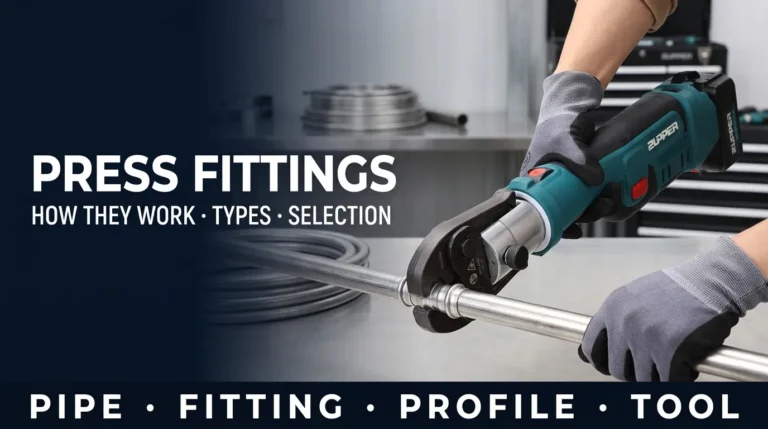
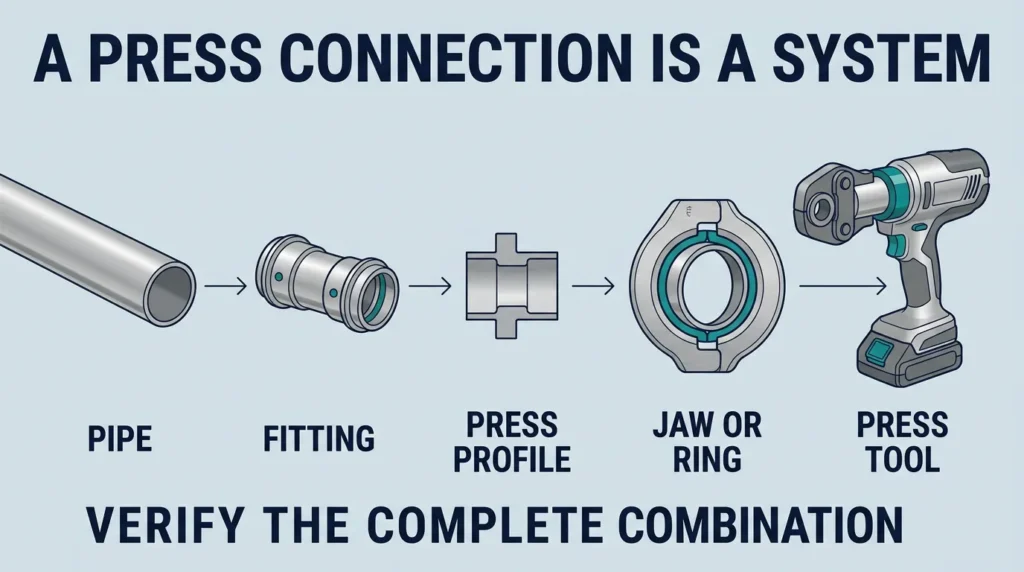
Press fittings create mechanical pipe connections by deforming a designed section of the fitting around a compatible pipe. They can reduce field welding and thread cutting, but the reliability of a pressed joint depends on far more than the fitting body alone. The pipe, fitting geometry, sealing structure, press profile, jaw or ring, press tool and installation procedure must be treated as one verified system.
This guide explains what press fittings are, how a press connection is formed, which components must be matched, the main stainless steel press-fitting product types, typical installation and inspection steps, and the details buyers should include in an RFQ.
It is a technical overview rather than a universal installation instruction. Always follow the approved system manual, applicable project specification, local code and verified compatibility information for the exact pipe, fitting, profile and tool combination.
What Are Press Fittings?
Press fittings are pipe fittings with connection ends designed to be mechanically compressed by an approved press tool and a matching jaw, ring or actuator. Depending on the system, a fitting may use a sealing element, a controlled metal deformation zone or a combination of features to form the joint.
The term press fitting usually refers to the fitting component, while press connection describes the completed joint. A press-fitting system includes all parts required to produce that joint, such as the pipe, fitting, seal where used, tool, jaw or ring, press profile, preparation method and inspection requirements.
Press fittings are available as couplings, elbows, tees, reducers, caps, threaded transitions and other configurations. Explore the broader range of stainless steel pipe fittings when comparing press-fit, threaded and welded connection families.
How Do Press Fittings Work?
A typical press connection begins with a correctly prepared pipe inserted into the fitting socket to the required depth. The approved jaw or ring is placed over the specified press zone. When the press cycle is completed, the fitting and, depending on the system design, the pipe are permanently deformed in a controlled geometry.
This deformation creates the mechanical retention required by the system and compresses the sealing structure where one is used. The resulting connection is normally treated as non-demountable: it should not be separated and reused as though it were a threaded union or compression joint.
The exact geometry is system-specific. Two fittings that appear similar from the outside may require different press profiles, jaw sizes, seal materials, insertion depths or preparation steps. For that reason, visual similarity is not proof of compatibility.
Main Components of a Press Connection
| Component | Primary Function | What Must Be Confirmed |
|---|---|---|
| Pipe or tube | Provides the mating surface and carries the service medium. | Material, outside diameter, wall thickness, dimensional tolerance and surface condition. |
| Fitting body | Joins pipe sections or changes direction, size or connection type. | Product family, material grade, size, geometry and intended service. |
| Sealing element | Supports sealing in systems that use an elastomeric or other designed seal. | Material, medium compatibility, temperature range, cleanliness and condition. |
| Press zone | Defines where the fitting is mechanically deformed. | Correct location, fitting orientation and approved profile. |
| Jaw or ring | Transfers the required press geometry to the fitting. | Model, size, profile, wear condition and compatible tool interface. |
| Press tool | Provides the energy and controlled cycle needed to close the jaw or ring. | Approved model, output, maintenance status, battery condition and cycle completion. |
| Installation procedure | Controls preparation, insertion, pressing and inspection. | Current manual, project specification, training and acceptance criteria. |
A fitting should not be evaluated independently from the rest of the system. A correctly manufactured fitting can still be installed incorrectly if the pipe is unsuitable, the insertion depth is not achieved, the wrong profile is selected or the tool does not complete the cycle.
Typical Press-Fitting Installation Sequence
The approved instructions for the actual product always take priority, but a general installation sequence often includes the following stages:
- Confirm the complete system combination. Verify the pipe, fitting family, size, seal, tool, jaw or ring, press profile and applicable instructions.
- Cut the pipe square. Use a suitable cutting method that does not significantly deform, overheat or contaminate the pipe end.
- Remove burrs and sharp edges. Internal and external burrs can interfere with insertion or damage a sealing element.
- Inspect and clean the pipe end. Remove chips, oil, dirt and foreign material. Reject pipe ends with unacceptable damage or distortion.
- Mark the required insertion depth. The mark helps verify that the pipe has remained fully inserted during positioning and pressing.
- Insert the pipe correctly. Avoid forcing the pipe through the seal or using unapproved lubricants.
- Position the approved jaw or ring. Place it squarely over the designated press zone rather than on the bare pipe or an adjacent fitting feature.
- Complete and verify the press cycle. Follow the tool indication, inspect the connection and record the work where traceability is required.
Pipe preparation is not a minor housekeeping step. A rough edge, oval pipe end, incomplete insertion or contaminated sealing surface can undermine an otherwise correct tool cycle.
Why Tool, Jaw, Ring and Profile Compatibility Matters
A press tool does not establish compatibility by force rating alone. The tool must operate the correct jaw or ring, and that accessory must reproduce the press profile intended for the exact fitting family and size.
| Compatibility Question | Why It Matters |
|---|---|
| Is the tool approved for the jaw or ring? | A similar mounting interface or force value does not prove that the combination closes correctly. |
| Is the jaw or ring the correct size? | Accessories are normally size-specific and must match the fitting designation. |
| Is the press profile correct? | Different profiles create different deformation geometry, even when the nominal pipe size is the same. |
| Does the profile match the fitting family? | The same profile name should not be assumed to make different manufacturers or product families interchangeable. |
| Is an actuator required? | Some ring systems require a separate actuator or intermediate component. |
| Has the complete combination been verified? | Compatibility should be supported by current manufacturer information or documented testing, not appearance alone. |
The safe principle is:
Pipe + fitting + sealing structure + press profile + jaw or ring + tool + installation procedure = one verified press system.
Do not assume that two 32 kN tools, two visually similar jaws or two fittings described with the same profile letter are automatically interchangeable. Tool maintenance also matters because worn pins, damaged jaws, contaminated moving parts or overdue service can affect cycle completion and press geometry.
Need Help Reviewing a Press-Fitting Application?
Send your pipe material, outside diameter, fitting type, service medium, design temperature and required standard. Nonleak can review the relevant product family and identify the compatibility details that still need confirmation.
Common Types of Stainless Steel Press Fittings
Press-fitting ranges can include many of the same functional shapes found in welded or threaded piping systems. The connection geometry, however, is specific to the press product family.
Couplings
Couplings connect two straight pipe sections. Buyers should confirm whether the coupling is equal or reducing, the pipe size, the press system and any stop or no-stop design feature.
Elbows
Elbows change pipeline direction, commonly through 45-degree or 90-degree configurations. Confirm the angle, end configuration, installation clearance and orientation of any threaded transition.
Equal and Reducing Tees
Tees create a branch connection. An equal tee uses the same nominal size for the run and branch, while a reducing tee changes one or more outlet sizes. A complete order should identify each connection size clearly.
Reducers
Reducers connect different pipe sizes. Confirm the direction of reduction and whether the design is a straight reducing coupling or part of another fitting configuration.
Pipe Caps
Caps terminate a pipe end. They should be selected as part of the same verified fitting system and installed with the specified insertion and pressing method.
Threaded Adapters, Elbows and Tees
Transition fittings combine a press end with a male or female threaded connection. The RFQ should state the press size, thread type, thread size, sealing method and material requirements.
Special and Crossover Fittings
Crossover fittings and other special geometries can simplify routing in selected layouts. Availability, dimensions and installation access should be confirmed against the actual project drawing.
Double Press, Threaded Press-Fit and Orbital Press Families
Nonleak organizes stainless steel press products into distinct families. They should be compared by verified system information rather than assumed to be interchangeable.
| Product Family | General Role | Buyer Should Confirm |
|---|---|---|
| Double Press Fittings | A stainless steel press-fitting family with its own fitting geometry and pressing requirements. | Size, pipe specification, approved profile, jaw or ring, sealing element and application. |
| Threaded Press-Fit Fittings | Transition products combining a press connection with a threaded end. | Press side, male or female thread, thread standard, size, sealing method and service conditions. |
| Orbital Press Fittings | A separate press-fitting family intended for defined system applications. | Approved application, pipe, fitting geometry, press equipment, size range and documentation. |
A product-family name does not replace a compatibility matrix. Confirm the exact tool, accessory, profile and size combination before publishing installation instructions or approving field use.
Press Fittings vs Welding, Threading and Compression
Press fittings are one of several ways to connect metal piping. No method is automatically best for every project.
| Connection Method | Main Characteristic | Important Project Considerations |
|---|---|---|
| Press fitting | Mechanically pressed, normally non-demountable system connection. | System compatibility, pipe preparation, tool access, pressing procedure and inspection. |
| Welding | Heat-based permanent joint. | Welding procedure, welder qualification, fire controls, purge where applicable, inspection and post-weld condition. |
| Threading | Mechanical connection using mating threads. | Thread standard, thread quality, sealing material, assembly practice and allowance for maintenance. |
| Compression connection | Mechanical sealing through compression components. | Component design, assembly method, pipe compatibility and service conditions. |
For a deeper comparison of installation, inspection and site-control differences, read press fittings vs welding. The existing guide to press fit piping systems also focuses on installation workflow and system-level benefits.
Where Press Fittings May Be Considered
Depending on the approved system, press fittings may be considered for building water services, HVAC and mechanical services, industrial utility piping, refurbishment projects and installations where field welding is restricted or undesirable.
Suitability must be confirmed for the actual medium, design temperature, pressure basis, external environment, cleaning procedure, code and approval requirements. A fitting used successfully in a water installation should not automatically be assumed suitable for gas, compressed air, process chemicals or another market.
Press technology can be especially useful where a repeatable installation sequence and reduced hot-work activity are project priorities. However, access for the tool and jaw must be considered during design. A fitting that fits physically between two walls may still be impossible to press if the head or ring cannot be positioned correctly.
Material, Seal and Service Conditions to Confirm
The words “stainless steel press fitting” are not a complete service specification. The selected product must be reviewed against the full set of operating and environmental conditions.
- Pipe and fitting material: Confirm grade, dimensions, wall thickness and compatibility with the specified product family.
- Service medium: Identify water quality, gas composition, compressed air, process fluid, additives and possible contamination.
- Design temperature: Include normal operation, cleaning, startup, shutdown and credible upset conditions.
- Pressure basis: State the project design pressure and applicable piping or plumbing requirements rather than relying on a generic catalogue figure.
- Sealing material: Where an elastomeric seal is used, confirm chemical and temperature compatibility.
- External environment: Consider moisture, chlorides, insulation, cleaning chemicals, indoor or outdoor exposure and contact with dissimilar materials.
- Approvals and code: Confirm the exact product, size, market and application covered by any declaration or listing.
IAPMO/ANSI/CAN Z1117-2022 is one example of a press-connection standard whose published scope includes specified copper, carbon steel and stainless steel pipe-and-fitting combinations, along with requirements for materials, physical characteristics, performance testing and markings. Referencing such a standard does not establish that a particular product is compliant; the exact product documentation must be checked.
Similarly, ASME B16.51 specifically addresses copper and copper-alloy press-connect pressure fittings for defined copper tube service. It should not be presented as a universal standard for stainless steel press fittings.
Inspection and Testing After Pressing
A completed press cycle should be followed by inspection appropriate to the system and project. Typical checks may include:
- Confirmation that the correct fitting and size were installed.
- Verification that the insertion-depth mark remains in the expected position.
- Visual confirmation that the fitting was pressed in the designated zone.
- Inspection for obvious pipe distortion, fitting damage or an incomplete cycle.
- Confirmation that the correct jaw, ring or actuator was used.
- Identification of any unpressed or partially pressed connections.
- System pressure or tightness testing under an approved procedure.
- Documentation of test boundaries, medium, acceptance criteria and results.
Do not invent a universal test pressure from the fitting catalogue alone. Test pressure, medium, duration, safety controls and acceptance criteria should come from the applicable system instructions, project specification and governing code.
Review Nonleak Quality Control and Technical Documentation resources when preparing inspection, traceability and submittal requirements.
Power-Tool Safety and Maintenance
A press tool creates a high-force pinch zone at the jaw or ring. Operators should keep hands away from moving components, use appropriate personal protective equipment, inspect the tool before use and follow the current manufacturer instructions.
The U.S. Occupational Safety and Health Administration states that hand and power tools should be maintained in a safe condition and highlights guarding and personal protective equipment requirements for applicable workplace hazards. See the official OSHA hand and power tool guidance for general safety background.
Maintenance requirements can include cleaning, lubrication, jaw inspection, pin inspection, battery checks, service-cycle review and calibration or output verification where specified. An overdue maintenance indicator should not be ignored, and damaged accessories should not be returned to service based only on a visual wipe-down.
Common Press-Fitting Installation Errors
| Installation Error | Potential Consequence | Prevention |
|---|---|---|
| Wrong jaw, ring or profile | Incorrect deformation, incomplete retention or sealing risk. | Verify the complete compatibility matrix before installation. |
| Pipe not inserted to the required depth | Insufficient engagement or incorrect seal position. | Mark insertion depth and confirm the mark before and after pressing. |
| Burrs or sharp pipe edges | Seal damage or difficult insertion. | Deburr and inspect the pipe end using the approved preparation method. |
| Jaw positioned on the wrong area | Distorted fitting or incomplete press geometry. | Place the accessory squarely over the designated press zone. |
| Dirty or damaged sealing surface | Potential leakage path. | Keep components clean and reject damaged parts. |
| Incomplete press cycle | Connection may appear assembled but remain unverified. | Check the tool indication and follow the system inspection procedure. |
| Mixing unverified system components | No supported basis for performance or approval. | Use only documented, verified combinations. |
What Buyers Should Include in a Press-Fitting RFQ
A useful RFQ should identify the complete connection requirement rather than listing only a fitting name.
| RFQ Item | Information to Provide |
|---|---|
| Fitting type | Coupling, elbow, tee, reducer, cap, adapter or special fitting. |
| Connection family | Double press, threaded press-fit transition, orbital press or another verified system. |
| Size | Outside diameter, DN or NPS as applicable to the product. |
| Pipe specification | Material grade, outside diameter, wall thickness and product standard. |
| Service medium | Water, air, gas or identified industrial fluid, including relevant additives. |
| Design conditions | Pressure basis, design temperature and cleaning conditions. |
| Tooling information | Tool, jaw, ring, actuator and profile where already specified. |
| Quantity | Required quantity for each fitting type and size. |
| Documentation | Datasheet, drawing, declaration, test report, material certificate or inspection record. |
| Project information | Country, application, code, drawings, BOM and required delivery schedule. |
Buyers should also identify exclusions. For example, state whether tools, jaws, replacement seals, spare parts, training or commissioning support are outside or inside the supply scope.
Frequently Asked Questions
What are press fittings?
Press fittings are pipe fittings designed to be mechanically compressed with an approved tool and matching jaw or ring. The fitting, pipe, press profile and tooling must be treated as one verified system.
How do press fittings work?
The pipe is prepared and inserted into the fitting, then an approved jaw or ring deforms the specified press zone. This creates the system’s designed mechanical retention and compresses the sealing structure where one is used.
Are press fittings suitable for stainless steel pipe?
Yes, dedicated stainless steel press-fitting systems are available. Suitability depends on the exact pipe dimensions, fitting family, material, service conditions, approvals and verified tooling combination.
Is a press fitting the same as a compression fitting?
No. A press fitting is deformed by a powered or manual press tool using a defined profile. A compression fitting uses its own mechanical compression components and assembly method.
Can any press tool be used with any press fitting?
No. Similar force values or jaw interfaces do not establish compatibility. Confirm the tool, jaw or ring, profile, size and fitting family as one approved combination.
What is a press profile?
A press profile is the defined geometry applied by the jaw or ring to the fitting. Different profiles are not automatically interchangeable, even when the nominal size is the same.
Do all press fittings use the same sealing element?
No. Seal material and geometry vary by system, and some connection designs differ substantially. Confirm the approved seal and its compatibility with the medium and temperature.
Can press fittings be used for gas piping?
Only when the exact product system, size, material, seal, tool and application are approved for the relevant gas service and market requirements. Do not extend a water-system approval to gas service.
How can an installer identify an unpressed joint?
Use the inspection method defined by the system manufacturer and project procedure. This may include insertion marks, visual checks, tool-cycle records, designed leak-detection features and system testing.
What information is needed when ordering press fittings?
Provide the fitting type, connection family, pipe material and dimensions, medium, design conditions, quantity, required standard, documentation and any specified tool or profile information.
Request Press-Fitting Product Support
Send your fitting list, pipe material and size, service medium, design temperature, quantity, required documentation and project drawings for product review and quotation.