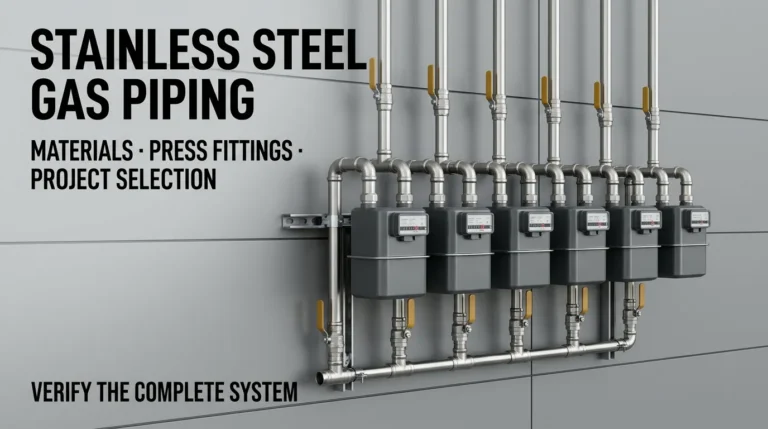
Gas piping is a safety-critical part of building and industrial infrastructure. The pipe material, joining method, fitting system, sealing components, supports, inspection plan and local code requirements must work together as one defined system. For stainless steel installations, press connections can offer a practical alternative to field welding or threaded joints, but only when the exact pipe, fitting, press profile, tooling and application have been verified for the intended gas service.
This guide explains how stainless steel gas piping systems are typically planned, where gas press fittings may fit into the system, which compatibility and approval details buyers should confirm, and what information should be included in a project RFQ. It is a selection and procurement guide, not a substitute for an approved design, local fuel-gas code, manufacturer instructions or qualified installation practice.
What Is Gas Piping?
Gas piping is the network of pipe, fittings, valves, supports and related components used to convey a fuel gas or other approved gaseous medium from a supply point to downstream equipment or distribution branches. Depending on the project and jurisdiction, the system may include service piping, building distribution piping, risers, branches, isolation points, appliance connections and testing or commissioning boundaries.
Unlike general water piping, gas service requires especially careful control of leakage risk, ignition risk, material compatibility, joint integrity, routing and inspection. The applicable requirements depend on the gas type, operating conditions, building use, local regulations and the specific piping system that has been approved for the project.
For a broader overview of available materials and products, see Nonleak stainless steel pipes and stainless steel pipe fittings.
Why Stainless Steel Is Considered for Gas Piping
Stainless steel is considered for selected gas piping projects because it combines corrosion resistance, relatively low maintenance requirements, clean external appearance and compatibility with multiple mechanical or welded connection methods. It can be particularly attractive where the piping is exposed, where corrosion control matters, or where project teams want a clean prefabricated or mechanically joined system.
However, “stainless steel” is not one universal gas-piping specification. Grade, wall thickness, pipe dimensions, manufacturing standard, surface condition and the approved connection system all matter. A project should not select a material grade based only on the assumption that one stainless grade is always suitable for every gas composition or environment.
External exposure also matters. Chlorides, coastal environments, cleaning chemicals, condensation, dissimilar-metal contact and concealed moisture can influence corrosion risk. Material selection therefore needs to consider both the internal service medium and the external installation environment.
Gas Piping Materials and Connection Methods
Gas distribution systems can use different piping materials and jointing technologies depending on the market, code and project design. The following table is a high-level comparison rather than an approval list.
| System Approach | Typical Connection Concept | Key Project Questions |
|---|---|---|
| Stainless steel press system | Pipe is inserted into a system-specific fitting and mechanically pressed with approved tooling. | Is the pipe, fitting, seal, profile, jaw or ring and tool combination approved for the gas service? |
| Threaded metallic piping | Threaded pipe and fittings are assembled with the specified thread form and sealing method. | What thread standard, sealing method, material and installation procedure apply? |
| Welded metallic piping | Pipe and fittings are permanently joined using a qualified welding process. | What welding procedure, welder qualification, inspection and site controls are required? |
| Other approved gas systems | May include market-specific tubing or proprietary connection systems. | Is the complete system listed or accepted by the applicable authority and project specification? |
No joining method is automatically best for every gas project. The correct choice depends on system approval, pipe size, installation access, labour capability, inspection requirements, environmental conditions, project schedule and lifecycle maintenance strategy.
Where Gas Press Fittings Fit Into a Gas Piping System
Gas press fittings are used as part of a complete press-connection system. Depending on the approved product family, the range may include couplings, elbows, tees, reducers, caps and threaded transition fittings. The fitting alone is not the system: the pipe dimensions, sealing structure, press geometry and tooling must all match.
Nonleak organizes its press-connected products into distinct families. The Orbital Press Fittings range is positioned for defined gas and industrial applications, while other press-fitting families have different geometries and installation requirements. Product-family names should not be treated as proof that tools, profiles or fittings are interchangeable.
For the general mechanics of a pressed joint, read the press fittings technical guide.
What Must Be Verified Before Selecting Gas Press Fittings?
Gas service raises the importance of compatibility and documentation. Before a product is specified or ordered, the buyer, designer and installer should confirm the complete system rather than reviewing the fitting body in isolation.
| Verification Item | Why It Matters |
|---|---|
| Gas type and service | The approved medium must match the actual project service. Natural gas, LPG and other gases should not be assumed to have identical requirements. |
| Pipe material and dimensions | The fitting system must match the specified pipe grade, outside diameter, wall thickness and dimensional tolerance. |
| Fitting family | Different press systems can use different socket, groove, seal and deformation geometry. |
| Sealing element | Where an elastomeric or other seal is used, its material and approved service conditions must match the application. |
| Press profile | The profile controls how the fitting is deformed. A similar-looking profile is not proof of interchangeability. |
| Jaw, ring or actuator | The accessory must match the fitting size, press profile and approved press tool. |
| Press tool | Tool force alone does not establish compatibility. The exact tool/accessory combination must be confirmed. |
| Approvals and local code | Acceptance can vary by market, gas service and jurisdiction. Verify current project and regulatory requirements. |
| Inspection and test plan | The completed installation must be inspected, tested and documented according to the applicable procedure. |
A useful rule is: pipe + fitting + seal or sealing structure + press profile + jaw or ring + tool + installation procedure + applicable approval = one defined gas press system.
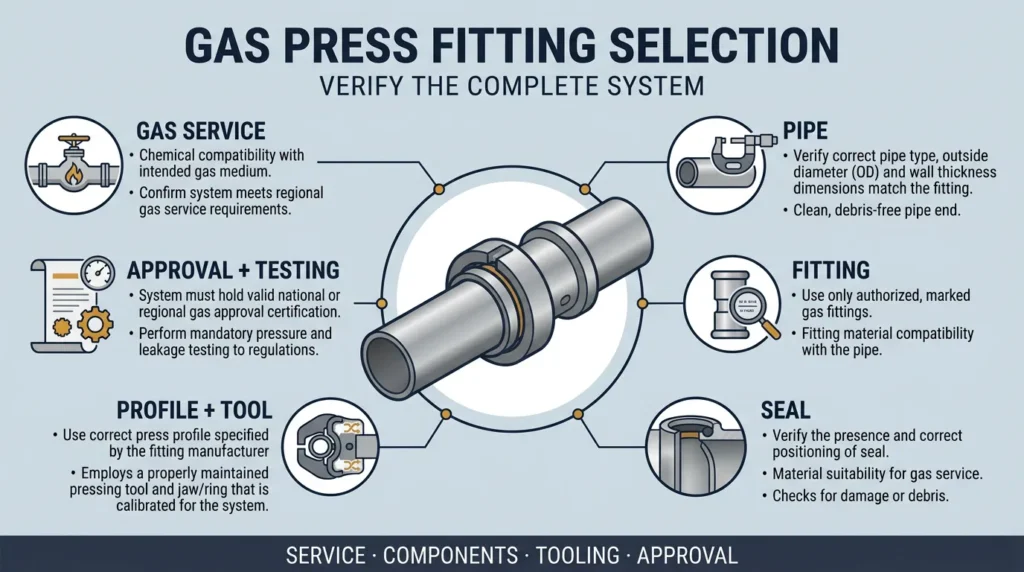
Need Help Reviewing a Gas Piping Application?
Send your gas type, pipe material, outside diameter, fitting family, design conditions, target market and required standard or approval. Nonleak can review the relevant stainless steel pipe and fitting options and identify the compatibility details that still need confirmation.
Stainless Steel Gas Piping System Components
A complete stainless steel gas piping package normally requires more than straight pipe and a few elbows. Project teams should review the whole bill of materials and the transitions between components.
- Straight pipe or tube: confirm grade, dimensions, wall thickness, manufacturing standard and required documentation.
- Couplings: identify equal or reducing configurations and the exact connection family.
- Elbows: confirm angle, size and installation clearance.
- Tees: state run and branch sizes clearly, especially for reducing tees.
- Reducers: identify the required inlet and outlet sizes and system geometry.
- Threaded transitions: confirm press-side size, male or female thread, thread standard and sealing method.
- Isolation and accessory interfaces: verify how valves, equipment and other system components connect to the stainless steel piping.
- Supports: define spacing, load, movement, isolation from dissimilar materials and access for inspection.
- Identification: follow project and local requirements for gas-service marking and traceability.
The commercial benefit of reviewing the system as a package is that the RFQ becomes more complete. It also reduces the risk of ordering a correct fitting size but an incorrect connection family, thread form, press profile or accessory.
Press-Fit vs Threaded vs Welded Gas Piping
The best connection method depends on the project. The comparison below focuses on decision factors rather than making a universal performance ranking.
| Factor | Press Connection | Threaded Connection | Welded Connection |
|---|---|---|---|
| Field heat | Mechanical pressing normally avoids a field welding arc or flame at the joint. | Thread assembly does not require welding at the connection. | Requires an approved welding process and related hot-work controls where applicable. |
| Installation equipment | Requires verified press tool, jaw/ring and profile. | Requires threading and assembly tools appropriate to the pipe system. | Requires welding equipment and qualified welding personnel. |
| Compatibility control | High: the complete pipe/fitting/tooling system must match. | High: thread form, material and sealing method must match. | High: material, joint preparation, filler and welding procedure must match. |
| Inspection focus | Pipe preparation, insertion, press position, completed cycle and system testing. | Thread condition, engagement, sealant application, alignment and testing. | Joint preparation, weld quality, required NDE and system testing. |
| Site suitability | Useful where approved pressing access is available and hot work is undesirable. | Useful where the specified threaded system and access are practical. | Common where welded construction is specified and welding controls are available. |
For a more general connection-method comparison, see press fittings vs welding.
Design and Layout Factors for Gas Piping
Connection selection is only one part of gas piping design. The routing and support strategy can influence installation quality, inspection access and long-term maintainability.
Routing and Accessibility
Allow enough space for the selected press jaw, ring or welding equipment where applicable. A fitting may be theoretically compatible but difficult to install correctly if the tool cannot be positioned squarely around the joint.
Supports and Movement
Pipe supports should control the piping without creating unnecessary local stress, abrasion or dissimilar-metal contact. Thermal movement, vibration and equipment connections should be considered in the system design rather than addressed only after installation.
External Corrosion Environment
Stainless steel is corrosion resistant, but it is not immune to localized attack. Moisture retention, chlorides, deposits, aggressive cleaning chemicals and crevices around supports or insulation can increase risk. Material grade and detailing should reflect the actual environment.
Access for Inspection
Critical joints, valves and transitions should remain accessible where inspection or maintenance is required. Concealment rules vary by code and system, so the project specification and local authority requirements should be checked before construction.
Installation Quality Checks for Press-Connected Gas Piping
The exact manufacturer instructions govern the installation, but several quality-control themes are common to press-connection systems:
- Verify the system before installation. Confirm the pipe, fitting, size, seal, profile, tool and accessory combination.
- Cut the pipe correctly. The pipe end should be square and free from unacceptable deformation.
- Remove burrs and sharp edges. Poor preparation can interfere with insertion or damage a sealing component.
- Inspect and clean the pipe end. Remove chips, dirt and contamination that could affect assembly.
- Control insertion depth. Use the system procedure to verify that the pipe remains fully inserted.
- Position the jaw or ring correctly. It must align with the designated press zone, not the bare pipe or an adjacent feature.
- Complete the press cycle. Follow the tool and system indication for a completed cycle.
- Inspect the finished joint. Check alignment, insertion, visible damage and any system-specific inspection features.
These are general quality themes only. They do not replace product-specific instructions, installer qualification requirements or project acceptance criteria.
Inspection, Testing and Commissioning
A gas piping system should not be placed into service simply because the fittings appear correctly installed. Inspection, strength or tightness testing, leak checking, purging and commissioning requirements can differ significantly by jurisdiction and system type.
For U.S. projects, the current adopted fuel-gas code and local amendments should be checked. NFPA publishes the National Fuel Gas Code, NFPA 54, with sections covering gas piping system design, materials and components, pipe sizing, installation, and inspection/testing/purging. The edition adopted by the authority having jurisdiction may differ from the latest published edition.
For press-connection product requirements, IAPMO/ANSI/CAN Z1117 covers press connections made with several metallic pipe/fitting combinations, including stainless steel press connections, and addresses materials, physical characteristics, performance testing and markings. A standard covering press connections does not by itself prove that every product is approved for every gas service; the project must still verify the exact listing, intended use and local acceptance.
Nonleak also maintains a Testing & Acceptance resource. Project-specific test pressures, media, durations and acceptance criteria should come from the applicable code, approved design and system instructions rather than a generic rule copied from another project.
Codes, Standards and Market Approvals
Gas-system acceptance is market-specific. Buyers should ask for current documents that match the exact model or product family being supplied. Useful questions include:
- Which fuel-gas code or national standard applies to the project?
- Is the press-fitting system listed, certified or otherwise accepted for the intended gas service in the target market?
- Does the approval cover the exact material, size range and connection family being ordered?
- Does the declaration or certificate identify the correct manufacturer and product?
- Are the pipe, fitting, seal and tooling requirements included in the approved system documentation?
- Are there exclusions for specific gases, temperatures, pressures, locations or installation methods?
Official references for project teams include NFPA 54 National Fuel Gas Code information and the IAPMO press-connection standards page.
Documentation Buyers Should Request
For B2B gas piping procurement, documentation can be as important as the fitting itself. The required package depends on the project, but buyers may need:
- pipe and fitting technical datasheets;
- material grade and dimensional information;
- product drawings;
- current installation instructions;
- tool, jaw/ring and press-profile compatibility information;
- applicable declarations, certificates or listings;
- material inspection or traceability documents where specified;
- batch identification;
- test or inspection records;
- packing list and product markings;
- spare seals or installation accessories where applicable.
Nonleak Technical Documentation and Quality Control pages can be used alongside the project-specific submittal package.
Gas Piping Project Example and System Selection
Real project requirements often combine system design, material selection, connection method and installation logistics. Nonleak has documented a commercial gas distribution application at Colourful Yunnan No.1 City. Project pages are useful because they show how a piping system is selected for an actual building context rather than presenting a fitting in isolation.
See the stainless steel gas distribution project and the broader piping project portfolio for application context.
Gas Piping RFQ Checklist
A complete RFQ helps the supplier review product suitability and reduces back-and-forth during quotation. Include as much of the following information as the project has already defined:
| RFQ Item | Information to Provide |
|---|---|
| Project location | Country, region and project type. |
| Gas service | Gas type and any relevant composition or service classification. |
| Pipe specification | Material grade, outside diameter or nominal size, wall thickness and standard. |
| Connection method | Press, threaded, welded or project-specified combination. |
| Press-fitting family | Required product family or approved system reference. |
| Design conditions | Design pressure and temperature basis from the approved project specification. |
| Fitting schedule | Couplings, elbows, tees, reducers, transitions and quantities by size. |
| Tooling information | Specified tool, jaw/ring, actuator and profile if already selected. |
| Approval requirements | Target code, certification, listing or authority requirements. |
| Inspection documents | Datasheets, drawings, material documents, traceability and test records required. |
| Drawings | Piping layout, isometrics, BOM or fitting schedule where available. |
| Quantity and delivery | Required quantities, packaging expectations and requested delivery window. |
Frequently Asked Questions About Gas Piping and Press Fittings
Can stainless steel be used for gas piping?
Stainless steel can be used in approved gas piping systems, but suitability depends on the pipe specification, connection system, gas service, design conditions and local code or approval requirements. Do not assume that every stainless steel pipe or fitting is automatically accepted for fuel-gas service.
What are gas press fittings?
Gas press fittings are fittings that form part of a press-connected piping system intended and approved for defined gas applications. The pipe, fitting, sealing structure, press profile and tooling must be treated as one system.
Are all press fittings suitable for gas?
No. A press fitting designed for one service should not be assumed suitable for gas. Verify the manufacturer’s intended use, exact product documentation and the requirements of the applicable authority or project specification.
Can the same press tool be used for different gas fitting systems?
Only when the exact tool, jaw or ring, actuator, profile and fitting combination has been approved or otherwise verified. Similar tool force or a similar jaw interface does not prove compatibility.
Does a gas press fitting need a special seal?
Some press systems use elastomeric sealing elements and others use different sealing structures. Where a seal is used, its material and approved service conditions must match the gas application. Do not select a seal only by color or appearance.
Are press fittings better than welded gas piping?
Neither method is universally better. Press systems can reduce field hot work and speed repetitive installation, while welded systems may be preferred or required in other projects. The decision should follow code, project specification, system approval, access, installer capability and inspection requirements.
What should be checked after a gas press fitting is installed?
General checks include pipe insertion, alignment, correct press position, completed tool cycle, visible damage and system-specific inspection features. The completed piping must then follow the required project inspection and testing procedure.
Can gas piping be tested using one universal pressure?
No. Test pressure, medium, duration, isolation and acceptance criteria depend on the applicable code, design pressure, system type and jurisdiction. Use the approved project procedure rather than a universal value.
What information should be provided when ordering gas press fittings?
Provide the gas service, project location, pipe material and size, fitting family, design conditions, required approval or standard, fitting quantities, tooling information where specified, and project drawings or BOM where available.
How can a supplier help during gas piping selection?
A supplier can review the requested pipe and fitting family, identify missing compatibility data, prepare product documents and clarify which details require project or authority confirmation. Final design and installation acceptance remain subject to the qualified project team and applicable requirements.
Request Gas Piping Product Support
Send your gas type, project location, pipe material and size, fitting list, design conditions, required standard or approval, quantities and drawings. Nonleak can review the relevant stainless steel piping and press-fitting options and prepare a project quotation based on the information provided.