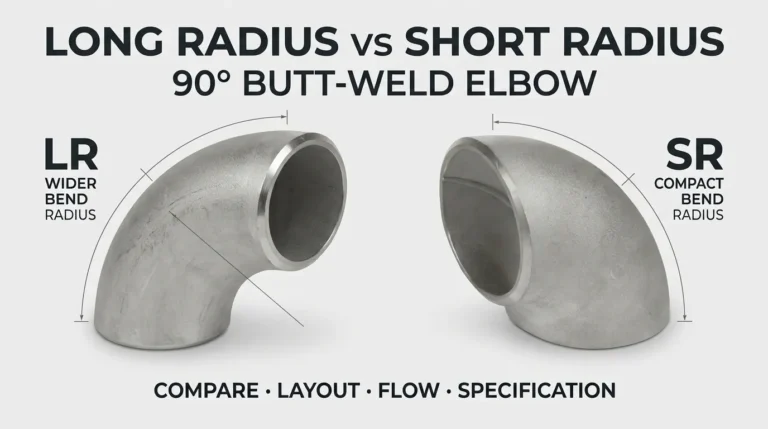
Choosing between a long radius vs short radius elbow is not simply a matter of selecting the fitting that looks smoother or takes up less space. The elbow radius affects piping layout, center-to-end dimensions, direction change, local flow behavior and the space needed around a welded joint.
For stainless steel butt-weld systems, the correct choice should also match the required fitting standard, nominal pipe size, wall thickness, material, design conditions and approved project drawings.
This guide explains the practical differences between long radius (LR) and short radius (SR) elbows, when each configuration may be appropriate, how ASME B16.9 fits into the specification, and what buyers should confirm before requesting a quotation.
Long Radius vs Short Radius Elbow: Quick Comparison
| Selection Factor | Long Radius Elbow | Short Radius Elbow |
|---|---|---|
| Common abbreviation | LR | SR |
| Common geometry description | Approximately 1.5D | Approximately 1D |
| Direction change | More gradual | Tighter |
| Installation footprint | Larger | More compact |
| Local flow disturbance | Generally lower under comparable conditions | Generally higher under comparable conditions |
| Typical selection driver | Flow path, standard routing and available space | Compact routing where space is limited |
| Dimensional reference when specified | ASME B16.9 | ASME B16.9 |
The 1.5D and 1D descriptions are useful engineering shorthand, but they should not replace the actual dimensional table required by the project. Exact center-to-end dimensions should be checked against the applicable standard and ordered fitting size rather than calculated from a simple multiplier for every NPS.
What Is a Long Radius Elbow?
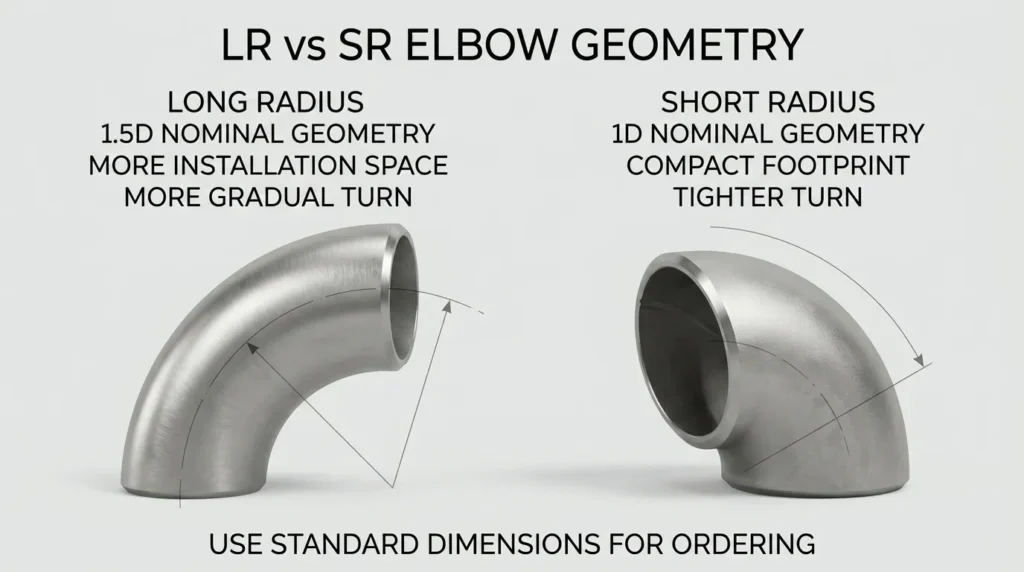
A long radius elbow uses a larger centerline bend radius to change the direction of a pipeline more gradually. In butt-weld piping terminology, LR elbows are commonly described using a nominal 1.5D geometry.
The larger radius requires more room for the turn. However, it also produces a smoother directional change than a tighter-radius elbow under otherwise comparable conditions.
Nonleak’s stainless steel butt-weld elbow range includes 90° long-radius and 45° long-radius configurations, as well as a 90° short-radius option for layouts with different space requirements.
What Is a Short Radius Elbow?
A short radius elbow changes pipe direction within a tighter footprint. SR elbows are commonly described using a nominal 1D geometry.
Compared with an LR elbow of the same nominal size and turning angle, the tighter geometry reduces the space needed around the directional change. This can be useful where equipment, structural steel, adjacent piping or existing site conditions restrict the installation envelope.
However, selecting SR only because it is smaller can create other design questions. The tighter turn changes the local flow path more abruptly, so the complete hydraulic or process requirement should be reviewed instead of treating space as the only decision factor.
Does 1.5D or 1D Mean the Actual Pipe Outside Diameter?
Not necessarily. The terms 1.5D long radius and 1D short radius are commonly used to describe elbow geometry, but they should not be interpreted as permission to multiply the measured pipe outside diameter by 1.5 or 1.0 and use that result as the final purchasing dimension.
NPS and actual pipe outside diameter are not the same thing across all pipe sizes, and standardized elbow dimensions are tabulated. For procurement, fabrication and dimensional inspection, use the actual center-to-end dimension specified for the required NPS, angle and standard edition.
If your project specifies ASME fittings, review the applicable ASME B16.9 butt-weld fitting requirements rather than creating purchasing dimensions from a simplified radius formula.
How Does Bend Radius Affect Piping Layout?
The clearest practical difference between LR and SR elbows is the amount of space required to complete the turn.
Long Radius Elbow Layout
An LR elbow extends farther from the intersection point of the two pipe centerlines. Designers therefore need sufficient room for the larger sweep, field fit-up, weld access, insulation where applicable and nearby piping or structural components.
The additional footprint is usually easier to accommodate in open process piping, pipe racks and plant layouts where the routing can be planned around standard elbow geometry.
Short Radius Elbow Layout
An SR elbow brings the outlet centerline closer to the direction-change point. This shorter footprint can help where routing space is constrained.
Examples may include compact equipment assemblies, retrofit work, tightly grouped utility lines or areas where another component limits the available center-to-end distance.
Physical fit alone does not confirm that SR is the correct engineering choice. Flow behavior, stress, welding access, maintenance clearance and the governing piping specification still need to be reviewed.
Does a Long Radius Elbow Have Lower Pressure Loss?
Under otherwise comparable conditions, a more gradual bend generally produces less severe local flow disturbance than a tighter bend. For that reason, LR elbows are often considered where pressure-loss control and smoother direction changes are important.
However, it is not good engineering practice to assign one universal pressure-loss value to every LR or SR elbow. Actual system pressure loss depends on factors such as:
- pipe inside diameter;
- flow rate and velocity;
- fluid properties;
- elbow geometry;
- surface condition;
- upstream and downstream fittings;
- valves and equipment;
- flow regime; and
- the complete piping layout.
Therefore, the statement that an LR elbow generally creates a more gradual flow path is useful as a comparison, but it should not replace an engineering pressure-drop calculation for the actual system.
Is a Short Radius Elbow Lower Pressure Rated?
Not simply because it has a shorter radius. Radius type and pressure capability are different specification questions.
The allowable conditions for a piping component depend on the applicable fitting standard, material, wall thickness, temperature, piping code, manufacturing requirements, welding and the complete system design.
It would therefore be misleading to classify SR elbows as “low-pressure fittings” or LR elbows as automatically suitable for higher pressure solely because of bend radius.
90° LR vs 90° SR Elbow
The difference is easiest to see in a 90-degree direction change. A 90° LR elbow uses a wider sweep between the inlet and outlet centerlines, while a 90° SR elbow creates the same nominal direction change within a tighter space.
Nonleak’s current butt-weld elbow product range includes both 90° LR and 90° SR elbows, allowing buyers to select geometry according to the project layout.
Before substituting one for the other, compare the center-to-end dimension carefully. Replacing an LR elbow with an SR elbow, or vice versa, changes the pipe centerline position and can affect spool dimensions, weld locations and equipment alignment.
What About 45° Elbows?
A 45-degree elbow changes the piping direction by a smaller angle and is frequently used for offsets, gradual routing changes and combinations of fittings.
Nonleak’s butt-weld elbow range also lists a 45° long-radius elbow. When a project drawing calls for a 45-degree fitting, do not assume that the 90-degree LR/SR dimensional relationship can simply be transferred to the 45-degree elbow. Use the actual standard dimensions and fitting designation required by the drawing.
ASME B16.9 and LR/SR Butt-Weld Elbows
ASME B16.9 is an important product and dimensional standard for factory-made wrought butt-welding fittings. It covers overall dimensions, tolerances, ratings, testing and markings for fittings within its scope, and the current ASME scope includes short-radius elbows and returns.
This makes ASME B16.9 an important reference when specifying either long-radius or short-radius wrought butt-weld elbows for projects using that standard.
However, an ASME B16.9 reference does not by itself provide the complete stainless steel elbow specification. The buyer still needs to identify the required:
- elbow angle;
- LR or SR configuration;
- nominal pipe size;
- wall thickness or Schedule;
- material specification and grade;
- weld-end requirement;
- project design conditions;
- inspection and documentation requirements; and
- applicable standard edition.
For the broader standard scope and ordering responsibilities, see our ASME B16.9 butt-weld fittings guide. For the full available product family, explore stainless steel butt-weld fittings.
Does LR or SR Change the Material Requirement?
No. The radius designation does not tell the supplier which stainless steel grade is required. A project may require 304L, 316L, duplex stainless steel or another material according to corrosion conditions, service medium, temperature, mechanical requirements and the applicable material specification.
Likewise, LR or SR does not define pipe wall thickness. The fitting wall requirement needs to match the piping specification and the connected stainless steel pipe system.
For this reason, an RFQ such as “4-inch LR stainless elbow” is still incomplete. Material, wall thickness, fitting standard and project conditions must also be stated.
Need Help Comparing LR and SR Elbows?
Send Nonleak the elbow angle, LR/SR requirement, NPS or DN, wall thickness or Schedule, material grade, applicable standard, design conditions and quantity. A piping drawing or fitting schedule can also help us review the required center-to-end dimensions and configuration.
When Should You Consider a Long Radius Elbow?
An LR elbow is usually worth considering when the system has enough space for the wider sweep and the design benefits from a more gradual directional change.
Typical decision conditions may include:
- standard process-piping layouts;
- pipe racks with sufficient routing space;
- systems where local pressure loss is being controlled;
- higher-flow lines where the direction change needs hydraulic review;
- layouts where the project specification already calls for LR fittings; and
- spools designed around standard long-radius center-to-end dimensions.
This does not mean LR is automatically the correct choice for every service. The approved project piping specification remains the controlling document.
When Should You Consider a Short Radius Elbow?
An SR elbow may be useful when the installation envelope cannot accommodate the larger LR geometry.
Potential selection conditions include:
- tight equipment layouts;
- retrofit piping with fixed connection points;
- limited clearance between piping and structures;
- compact skids or utility assemblies; and
- locations where the engineering specification specifically permits or requires SR geometry.
Before selecting SR for space savings, confirm that the tighter bend is acceptable for the actual fluid, velocity, pressure-loss calculation and piping design.
Long Radius vs Short Radius Elbow: Selection Checklist
| Question | Why It Matters |
|---|---|
| What angle is required? | 90°, 45° and return configurations have different dimensions and functions. |
| Does the drawing specify LR or SR? | The radius changes center-to-end dimensions and spool geometry. |
| How much installation space is available? | SR requires a smaller footprint than LR. |
| Is pressure loss important? | Radius affects local flow behavior, but the actual system must be calculated. |
| What NPS or DN is required? | Standard dimensions depend on the nominal fitting size. |
| What wall thickness or Schedule is required? | The fitting must match the project piping specification. |
| What stainless steel grade is specified? | Radius does not define material. |
| Which fitting standard applies? | ASME B16.9 or another project standard may control the fitting geometry. |
| What documents are required? | MTRs, dimensional reports and inspection documents should be defined before ordering. |
Common LR and SR Elbow Specification Mistakes
Choosing SR Only Because It Is Smaller
A compact layout is an important advantage, but it is not the only selection criterion. The complete flow and piping design still need review.
Assuming LR Is Always Better
LR provides a more gradual directional change, but its larger footprint may conflict with equipment layout or fixed connection points. Engineering selection should balance geometry and system requirements.
Treating 1.5D and 1D as Universal Dimensional Formulas
The designations are useful descriptions of elbow geometry. For fabrication and procurement, use the actual standardized center-to-end dimensions for the ordered fitting rather than calculating every size from a simple multiplier.
Forgetting Wall Thickness
An elbow cannot be fully specified by angle, radius and NPS alone. The wall requirement must match the piping specification.
Confusing Butt-Weld Elbows with Other Connection Types
Press-fit, threaded, socket-weld and butt-weld elbows use different connection structures. If your project is comparing welded connection methods, review our Butt Weld vs Socket Weld guide.
Assuming Radius Determines Pressure Rating
LR and SR describe geometry. They do not replace the material specification, piping code, wall requirement or design pressure and temperature.
Inspection Points for Butt-Weld Elbows
Before shipment, the inspection plan should match the purchase specification rather than rely only on a visual check.
Typical items may include:
- material identification and traceability;
- outside diameter at the weld end;
- center-to-end dimensions;
- elbow angle;
- wall thickness;
- LR or SR geometry;
- weld-end preparation;
- surface condition;
- marking; and
- project-required inspection or testing documentation.
Nonleak’s Quality Control section provides background on current inspection and documentation capabilities. For general system testing and final checks, see Testing & Acceptance. Final acceptance requirements should always follow the actual purchase order, applicable code and project specification.
What Information Should Be Included in an Elbow RFQ?
A complete RFQ reduces the risk of receiving the correct material but the wrong elbow geometry.
For each elbow item, provide:
- Angle: such as 90° or 45°.
- Radius type: LR or SR.
- Nominal size: NPS or DN.
- Wall thickness: Schedule or specified wall.
- Material: specification and grade.
- Dimensional standard: for example ASME B16.9 where applicable.
- Standard edition: if contractually specified.
- Service medium: where relevant to material and engineering review.
- Design pressure and temperature: according to project documents.
- Quantity: for each size and configuration.
- Inspection documents: MTR, dimensional reports, PMI, NDE or other required records.
- Drawings: when layout, center-to-end or special geometry requires confirmation.
For additional installation and dimensional resources, review Technical Documentation. You can also browse the complete stainless steel butt-weld fittings range for elbows, tees, reducers, caps, return bends and related welded components.
Long Radius vs Short Radius Elbow FAQ
What is the main difference between a long radius and short radius elbow?
The main difference is bend geometry. An LR elbow makes a more gradual directional change and requires more installation space, while an SR elbow makes a tighter turn within a smaller footprint.
What does 1.5D mean for a long radius elbow?
1.5D is commonly used as shorthand for long-radius elbow geometry. Buyers and fabricators should still use the actual dimensional table required by the applicable fitting standard rather than calculating every center-to-end dimension directly from the shorthand.
What does 1D mean for a short radius elbow?
1D describes the tighter nominal geometry associated with a short-radius elbow. Exact ordered dimensions should still be checked against the relevant standard and fitting size.
Does a long radius elbow have less pressure loss?
Under otherwise comparable conditions, the more gradual LR geometry generally creates less severe local flow disturbance than an SR elbow. Actual pressure loss still depends on fluid properties, velocity, pipe dimensions and the complete piping system.
Is a short radius elbow only for low-pressure piping?
No. Radius alone does not establish the allowable pressure of the fitting or piping system. Material, wall thickness, temperature, fitting standard, welding and the governing piping code must also be considered.
Are short radius elbows covered by ASME B16.9?
Yes. The current ASME scope for B16.9 includes short-radius elbows and returns within the standard for factory-made wrought butt-welding fittings.
Can I replace an LR elbow with an SR elbow without changing the piping?
Not automatically. The center-to-end dimension changes, so replacing one radius type with another may move the pipe centerline, weld location and downstream connection point. The drawing and spool dimensions should be checked first.
Are LR and SR available in the same stainless steel materials?
Radius type does not itself define stainless steel grade. Material should be selected separately according to the piping specification and project requirements.
What information should I send for a stainless steel elbow quotation?
Provide the elbow angle, LR or SR type, NPS/DN, wall thickness or Schedule, material specification and grade, dimensional standard, quantities, service conditions, documentation requirements and drawings where applicable.
Request Stainless Steel Butt-Weld Elbow Support
If your project requires long-radius or short-radius stainless steel elbows, send the complete fitting schedule instead of only an elbow size.
Include the angle, LR/SR configuration, NPS or DN, wall thickness, material, applicable standard, quantities, project conditions and required inspection documents. This allows the fitting geometry and specification to be reviewed before quotation.
Need LR or SR Butt-Weld Elbows?
Send your elbow schedule, sizes, wall thickness, material, standard and quantities for technical review and quotation.
Official Standard References
For authoritative requirements covering factory-made wrought butt-welding fittings, refer to the ASME B16.9 official page. For butt-welding end preparation, see the ASME B16.25 official page.
Use the edition required by the actual contract, piping code and approved project specification when purchasing or fabricating fittings.