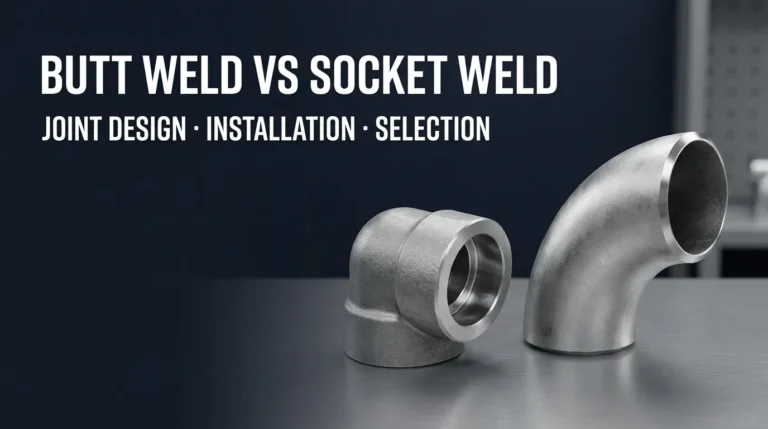
Choosing between butt weld vs socket weld connections is not simply a question of which joint is stronger. The correct choice depends on pipe size, fitting construction, internal flow requirements, welding access, inspection methods, service conditions and the piping code used for the project. Both methods can provide reliable stainless steel pipe connections when the fittings, pipe, welding procedure and inspection plan are correctly matched.
This guide explains how butt-weld and socket-weld fittings differ, where each method is commonly used and what buyers should confirm before requesting a quotation or approving a piping specification.
Butt Weld vs Socket Weld: Quick Comparison
| Comparison Point | Butt Weld | Socket Weld |
|---|---|---|
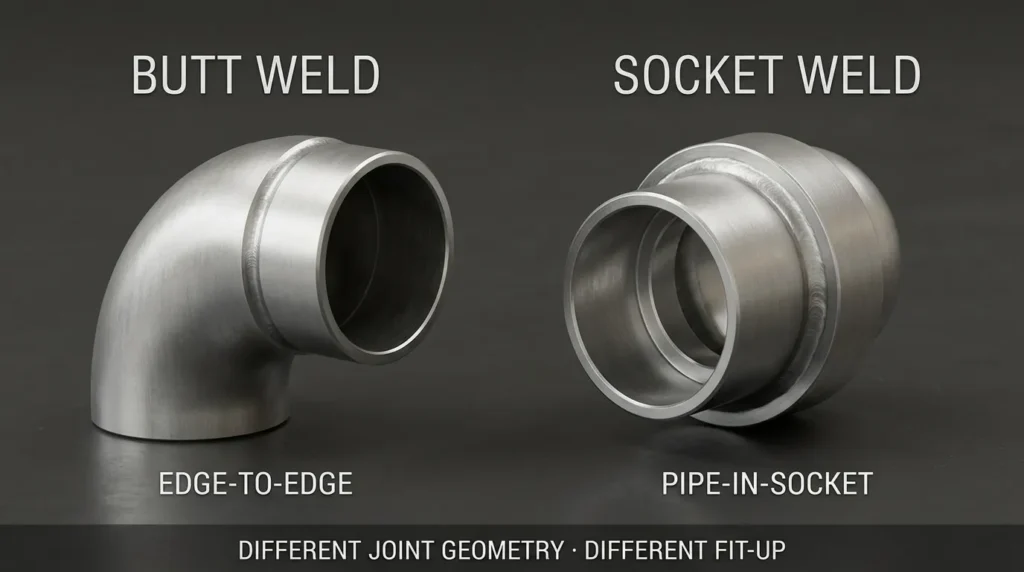
| Joint structure | Pipe and fitting ends are aligned edge-to-edge and joined with a groove weld. | The pipe is inserted into a recessed socket and joined with an external fillet weld. |
| Typical fitting standard | ASME B16.9 for factory-made wrought butt-welding fittings. | ASME B16.11 for forged socket-welding and threaded fittings. |
| Typical fitting construction | Wrought, formed or fabricated fitting, depending on product and specification. | Usually a compact forged fitting in ASME-style pressure piping systems. |
| Internal flow path | Can provide a smooth, nearly continuous bore when pipe and fitting dimensions are correctly matched. | Includes a socket shoulder and an internal pipe-end gap that must follow the applicable installation requirement. |
| Fit-up | Requires accurate bevel preparation, root opening and alignment. | The socket helps position the pipe, but insertion depth and clearance still require control. |
| Common selection direction | Frequently used for process piping, larger sizes and services where bore continuity or detailed weld inspection is important. | Frequently used for smaller-bore piping, compact layouts and forged fitting systems specified by the project. |
| Inspection planning | Can accommodate surface and, when specified, volumetric examination methods. | Inspection is commonly focused on the external fillet weld using visual and suitable surface methods. |
Neither column is a universal rule. The final selection must follow the design code, material specification, pressure and temperature conditions, corrosion risk, cyclic loading, welding procedure and owner requirements.
What Is a Butt-Weld Connection?
A butt-weld connection joins the prepared end of a pipe directly to the prepared end of a fitting. The two ends are aligned, a root gap is established when required, and the joint is completed using a qualified groove-welding procedure. After proper welding and finishing, the connection can form a continuous metallic path through the pipeline.
The joint geometry is only one part of weld control. For project fabrication, the production weld should also follow an applicable qualified procedure. See our WPS for butt weld pipe guide for the relationship between the WPS, PQR, welder qualification and project review.
Factory-made wrought butt-weld fittings commonly include elbows, tees, reducers, crosses, caps, return bends and stub ends. Their dimensions and tolerances may be specified under ASME B16.9, while stainless steel material requirements may be addressed by a separate material specification. This separation is important: a dimensional standard does not, by itself, define the complete material grade, pipe schedule, welding procedure or system design.
Because the fitting end is matched to the pipe outside diameter and wall thickness, buyers should confirm the nominal size, schedule or wall thickness, material grade, construction type and end preparation before ordering. For additional standard responsibilities and RFQ checks, review the ASME B16.9 butt-weld fittings guide.
What Are Socket Weld Pipe Fittings?
Socket weld pipe fittings contain a recessed socket that receives the pipe end. The installer inserts the pipe to the required position, provides the specified clearance from the socket bottom and completes an external fillet weld around the fitting hub. The socket geometry helps locate the pipe during assembly, which can simplify alignment in compact small-bore piping layouts.
Under ASME B16.11, socket-welding fittings are forged products with defined ratings, dimensions, tolerances, marking and material requirements. Common fitting types include elbows, tees, couplings, half couplings, crosses, caps and unions, depending on the applicable product range and project specification.
The words “socket weld” describe the connection geometry, not a complete purchasing specification. A buyer still needs to define the fitting type, nominal pipe size, class, material, pipe schedule, applicable standard edition, service medium and required inspection documents.
How the Joint Geometry Affects Flow and Service
One of the clearest differences between the two methods is the internal flow path. A correctly aligned butt-weld joint can produce a relatively smooth transition between the pipe and fitting. This may be useful where the project prioritizes bore continuity, cleaning, drainage or reduced internal discontinuities.
A socket-weld joint has a pipe end positioned inside the fitting socket. The required clearance at the socket bottom accommodates assembly and thermal effects, but it also creates an internal geometric discontinuity. In services where crevice retention, deposit buildup, cleanliness or localized corrosion is a concern, the system designer should evaluate whether that geometry is acceptable.
This does not mean that socket weld fittings are automatically unsuitable for corrosive or high-pressure service. It means that joint geometry, material grade, fluid chemistry, temperature, cleaning method and operating cycle must be assessed together rather than judging the connection by name alone.
Fit-Up, Welding and Installation Differences
Butt-Weld Fit-Up
Butt-weld installation normally requires controlled end preparation and alignment. The installer must verify bevel geometry, root opening, wall-thickness matching, internal misalignment and tack-weld condition before completing the weld. Skilled fit-up is especially important when joining thin-wall stainless steel or components with different nominal wall thicknesses.
Socket-Weld Fit-Up
Socket-weld assembly can be more compact because the pipe is positioned inside the fitting. However, the pipe should not simply be forced hard against the socket bottom and welded without following the applicable procedure. Insertion position, clearance, cleanliness and fillet-weld size all need to match the project specification and qualified welding procedure.
Both methods involve hot work. Welding planning should therefore include ventilation, fire prevention, suitable personal protective equipment, surface cleanliness and controls for stainless steel welding fumes. The OSHA welding safety resources provide additional hazard-control guidance. Installation speed should never replace the approved welding and safety procedure.
Inspection and Quality-Control Planning
Inspection requirements depend on the piping code, service category, owner specification and weld acceptance criteria. Butt welds can be evaluated using visual and surface examination, and some projects also specify volumetric methods such as radiographic or ultrasonic examination. The selected method must suit the joint geometry, material and required acceptance level.
Socket-weld fillet welds are commonly checked through visual inspection and appropriate surface examination methods. Because the joint geometry differs from a butt weld, the same examination method may not provide the same information for both joints. The inspection plan should therefore be established before fabrication rather than selected only after welding is complete.
Nonleak’s Testing & Acceptance guidance can support general project planning, but the final acceptance criteria must come from the applicable code, approved procedure and contract documents.
Standards and Material Specifications to Confirm
| Specification Item | Common Butt-Weld Reference | Common Socket-Weld Reference | What the Buyer Should Confirm |
|---|---|---|---|
| Fitting dimensions and product requirements | ASME B16.9 | ASME B16.11 | Fitting type, size, dimensions, tolerances, marking and standard edition. |
| Stainless steel fitting material | ASTM A403/A403M may apply to wrought austenitic stainless steel pressure fittings. | ASTM A182/A182M may apply to forged stainless steel components, depending on grade and service. | Exact material specification, grade, heat treatment and supplementary requirements. |
| Matching stainless steel pipe | Pipe material and dimensions are specified separately from the fitting standard. | Pipe specification, grade, NPS or DN, outside diameter and schedule or wall thickness. | |
| Welding | Applicable piping code, qualified WPS/PQR and qualified personnel. | Process, filler metal, purge requirements, heat input, interpass control and acceptance criteria. | |
| Inspection documents | Project-specific visual, surface, volumetric, dimensional and material verification requirements. | MTR, NDE reports, dimensional records, traceability and any third-party inspection. | |
A common ordering error is to write only “ASME B16.9” or “ASME B16.11.” These standards address important fitting requirements, but a complete order also needs material, size, wall thickness or class, fitting configuration, service conditions and documentation requirements.
Which Connection Should You Choose?
Consider Butt Weld When:
- The project uses medium- or large-bore welded piping.
- A smooth internal transition is important for flow, drainage or cleaning.
- The specification requires matching pipe schedule and butt-weld end preparation.
- The inspection plan includes detailed examination of groove welds.
- The service involves process piping where internal crevices should be minimized.
Consider Socket Weld When:
- The project uses smaller-bore piping and compact forged fittings.
- The piping specification explicitly calls for ASME B16.11 socket-weld fittings.
- Compact branch, elbow or coupling connections are needed in a limited space.
- The installation team has an approved socket-weld procedure and inspection plan.
- The service conditions are compatible with the socket geometry and internal clearance.
For severe cyclic service, vibration, frequent thermal movement, highly crevice-sensitive media or strict hygienic requirements, the joint geometry deserves additional engineering review. The final choice should be made by the piping designer or responsible engineer, not by using a general “high pressure” or “low pressure” label.
Cost and Installation Planning
Socket weld fittings can reduce alignment work on some small-bore assemblies because the socket helps position the pipe. However, forged fitting cost, class, material grade, accessibility and the required fillet weld can change the total installed cost.
Butt weld connections may require more end preparation, alignment and welding control. On the other hand, they are widely available across larger pipe sizes and can reduce internal discontinuities. The most economical option is therefore the one that meets the project specification with the lowest total fabrication, inspection, installation and lifecycle cost—not simply the fitting with the lowest unit price.
When the project is also comparing welded joints with mechanical installation, see our guide to press fittings vs welding. For the complete product range, explore stainless steel pipe fittings and matching stainless steel pipes.
RFQ Checklist for Butt-Weld and Socket-Weld Fittings
Include the following information in your inquiry to reduce technical clarification and quotation delays:
- Connection type: butt weld or socket weld.
- Fitting type: elbow, tee, reducer, coupling, cross, cap, union or other configuration.
- Nominal pipe size or DN and the required branch sizes.
- Pipe outside diameter and schedule or wall thickness.
- Socket-weld class when applicable.
- Material specification and grade, such as the project’s required stainless steel grade.
- Applicable dimensional standard and edition.
- Service medium, design pressure and design temperature.
- Weld-end preparation, purge and welding-procedure requirements.
- NDE, inspection, MTR, traceability and third-party inspection requirements.
- Quantity, packaging, destination and required delivery date.
For project-specific dimensions, fitting combinations and documentation, review the Technical Documentation section or contact Nonleak with your piping list and drawings.
Frequently Asked Questions
What is the main difference between butt weld and socket weld?
A butt weld aligns the pipe and fitting ends and joins them with a groove weld. A socket weld inserts the pipe into a fitting recess and uses an external fillet weld. This creates different fit-up, flow-path and inspection requirements.
Is butt weld stronger than socket weld?
Strength cannot be decided from the connection name alone. Joint performance depends on material, fitting dimensions, pipe wall, welding procedure, workmanship, design temperature, loading and the applicable piping code.
Can socket weld fittings be used for high-pressure piping?
Yes, socket-weld fittings are used in pressure piping and ASME B16.11 includes high-class forged fitting designations. However, the allowable system pressure must be determined from the complete material, temperature, pipe schedule, fitting class and piping-code calculation.
Why are socket welds often used on small-bore piping?
The compact forged fitting and internal socket can simplify positioning in small-bore assemblies. Actual size limits and suitability depend on the applicable standard and project specification.
Which joint has a smoother internal bore?
A properly aligned butt-weld joint generally provides a smoother internal transition. A socket-weld joint includes a pipe end and clearance inside the socket, which creates an internal discontinuity.
Are socket weld fittings cheaper than butt-weld fittings?
Not always. Socket weld may reduce some fit-up time on small-bore lines, but fitting class, forged material cost, welding access and inspection can change the installed cost. Compare total project cost rather than fitting price alone.
Which stainless steel grades are available?
Common project grades include 304/304L and 316/316L, while duplex or other grades may be specified for more demanding service. Availability and suitability must be confirmed against the material specification and project conditions.
What information is needed to order welded pipe fittings?
At minimum, state the connection type, fitting type, size, pipe schedule or socket-weld class, material grade, standard, pressure, temperature, quantity and documentation requirements.
Need Help Comparing Welded Fitting Options?
The right choice between butt weld vs socket weld depends on the complete piping specification. Nonleak can review your pipe sizes, material requirements, fitting list, standards and application conditions to help identify suitable stainless steel pipe and fitting options. Send your RFQ or project drawings for technical review and quotation support.