A WPS for butt weld pipe is a controlled welding procedure document used to direct production welding within an applicable qualification range and project specification. For buyers, contractors, fabricators and QA/QC teams, the important question is not simply whether a document is titled “WPS.” The document must be relevant to the actual materials, joint, welding process, thickness range and governing project requirements.
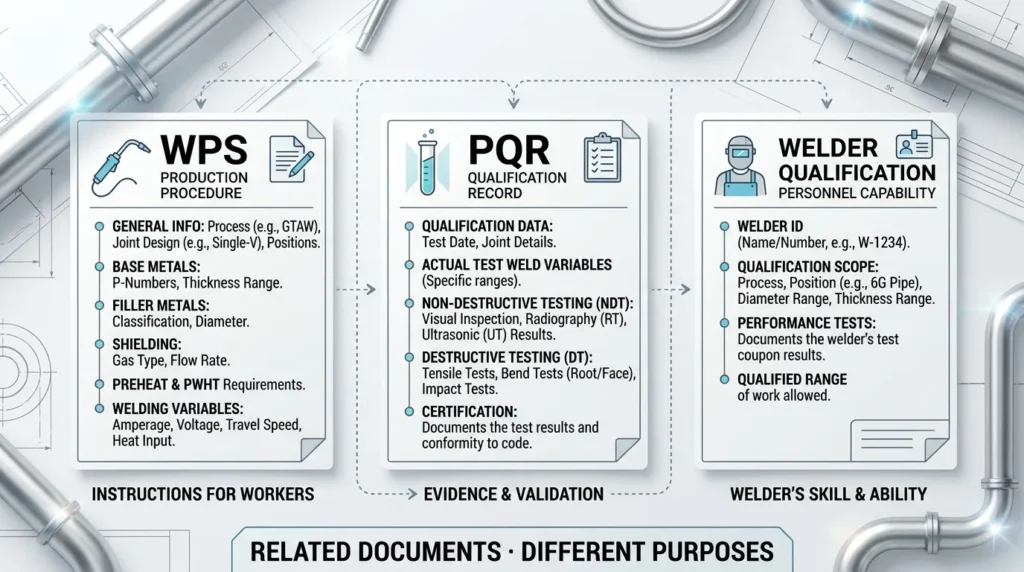
A WPS also should not be confused with the records used to qualify a procedure or the records used to qualify the person making the weld. In an ASME Section IX context, the Welding Procedure Specification (WPS), Procedure Qualification Record (PQR) and Welder Performance Qualification (WPQ) serve related but different purposes.
Quick answer: A WPS tells the welding team how production welding is to be carried out within its qualified scope. A PQR records the variables and test results used to support procedure qualification. Welder qualification demonstrates that the individual welder is qualified for the applicable work. They are connected documents, but they are not interchangeable.
This guide explains what project teams should look for in a butt-weld piping WPS, how WPS and PQR differ, how qualification fits into project documentation, and what information should be confirmed before stainless steel pipe and butt-weld fittings are released for fabrication.
Important: This article is a general project and procurement guide. It does not replace the controlled text of the applicable welding code, construction code, approved WPS/PQR, project specification, engineering review or site safety procedure.
What Is a WPS for Butt Weld Pipe?
WPS means Welding Procedure Specification. It is a controlled document that gives direction for making production welds. Depending on the governing code, welding process and project requirements, a WPS can identify or control items such as the joint configuration, base materials, filler metals, welding process, position, preheat or interpass controls, shielding or backing gas, electrical characteristics, technique and postweld heat treatment.
The exact variables and qualification ranges cannot be assumed from a generic WPS template. They depend on the applicable code and the procedure that has actually been qualified or otherwise permitted for use.
For pressure-equipment work governed by ASME requirements, ASME BPVC Section IX contains rules relating to qualification of welding procedures and personnel. ASME also publishes suggested formats for WPS, PQR and welder performance qualification records. A project may specify a particular edition or another governing welding standard, so the project specification remains the starting point.
For butt-weld piping, the WPS is only one part of the technical picture. The pipe and fitting still need the correct product specifications, dimensions, wall thicknesses, end preparations and material grades. For example, ASTM A312 stainless steel pipe addresses pipe product requirements, while ASME B16.9 butt-weld fittings addresses factory-made wrought butt-weld fitting requirements. Neither document by itself replaces the project welding procedure.
WPS vs PQR vs Welder Qualification
These three records are often mentioned together, but each answers a different question.
| Document | Main question | Main role in the project |
|---|---|---|
| WPS — Welding Procedure Specification | How should the production weld be made within the applicable qualified scope? | Gives controlled instructions and limits for production welding. |
| PQR — Procedure Qualification Record | What variables were used during the qualification test, and what were the test results? | Records the qualification test and provides the supporting basis for a qualified procedure where required. |
| WPQ — Welder Performance Qualification | Is the individual welder qualified for the applicable welding work? | Documents personnel performance qualification within the permitted range. |
ASME’s official data-report-form page lists separate suggested formats for QW-482 WPS, QW-483 PQR and QW-484A Welder Performance Qualification. That separation is important.
A PQR is not simply a more detailed WPS. A procedure qualification record documents the actual variables used for the qualification test and the required test results. The WPS is the controlled production instruction derived from or supported by the applicable qualification route.
Welder qualification is different again. A qualified procedure does not automatically mean every welder is qualified to use it, and a qualified welder does not independently qualify an unqualified procedure.
Related documents do not mean interchangeable documents.
What Information Should a Butt-Weld Pipe WPS Define?
A useful WPS should let the fabrication and QA/QC teams understand what procedure is being authorized and where its limits are. The exact fields vary with the code and welding process, but the following review structure is practical for piping projects.
| WPS review area | What the project team should confirm |
|---|---|
| Identification | WPS number, revision and document status are clear. |
| Qualification basis | The supporting PQR, SWPS route or other permitted qualification basis is identified where applicable. |
| Welding process | The specified process or process combination matches the approved fabrication scope. |
| Joint design | Butt-joint configuration, preparation and backing details are appropriate for the production joint. |
| Base materials | Material specification/grouping and permitted range cover the actual pipe and fitting materials. |
| Thickness range | The actual production wall thickness is within the applicable qualified or permitted range. |
| Diameter range | Where diameter is a governing variable or project requirement, the production diameter is covered. |
| Filler metal | Required filler-metal classification or designation is defined where applicable. |
| Position | The production welding position is within the applicable scope. |
| Preheat / interpass | Required temperature controls are defined where applicable. |
| Shielding / backing | Gas, backing or purge requirements are defined where applicable. |
| Electrical characteristics | Applicable current/polarity and other controlled characteristics are addressed by the qualified procedure. |
| Technique | Relevant technique requirements are controlled where required. |
| PWHT | Postweld heat treatment requirements are identified where applicable. |
| Inspection interface | The project inspection/NDE plan and acceptance requirements are coordinated with the welding scope. |
The purpose of this checklist is not to create a universal WPS. It is to help a reviewer identify whether the document actually matches the work being performed.
For stainless steel piping, seemingly small differences can matter. A change in material grouping, welding process, wall thickness, backing condition or other controlled variable may affect whether a procedure remains within its qualified scope. The applicable welding code and project specification should decide that question, not a generic online parameter table.
How Is a Welding Procedure Qualified?
The basic qualification logic can be understood as a controlled evidence chain:
Procedure concept → qualification test coupon → actual variables recorded → required examination/testing → qualification record → production WPS within the permitted range
For a conventional procedure-qualification route, a test weld is made using controlled variables. The actual variables and required test results are recorded in the PQR. The WPS then establishes the instructions and permitted ranges for production welding in accordance with the governing code.
However, project teams should not assume that every document labeled “WPS” follows exactly the same qualification route. ASME also recognizes Standard Welding Procedure Specification (SWPS) concepts within defined rules, and other construction or welding codes can use different qualification structures.
The practical review question is therefore:
What is the qualification basis for this WPS, and does that basis apply to the actual production weld?
That is more useful than checking only whether a WPS number appears on a submittal.
What Should Buyers and Project Teams Check Before Accepting a WPS?
A purchasing team does not need to become a welding engineer to identify basic document gaps. Before a butt-weld piping package is released for fabrication, confirm that the WPS can be connected to the actual product and project requirements.
WPS Review Checklist
- WPS number and revision — Is the controlled document clearly identified?
- Governing project requirement — Which construction code, welding code and project specification apply?
- Qualification reference — Is the supporting qualification basis identified where required?
- Base material coverage — Does the WPS cover the actual pipe and fitting materials?
- Wall-thickness coverage — Is the production thickness inside the permitted range?
- Diameter coverage — Where applicable, is the production diameter covered?
- Joint configuration — Does the joint preparation match the production weld?
- Welding process — Is the approved process or process combination the one that will actually be used?
- Filler-metal requirement — Is the applicable filler specified and available?
- Position and technique — Do the site or workshop conditions fit the procedure scope?
- Gas, purge and heat controls — Are applicable backing, shielding, preheat, interpass or PWHT requirements defined?
- Welder qualification — Are the welders qualified for the applicable process and work range?
- Inspection / NDE — Are the required examinations and acceptance criteria coordinated with the fabrication plan?
- Approval status — Has the document reached the approval status required before production starts?
A technically complete submittal is more useful than a WPS number standing alone.
Need Help Reviewing Butt-Weld Piping Documentation?
A WPS is only one part of a complete butt-weld piping submittal. If you are reviewing stainless steel pipes, butt-weld fittings, material specifications or project documentation, Nonleak can help clarify the product and documentation requirements before quotation.
Please provide: project specification, pipe material, NPS/DN, schedule or wall thickness, fitting type, applicable standards, welding/documentation scope, inspection requirements, quantity and drawing/BOM where available.
Can You Copy a WPS from Another Project?
A WPS from another project can be useful as a reference for document structure, but it should not be assumed to be valid for a new project.
Before a previously used procedure is accepted for new work, the responsible project team should confirm at least:
- the governing construction and welding requirements;
- the base material and applicable material grouping;
- the welding process and process combination;
- the production joint design;
- the applicable thickness and, where relevant, diameter range;
- filler-metal requirements;
- backing, shielding and purge conditions;
- position and technique;
- qualification ownership and supporting records;
- project-specific inspection and client requirements;
- current revision and approval status.
This is why downloading a “stainless steel WPS PDF” from the internet does not establish that the procedure is qualified for a particular project. A document can look technically detailed and still be outside the required qualification range.
Nonleak therefore recommends using public WPS samples only for general document familiarization, not as production instructions.
WPS Considerations for Stainless Steel Butt-Weld Piping
Stainless steel butt-weld piping adds several material and fabrication considerations that should be coordinated with the WPS and project specification.
Material identification
The actual pipe and fitting grades must match the approved material documents. Common austenitic stainless steel piping projects may involve TP304L or TP316L pipe and corresponding fitting grades, but similar alloy names do not make different product specifications interchangeable.
For pipe procurement, review the ASTM A312 guide. For wrought austenitic stainless steel butt-weld fittings, review the ASTM A403 guide.
Pipe schedule and wall thickness
The WPS review should use the actual production wall thickness rather than relying only on a nominal description. A pipe schedule identifies a nominal wall-thickness series; it is not a welding procedure and it is not a pressure rating.
Use the pipe schedule chart to confirm nominal wall thickness before checking whether the actual joint falls within the applicable procedure range.
End preparation and fit-up
Butt-weld quality depends on controlled preparation and alignment. Joint geometry, bevel preparation, root condition, cleanliness and fit-up should follow the approved project requirements. The general connection geometry is explained in our butt weld vs socket weld guide.
Shielding, backing and cleanliness
Where the qualified procedure requires shielding or backing gas, the production arrangement must follow the controlled WPS rather than a generic online flow-rate recommendation. Stainless steel fabrication also requires appropriate contamination control, handling and post-fabrication cleaning requirements defined by the project.
Heat control
Heat input, preheat, interpass conditions and postweld heat treatment should be controlled only where and as required by the qualified procedure and governing specification. This article deliberately does not publish universal amperage, voltage, travel speed, purge-flow or interpass-temperature values because those numbers cannot be safely transferred between unrelated procedures.
How WPS Fits into a Method Statement and ITP
A WPS becomes more useful when its role is separated from the other project documents around it.
| Document | Main project question |
|---|---|
| WPS | How is the production weld made within the applicable qualified scope? |
| Method Statement | How is the overall fabrication or installation activity organized and executed? |
| ITP — Inspection and Test Plan | What is inspected or tested, at what stage, by whom and against which acceptance requirement? |
| Material documentation | What pipe and fitting materials were supplied, and how are they identified and traced? |
| Welder qualification | Is the person performing the weld qualified for the applicable work? |
A typical project control sequence may look like:
Approved materials → approved WPS → qualified personnel → fit-up/fabrication → inspection/NDE → pressure or system testing → final acceptance
The exact sequence and hold points depend on the project, but the principle is consistent: welding documentation should connect with material control, fabrication, inspection and final acceptance.
For related project information, review Nonleak’s technical documentation and quality control resources.
WPS Documentation Checklist for an RFQ or Technical Submittal
When requesting stainless steel pipe and butt-weld fittings for a project that includes controlled welding documentation, provide enough information for the product and documentation scope to be reviewed together.
| RFQ input | What to provide |
|---|---|
| Piping scope | System, service and project location |
| Pipe material | Grade and product specification |
| Pipe size | NPS or DN |
| Wall thickness | Schedule or actual nominal wall |
| Fittings | Type, configuration, grade and dimensional standard |
| Joint | Butt-weld scope and end-preparation requirement |
| Governing requirement | Construction code, welding code and project specification where applicable |
| Welding documents | Existing WPS/PQR or project welding-document requirements where applicable |
| Inspection | NDE, witness, hold-point or third-party requirements |
| Design/service conditions | Information required by the project for material and product review |
| Quantity | BOM, MTO or item quantities |
| Drawings | Isometrics, piping drawings or relevant details |
| Certificates | MTR, traceability and other specified documentation |
For product selection, explore Nonleak stainless steel pipes and stainless steel butt-weld fittings.
Frequently Asked Questions
What is a WPS for butt weld pipe?
A WPS for butt weld pipe is a controlled Welding Procedure Specification used to direct production welding for butt-jointed piping within the applicable qualified or permitted scope. It defines the welding requirements relevant to the procedure and must be matched to the actual project materials, joint, welding process and governing requirements.
What is the difference between WPS and PQR?
A WPS provides the controlled instructions for production welding. A PQR records the actual variables and required test results from a procedure qualification test. Where a PQR-based qualification route applies, the PQR supports the qualification basis while the WPS controls production welding within the permitted range.
Is welder qualification the same as WPS qualification?
No. WPS qualification concerns the welding procedure. Welder performance qualification concerns the individual performing the weld. A qualified procedure does not automatically qualify a welder, and a qualified welder does not independently qualify a procedure.
Can the same WPS be used for every pipe size and wall thickness?
Do not assume so. The applicable range depends on the governing code, welding process, qualification basis and controlled variables. The actual production size and wall thickness should be checked against the approved procedure.
Can I download a WPS from another project and use it?
A downloaded WPS can be used to understand document format, but it should not be treated as automatically valid production instruction. The qualification basis, materials, process, joint, ranges, project requirements, ownership and approval status must be verified before use.
Does pipe schedule determine the WPS?
No. Pipe schedule identifies a nominal wall-thickness series. Wall thickness can be relevant to procedure qualification, but schedule alone does not determine a WPS. Material, joint design, welding process, qualification variables and project requirements must also be considered.
Does ASTM A312 provide a pipe welding WPS?
No. ASTM A312/A312M is a product specification for austenitic stainless steel pipe. It does not replace a project welding procedure specification. Welding qualification and production controls must follow the applicable construction/welding requirements and approved project documents.
What documents should be checked together with a WPS?
Depending on the project, reviewers may need the supporting procedure qualification record or other permitted qualification basis, welder qualification records, approved material documents, joint details, inspection/NDE requirements, method statement, ITP and current project specifications.
Need Stainless Steel Pipe and Butt-Weld Fittings for Your Project?
A WPS is only one part of a complete butt-weld piping package. Product dimensions, material grades, wall thicknesses, end preparation, inspection requirements and project documentation should all be aligned before fabrication.
Send Nonleak your pipe size, wall thickness, material grade, fitting requirements, applicable specifications, quantity and project documentation requirements. We can review the product scope and identify the technical information needed before quotation.
Recommended RFQ information: Pipe/fitting type · NPS/DN · Schedule/wall thickness · Material grade · Applicable specifications · Welding/documentation scope · Inspection requirements · Quantity · Drawing/BOM