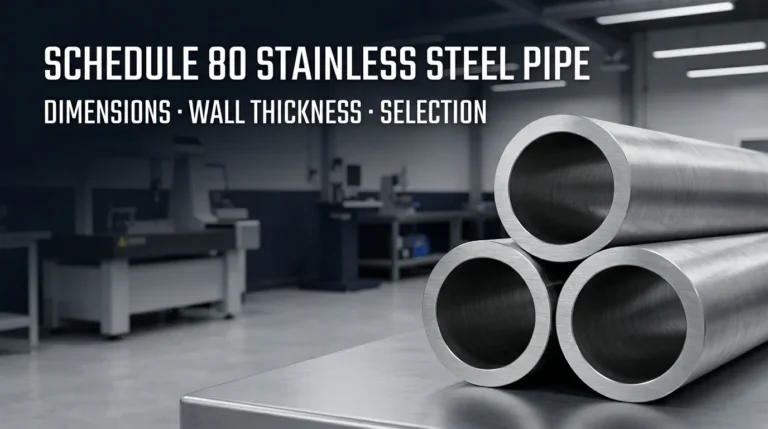
Schedule 80 stainless steel pipe is selected when a project requires a heavier wall than common Schedule 10S or Schedule 40S options. However, “Schedule 80” is not a complete pipe specification. Buyers still need to identify the dimensional standard, material grade, nominal pipe size, manufacturing route, length, end preparation, inspection and service conditions.
This guide explains Schedule 80 and Schedule 80S dimensions, how wall thickness changes internal diameter and weight, where heavier-wall stainless steel pipe may be considered, and what information should appear in an RFQ. The controlled dimensional standard, material specification, piping code and project documents always take precedence over this general reference.
Quick answer: For a given nominal pipe size, Schedule 80 stainless pipe has the same outside diameter as lighter schedules but a thicker wall and therefore a smaller internal diameter. The heavier wall can increase mechanical strength and may support a higher allowable pressure under the same design conditions, but Schedule 80 is not a pressure class. Material grade, temperature, corrosion allowance, joint design and the governing code must also be reviewed.
What Does Schedule 80 Mean?
A pipe schedule is a standardized wall-thickness series associated with nominal pipe size. It does not describe the alloy grade, manufacturing method or complete pressure rating. For example, NPS 2 Schedule 80 pipe and NPS 2 Schedule 10S pipe share the same nominal outside diameter, but the Schedule 80 wall is thicker.
The basic relationship is:
- NPS or DN identifies the nominal size;
- outside diameter remains fixed for a given NPS in the applicable dimensional series;
- schedule changes the nominal wall thickness;
- inside diameter decreases as the wall becomes thicker.
For a broader explanation of NPS, DN, OD, ID and how they relate to pipe Schedule, see our stainless steel pipe size and dimensions guide.
In stainless steel procurement, the suffix “S” matters. Schedule 80S is commonly referenced with ASME B36.19M for stainless steel pipe, while Schedule 80 without the suffix is associated with the dimensional series in ASME B36.10M. The dimensions coincide at many smaller sizes but not at every size, so the purchase order should identify the dimensional standard rather than relying on the schedule number alone.
Schedule 80 Stainless Steel Pipe Dimensions
The table below presents commonly referenced Schedule 80S dimensions from NPS 1/8 through NPS 12. Approximate inside diameter is calculated from nominal outside diameter minus twice the nominal wall thickness. Manufacturing tolerances are not included in that calculated value.
| NPS | DN | OD (in) | OD (mm) | 80S Wall (in) | 80S Wall (mm) | Approx. ID (mm) |
|---|---|---|---|---|---|---|
| 1/8″ | DN6 | 0.405 | 10.29 | 0.095 | 2.41 | 5.47 |
| 1/4″ | DN8 | 0.540 | 13.72 | 0.119 | 3.02 | 7.68 |
| 3/8″ | DN10 | 0.675 | 17.15 | 0.126 | 3.20 | 10.75 |
| 1/2″ | DN15 | 0.840 | 21.34 | 0.147 | 3.73 | 13.88 |
| 3/4″ | DN20 | 1.050 | 26.67 | 0.154 | 3.91 | 18.85 |
| 1″ | DN25 | 1.315 | 33.40 | 0.179 | 4.55 | 24.30 |
| 1-1/4″ | DN32 | 1.660 | 42.16 | 0.191 | 4.85 | 32.46 |
| 1-1/2″ | DN40 | 1.900 | 48.26 | 0.200 | 5.08 | 38.10 |
| 2″ | DN50 | 2.375 | 60.33 | 0.218 | 5.54 | 49.25 |
| 2-1/2″ | DN65 | 2.875 | 73.03 | 0.276 | 7.01 | 59.01 |
| 3″ | DN80 | 3.500 | 88.90 | 0.300 | 7.62 | 73.66 |
| 3-1/2″ | DN90 | 4.000 | 101.60 | 0.318 | 8.08 | 85.44 |
| 4″ | DN100 | 4.500 | 114.30 | 0.337 | 8.56 | 97.18 |
| 5″ | DN125 | 5.563 | 141.30 | 0.375 | 9.53 | 122.24 |
| 6″ | DN150 | 6.625 | 168.28 | 0.432 | 10.97 | 146.34 |
| 8″ | DN200 | 8.625 | 219.08 | 0.500 | 12.70 | 193.68 |
| 10″ | DN250 | 10.750 | 273.05 | 0.500 | 12.70 | 247.65 |
| 12″ | DN300 | 12.750 | 323.85 | 0.500 | 12.70 | 298.45 |
Table note: Values are provided as a practical reference. Confirm the required standard edition, dimensional tolerances and actual product data before design, fabrication or purchase.
Schedule 80S vs Schedule 80
Schedule 80S and Schedule 80 should not be treated as automatically interchangeable. In commonly used dimensional tables, their nominal wall thicknesses match from NPS 1/8 through NPS 8. At NPS 10 and NPS 12, the Schedule 80 values from the wrought-steel dimensional series are thicker than Schedule 80S values from the stainless-steel dimensional series.
| NPS | Schedule 80S Wall | Schedule 80 Wall | Difference |
|---|---|---|---|
| 8″ | 0.500 in / 12.70 mm | 0.500 in / 12.70 mm | Same nominal wall |
| 10″ | 0.500 in / 12.70 mm | 0.594 in / 15.09 mm | Schedule 80 is thicker |
| 12″ | 0.500 in / 12.70 mm | 0.687 in / 17.45 mm | Schedule 80 is thicker |
A quotation that only says “10-inch stainless steel Schedule 80 pipe” can therefore be ambiguous. A clearer description identifies NPS 10, the required material specification and grade, and either ASME B36.19M Schedule 80S or the explicitly required Schedule 80 wall from the applicable dimensional standard.
For controlled wording and current editions, consult the ASME Codes & Standards catalog.
How Wall Thickness Changes Inside Diameter and Weight
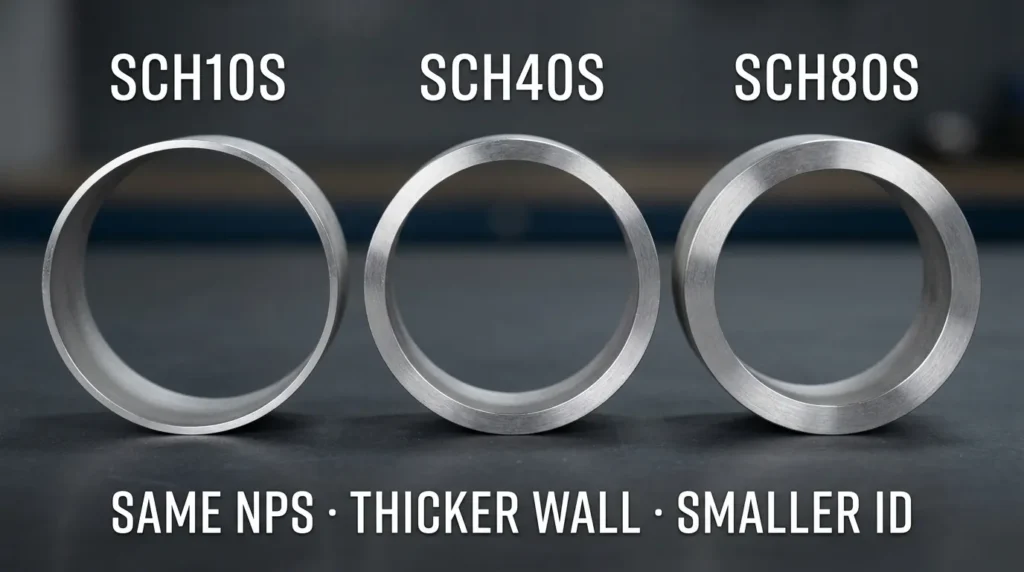
Increasing wall thickness affects more than pressure design. For the same NPS and outside diameter, a heavier schedule produces a smaller flow area. This may influence pressure drop, velocity, pump duty, cleaning behavior and the size of equipment connections.
A thicker wall also increases:
- pipe weight per unit length;
- support and handling loads;
- material cost;
- cutting and bevel-preparation time;
- welding volume and heat input for butt-welded systems;
- the importance of matching fittings and end preparations.
These effects become more significant as pipe size and project quantity increase. Selecting the heaviest available schedule without a design basis can add cost and installation difficulty without providing a useful project benefit.
SCH80S vs SCH40S and SCH10S
The following comparison shows how nominal stainless steel wall thickness increases across three common schedule series. It is not a pressure-rating table.
| NPS | Schedule 10S | Schedule 40S | Schedule 80S |
|---|---|---|---|
| 1/2″ | 2.11 mm | 2.77 mm | 3.73 mm |
| 1″ | 2.77 mm | 3.38 mm | 4.55 mm |
| 2″ | 2.77 mm | 3.91 mm | 5.54 mm |
| 4″ | 3.05 mm | 6.02 mm | 8.56 mm |
| 6″ | 3.40 mm | 7.11 mm | 10.97 mm |
| 8″ | 3.76 mm | 8.18 mm | 12.70 mm |
| 10″ | 4.19 mm | 9.27 mm | 12.70 mm |
| 12″ | 4.57 mm | 9.53 mm | 12.70 mm |
Review our detailed guides to Schedule 10 stainless steel pipe and Schedule 40 stainless steel pipe for their individual dimensions, applications and selection considerations.
For a broader NPS-by-NPS overview, review the pipe schedule chart. It provides a practical SCH 10, SCH 40 and SCH 80 wall-thickness comparison and links each schedule back to its detailed selection guide.
Does Schedule 80 Mean High-Pressure Pipe?
Schedule 80 is often described commercially as a “high-pressure” option because its wall is thicker than lighter schedules. That description is incomplete. A schedule number does not state the allowable working pressure of an installed piping system.
Allowable pressure depends on factors such as:
- material grade and allowable stress at design temperature;
- actual outside diameter and wall thickness after tolerances;
- corrosion or erosion allowance;
- weld-joint quality factor and manufacturing route where applicable;
- threading, grooving or other wall-reducing operations;
- fitting, flange, valve and gasket ratings;
- joining method and installation quality;
- the equations and limits in the governing piping code.
Schedule 80 can be part of a higher-pressure design, but the engineer must calculate the permitted pressure for the complete system. It should not be selected from the schedule label alone.
Material Grades for Heavy-Wall Stainless Pipe
Schedule describes dimensions, while ASTM A312/A312M or another applicable material specification defines the pipe grade, manufacture, heat treatment, testing and marking. Common austenitic grade choices include TP304, TP304L, TP316 and TP316L.
| Grade family | Typical selection consideration | Important limit |
|---|---|---|
| TP304 / TP304L | General water, utility and industrial service where the environment is compatible | May not be suitable for chloride-rich or more aggressive conditions |
| TP316 / TP316L | Improved resistance in many chloride-containing and corrosive environments | Not immune to pitting, crevice corrosion or stress-corrosion cracking |
Low-carbon “L” grades are frequently selected for welded systems, but grade selection still requires review of fluid chemistry, temperature, external exposure, cleaning chemicals and fabrication. See our 304 vs 316 stainless steel pipe comparison and ASTM A312 ordering guide for more detail.
Where Heavier-Wall Stainless Pipe May Be Considered
Schedule 80 stainless steel pipe may be considered where the design requires additional wall thickness for pressure, temperature, corrosion allowance, mechanical loading or fabrication. Potential applications include:
- industrial process and utility piping;
- chemical and water-treatment systems;
- high-temperature or cyclic service reviewed under an applicable code;
- lines exposed to vibration, impact or demanding support conditions;
- small-bore threaded or socket-weld systems where the design requires sufficient remaining wall;
- projects with a defined corrosion or erosion allowance;
- equipment connections that specify a heavier matching pipe wall.
These are selection contexts, not universal recommendations. The fluid, environment, joining method, code and project specification must support the choice.
When Schedule 80 May Not Be the Best Choice
A heavier wall is not automatically better. Schedule 80 may be unnecessary where a lighter schedule already satisfies the design requirements. It can also create disadvantages:
- higher material and freight cost;
- more difficult handling and support requirements;
- smaller internal diameter and greater pressure drop;
- more welding time and consumable use;
- reduced availability in some sizes, grades or manufacturing routes;
- mismatch with fittings, valves or existing equipment;
- longer lead time for special dimensions or fixed lengths.
Schedule selection should therefore be based on engineering requirements and lifecycle value rather than the assumption that the thickest pipe is the safest option.
Schedule 80 Stainless Pipe RFQ Checklist
A clear RFQ helps suppliers quote comparable products and prevents Schedule 80 and Schedule 80S from being mixed. Include:
- Material specification and edition: for example, ASTM A312/A312M where applicable.
- Grade: TP304L, TP316L or another approved grade.
- Dimensional standard: identify ASME B36.19M Schedule 80S or the specifically required Schedule 80 dimensions.
- Nominal size: NPS or DN range.
- Wall: schedule designation and, for critical orders, nominal wall thickness.
- Manufacturing route: seamless, welded or another permitted route.
- Length: random, fixed or cut length with tolerance.
- Ends: plain, beveled, threaded or project-specific preparation.
- Quantity: pieces, total length or weight by size.
- Testing and inspection: standard requirements plus any PMI, NDE or third-party inspection.
- Documentation: material test report, traceability and inspection certificates.
- Surface and packing: finish, pickling/passivation, end caps, bundling and export protection.
- Service conditions: fluid, design pressure, temperature and corrosion allowance.
An illustrative description might read:
ASTM A312/A312M TP316L welded stainless steel pipe, ASME B36.19M Schedule 80S, NPS 4, beveled ends, fixed 6 m lengths, material test report and project-specified inspection required.
The example shows the information structure only. The actual order must follow the project specification and governing code.
Frequently Asked Questions
Is Schedule 80 stainless steel pipe the same as Schedule 80S?
Not at every size. The nominal walls match through many smaller NPS sizes, but Schedule 80 and Schedule 80S differ at some larger sizes, including NPS 10 and NPS 12. State the dimensional standard in the purchase order.
Is Schedule 80 thicker than Schedule 40?
Yes, for the same NPS in the corresponding dimensional series, Schedule 80 has a thicker nominal wall than Schedule 40 and a smaller approximate inside diameter.
Does Schedule 80 have a different outside diameter?
No. For a given NPS, the outside diameter remains the same across schedules in the same dimensional system. The wall thickness and inside diameter change.
What is the wall thickness of 2-inch Schedule 80S stainless pipe?
NPS 2 Schedule 80S has a nominal wall thickness of 0.218 in, or 5.54 mm. Confirm the controlled standard and product tolerance before fabrication.
What is the wall thickness of 4-inch Schedule 80S pipe?
NPS 4 Schedule 80S has a nominal wall thickness of 0.337 in, or 8.56 mm.
Is Schedule 80 always suitable for higher pressure?
A heavier wall may increase pressure capability under the same conditions, but schedule alone does not determine allowable pressure. Grade, temperature, tolerances, corrosion allowance, joint design and the governing code must also be considered.
Can Schedule 80 stainless pipe be used with press fittings?
Only when the fitting system is designed and approved for that pipe outside diameter, wall range and material. Many press-fit systems are intended for specific thin-wall tube or pipe dimensions, so compatibility must be verified rather than assumed.
Can Schedule 80 pipe be threaded?
Some project designs use threaded heavy-wall pipe, but threading removes wall material and introduces stress concentration. The applicable code, remaining wall, fitting standard, thread specification and service conditions must be reviewed.
Is TP316L Schedule 80 automatically corrosion-proof?
No. TP316L improves resistance in many environments but can still corrode under unfavorable chloride, temperature, crevice, surface or fabrication conditions.
Should buyers specify both schedule and wall thickness?
For routine sizes, the schedule and dimensional standard may be sufficient. For critical or potentially ambiguous orders, stating the nominal wall thickness provides an additional verification point.
Discuss Your Heavy-Wall Pipe Requirements
Nonleak supplies stainless steel pipes and related piping components for commercial and industrial projects. Review our stainless steel pipe dimensions guide and technical documentation, or send the required standard, grade, NPS, wall thickness, length, quantity and inspection requirements through our contact page.
Technical note: This article is a general dimensional and procurement guide. It does not reproduce or replace the controlled text of ASME, ASTM, the governing piping code or the approved project specification.