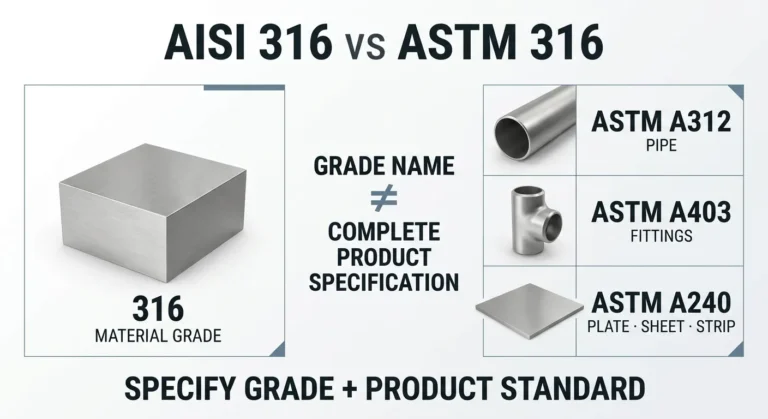
AISI 316 stainless steel vs ASTM 316 stainless steel is a common comparison, but the wording can be misleading. In most purchasing situations, these are not two competing stainless steels that can be compared like 304 versus 316. Instead, “316” identifies a stainless steel grade family, while ASTM specifications define requirements for particular product forms such as pipe, fittings, plate, sheet or strip.
This distinction matters because a buyer can specify the correct material grade and still order the wrong product if the applicable product standard, dimensions, wall thickness, manufacturing route or documentation requirements are missing.
This guide explains how AISI 316 terminology relates to ASTM product specifications, why there is no single universal “ASTM 316” specification for every stainless steel product, and what engineers and buyers should include in a complete RFQ.
AISI 316 vs ASTM 316 Stainless Steel: Quick Answer
| Term | What It Mainly Tells You | What It Does Not Fully Define |
|---|---|---|
| AISI 316 | Common stainless steel grade designation / material family reference | Product form, dimensions, manufacturing route, testing, marking and project-specific requirements |
| ASTM A240 316 | 316 stainless steel within a plate, sheet and strip product specification | Pipe or piping fitting requirements |
| ASTM A312 TP316 | 316 grade within an austenitic stainless steel pipe specification | Piping fitting dimensions or fitting product requirements |
| ASTM A403 WP316 | 316 grade within a wrought austenitic stainless steel piping fitting specification | Pipe dimensions or pipe manufacturing requirements |
The practical point is simple: “316” describes the alloy grade, while the complete ASTM designation tells you which product specification applies.
What Does AISI 316 Stainless Steel Mean?
AISI 316 is widely used in industry as a grade name for an austenitic stainless steel containing chromium, nickel and molybdenum. The designation helps identify the material family, but it is not by itself a complete pipe, fitting, plate or fabrication specification.
SAE J405, which covers chemical compositions of SAE wrought stainless steels, points to ASTM A240 for the chemical compositions of standard wrought stainless steel types. That relationship is useful because it shows that a familiar grade name and an ASTM product specification serve different roles.
For procurement, the grade designation should be combined with the actual product standard required by the project.
What Does “ASTM 316 Stainless Steel” Mean?
The phrase “ASTM 316 stainless steel” is commonly used in RFQs and online searches, but it is incomplete unless the ASTM specification is identified.
ASTM International publishes different standards for different product forms. For example:
- ASTM A240/A240M covers stainless steel plate, sheet and strip for pressure-vessel and general applications.
- ASTM A312/A312M covers seamless, welded and heavily cold worked austenitic stainless steel pipe.
- ASTM A403/A403M covers wrought austenitic stainless steel piping fittings for pressure piping applications.
Therefore, “ASTM 316” does not identify one universal product standard. The correct specification depends on whether the buyer needs pipe, fittings, plate, sheet, strip or another product form.
Why AISI 316 and ASTM 316 Are Not Equivalent Purchasing Specifications
The difference becomes clearer when the purchasing responsibilities are separated.
| Specification Question | Can “AISI 316” Answer It Alone? | What Else Is Needed? |
|---|---|---|
| What stainless steel grade is required? | Partly | Confirm the exact grade designation required by the applicable product specification |
| Is the product pipe, fitting, plate or sheet? | No | Identify the product form and corresponding ASTM specification |
| What pipe manufacturing route is permitted? | No | Use the pipe product specification and project requirements |
| What fitting manufacturing and testing requirements apply? | No | Use the applicable fitting product specification |
| What size, wall thickness or Schedule is required? | No | Provide the applicable dimensional standard and ordered size |
| What inspection documents are required? | No | State project, purchase-order and documentation requirements |
This is why a complete RFQ should not stop at wording such as “AISI 316 pipe” or “ASTM 316 fittings.”
ASTM A240: 316 Stainless Steel Plate, Sheet and Strip
ASTM A240/A240M is a product specification for chromium and chromium-nickel stainless steel plate, sheet and strip used in pressure-vessel and general applications.
This standard is relevant when the ordered product is flat-rolled stainless steel. It is not the pipe specification used to order finished stainless steel piping, and it is not the fitting specification used to order wrought piping fittings.
This distinction is important because the same stainless steel grade family can appear in several product standards while the manufacturing, dimensional and testing requirements change according to the product form.
ASTM A312: 316 Stainless Steel Pipe
For stainless steel pipe, one of the key product standards is ASTM A312/A312M.
ASTM A312 covers seamless, straight-seam welded and heavily cold worked welded austenitic stainless steel pipe intended for high-temperature and general corrosive service. Within this specification, grade designations such as TP316 and related variants are used for pipe.
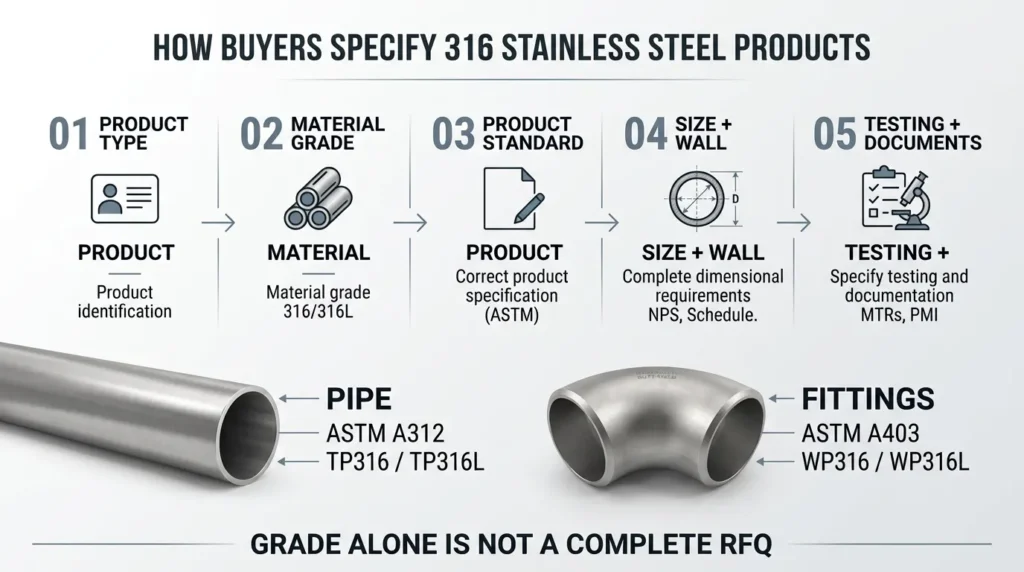
This means a pipe order should identify more than the word “316.” A practical specification should state the applicable ASTM A312 requirement together with the grade, nominal size, wall thickness or Schedule, manufacturing requirement where applicable, quantity and project documentation.
For a detailed explanation of the pipe standard, see our ASTM A312 stainless steel pipe guide.
ASTM A403: 316 Stainless Steel Piping Fittings
For wrought austenitic stainless steel piping fittings, ASTM A403/A403M serves a different product role.
ASTM A403 covers wrought austenitic stainless steel fittings for pressure piping applications. WP-grade designations are used for fittings covered by the standard.
Therefore, a 316 stainless steel butt-weld fitting may be specified using a designation such as ASTM A403 WP316 or the exact grade required by the project, while dimensions and geometry may be controlled by a separate fitting dimensional standard where applicable.
This is a different specification structure from ASTM A312 pipe, even when the pipe and fitting are both described generally as “316 stainless steel.”
For fitting-specific guidance, read our ASTM A403 stainless steel fittings guide.
Does the Same 316 Grade Mean Pipe and Fittings Have the Same Requirements?
No. Sharing a similar material grade designation does not make two product standards interchangeable.
A pipe specification addresses requirements for pipe products. A fitting specification addresses requirements for piping fittings. A flat-product specification addresses plate, sheet or strip.
The buyer should therefore separate two questions:
- What material grade is required?
- What product specification applies to the item being purchased?
Only after both are clear should dimensions, wall thickness, manufacturing route, end preparation, inspection and documentation be finalized.
Need Help Reviewing a 316 Stainless Steel Specification?
Send Nonleak the product type, material grade, ASTM specification, NPS or DN, wall thickness or Schedule, connection method, quantity and required inspection documents. A project drawing or piping material specification can help us review whether the pipe and fitting designations are complete before quotation.
AISI 316 vs 316L: Why the Suffix Still Matters
Buyers should also avoid treating “316” and “316L” as interchangeable shorthand.
The exact grade required should follow the applicable product specification and project documents. If the project calls for TP316L pipe or WP316L fittings, the “L” designation is part of the specified grade and should not be removed from the RFQ.
For a broader project-level material comparison between 304 and 316 grades, see our 304 vs 316 stainless steel pipe guide.
How to Specify 316 Stainless Steel Pipe Correctly
A pipe inquiry should combine the material grade with the product and dimensional requirements.
A more complete RFQ may include:
- Product: stainless steel pipe;
- Product standard: ASTM A312/A312M where applicable;
- Grade: TP316, TP316L or the exact project-specified grade;
- Nominal size: NPS or DN;
- Wall thickness: Schedule or specified wall thickness;
- Manufacturing requirement: welded, seamless or another requirement where specified;
- Length: standard or project-specific;
- Surface / finish: if required by the project;
- Quantity: pieces, meters or total project quantity;
- Testing / documents: according to the purchase order and project requirements.
Nonleak’s stainless steel pipes page provides an overview of available pipe grades and connection methods.
How to Specify 316 Stainless Steel Fittings Correctly
A fitting inquiry also needs more than the material grade.
For wrought stainless steel piping fittings, buyers should confirm:
- fitting type, such as elbow, tee, reducer, cap or return bend;
- material/product specification, such as ASTM A403/A403M where applicable;
- grade designation, such as WP316 or the exact project-required variant;
- nominal size;
- wall thickness / matching pipe Schedule;
- dimensional standard;
- connection type;
- quantity;
- testing and inspection documentation;
- project-specific marking or traceability requirements.
For available connection systems and fitting families, see our stainless steel pipe fittings range.
Where ASME Dimensional Standards Fit In
ASTM product specifications and ASME dimensional standards often have different responsibilities in a complete piping specification.
For example, a wrought butt-weld fitting may use ASTM A403 for material and product requirements while ASME B16.9 is specified for fitting dimensions and geometry. Pipe dimensions may be referenced through the applicable piping dimensional standard.
This is why a buyer should not assume that one standard number automatically defines every aspect of a pipe or fitting.
For a broader standards-level comparison, see our ASTM vs ASME guide, which explains why ASTM product specifications and ASME dimensional or piping standards often serve different but complementary roles.
For additional dimensional guidance, see our ASME B16.9 butt-weld fittings guide and stainless steel pipe dimensions guide.
Common Mistakes When Ordering “ASTM 316” Stainless Steel
1. Writing Only “ASTM 316”
This does not identify the actual ASTM product specification. The RFQ should state whether the item is pipe, fitting, plate, sheet or another product and identify the corresponding standard.
2. Assuming AISI 316 Is a Complete Pipe Specification
The grade name alone does not define NPS, Schedule, manufacturing route, testing or documentation.
3. Omitting TP or WP Grade Designations
Product specifications use their own grade structures. Pipe and fitting designations should follow the applicable standard and project requirement.
4. Mixing Pipe and Fitting Standards
ASTM A312 is a pipe specification. ASTM A403 is a wrought piping fitting specification. They should not be substituted for each other merely because both products use a 316 stainless steel grade.
5. Treating the Material Standard as the Dimensional Standard
Material/product requirements and dimensional geometry may be controlled by different standards. Confirm both before ordering.
6. Ignoring the Required Standard Edition
Standards are revised over time. If a project contract identifies a specific edition, use that edition rather than automatically substituting the newest publication.
A Practical 316 Stainless Steel RFQ Checklist
| RFQ Item | Example Information to Provide |
|---|---|
| Product type | Pipe, elbow, tee, reducer, plate or other component |
| Material grade | 316, 316L or exact project-required designation |
| Product specification | ASTM A312, ASTM A403, ASTM A240 or another applicable standard |
| Size | NPS / DN / OD as applicable |
| Wall thickness | Schedule or specified wall |
| Dimensions / geometry | Applicable ASME, ASTM or project dimensional requirement |
| Connection / end type | Butt-weld, press-fit, socket-weld or another approved system |
| Quantity | Pieces, lengths or project total |
| Testing and documents | MTR, dimensional report, PMI, NDE or project-required records where specified |
| Standard edition | Edition required by contract or project specification |
Why This Distinction Matters for Piping Projects
Stainless steel piping projects usually combine several product forms in one system. Pipes, butt-weld fittings, press-fit fittings, supports and other components may use related material grades but still follow different manufacturing, dimensional and inspection requirements.
Using a clear specification structure helps prevent mismatches between:
- pipe and fitting grade;
- pipe wall and fitting wall requirements;
- material and dimensional standards;
- connection method and end preparation;
- testing requirements and supplied documentation.
Additional specification and installation references are available in Nonleak’s Technical Documentation section, while our Quality Control page explains the broader inspection and traceability approach.
AISI 316 vs ASTM 316 Stainless Steel FAQ
Is AISI 316 the same as ASTM 316?
Not as a complete purchasing specification. AISI 316 is commonly used as a stainless steel grade designation, while ASTM standards define requirements for specific product forms. The buyer still needs the applicable ASTM specification for pipe, fittings, plate or another product.
Is there one ASTM 316 standard?
No single ASTM specification covers every 316 stainless steel product. Different standards apply to different product forms, such as ASTM A240 for plate, sheet and strip, ASTM A312 for austenitic stainless steel pipe and ASTM A403 for wrought austenitic stainless steel piping fittings.
What ASTM standard is used for 316 stainless steel pipe?
ASTM A312/A312M is a key specification for seamless, welded and heavily cold worked austenitic stainless steel pipe. The exact grade and project requirements must still be stated in the order.
What ASTM standard is used for 316 stainless steel fittings?
ASTM A403/A403M covers wrought austenitic stainless steel piping fittings for pressure piping applications. The required grade, fitting type, dimensions and project documentation should also be specified.
Does ASTM A240 apply to stainless steel pipe?
ASTM A240 is a specification for stainless steel plate, sheet and strip. Finished pipe is covered by pipe-specific standards such as ASTM A312 where applicable.
Can I order pipe by saying “AISI 316” only?
That wording is incomplete for a technical purchase order. A complete pipe RFQ should also identify the product specification, grade variant, size, wall thickness or Schedule, quantity and required testing or documentation.
Can TP316 pipe be matched with WP316 fittings?
They belong to related 316 stainless steel material families, but compatibility cannot be decided from the grade labels alone. The project must also confirm dimensions, wall requirements, connection type, design conditions and applicable piping standards.
Should I always use the newest ASTM edition?
Not automatically. Use the edition required by the project contract, purchase specification or governing engineering documents. If no edition is stated, confirm the required edition before ordering.
Request 316 Stainless Steel Pipe and Fitting Support
If your project specifies 316 or 316L stainless steel, send the complete pipe or fitting requirement rather than only the material grade.
Include the product type, ASTM specification, grade designation, NPS or DN, Schedule or wall thickness, connection method, quantity, standard edition and required inspection documents. This helps ensure that the supplied product matches both the material requirement and the correct product specification.
Need Help with a 316 Stainless Steel RFQ?
Send your pipe or fitting schedule, ASTM specification, grade, size, wall thickness, quantities and required documentation for technical review and quotation.
Official Standard References
For authoritative product requirements, refer to the current official standard pages from SAE International and ASTM International:
- SAE J405 — Chemical Compositions of SAE Wrought Stainless Steels
- ASTM A240/A240M — Stainless Steel Plate, Sheet and Strip
- ASTM A312/A312M — Austenitic Stainless Steel Pipe
- ASTM A403/A403M — Wrought Austenitic Stainless Steel Piping Fittings
Always use the edition required by the actual project specification or purchase contract.