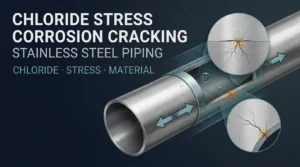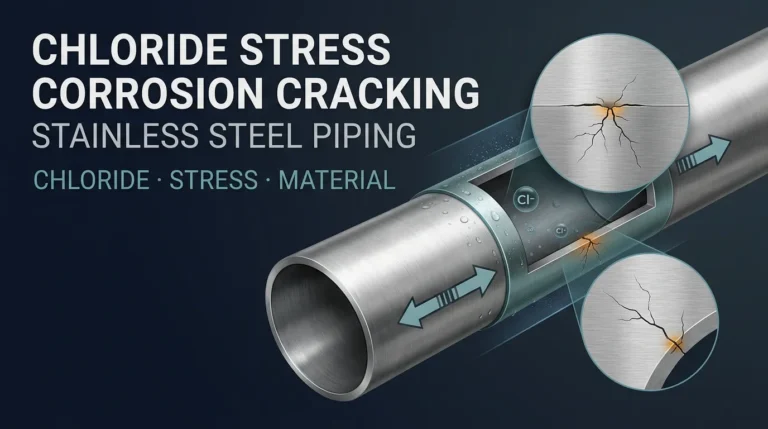
Chloride stress corrosion cracking is a form of environmentally assisted cracking that can affect stainless steel when a susceptible material, tensile stress and a chloride-containing environment act together.
For piping systems, this matters because the damage may develop without widespread general corrosion. A pipe can retain a relatively clean appearance while fine cracks initiate and propagate in a localized area.
Common sources of chloride exposure include process fluids, coastal environments, contaminated water, deposits, cleaning residues and moisture entering an insulation system. Tensile stress may come from operating loads, welding, forming, fabrication or other residual stresses.
However, chloride exposure alone does not mean that stress corrosion cracking will occur. Risk depends on the complete combination of material, environment, stress, temperature, moisture, fabrication condition and time.
This guide explains how chloride stress corrosion cracking develops in stainless steel piping, how it differs from pitting corrosion and intergranular corrosion, and what engineers and buyers should review when selecting, inspecting and specifying stainless steel pipe.
Important: This article provides a general materials, procurement and inspection overview. It does not replace an approved piping design, corrosion-management programme, inspection procedure or project-specific engineering assessment.
What Is Chloride Stress Corrosion Cracking?
Stress corrosion cracking, usually abbreviated SCC, occurs when a susceptible material is exposed simultaneously to a specific corrosive environment and tensile stress. When chlorides are an important environmental contributor, the mechanism is commonly described as chloride stress corrosion cracking, chloride-induced stress corrosion cracking or Cl-SCC.
Unlike uniform corrosion, SCC is primarily a cracking mechanism rather than widespread wall thinning. Three conditions normally need to interact:
| Factor | What It Means for Stainless Steel Piping |
|---|---|
| Susceptible material | Certain stainless steels, particularly common austenitic grades, can be susceptible under sufficiently aggressive conditions. |
| Tensile stress | Stress may be applied during service or remain from welding, forming, cold work, fit-up or fabrication. |
| Aggressive environment | Chlorides combined with moisture and other environmental conditions can create conditions favorable to localized attack and cracking. |
Temperature, chloride concentration, salt chemistry, oxygen, humidity, surface condition and exposure time can all influence the severity of the environment. The practical lesson is that chloride concentration by itself is not enough to determine SCC risk.
How Does Chloride Stress Corrosion Cracking Develop?
Stainless steel normally resists corrosion because chromium in the alloy forms a thin passive film on the surface. Under an aggressive localized environment, particularly one involving chlorides, this passive condition may become unstable. Pitting or another localized corrosion site can sometimes develop first.
If a susceptible area is also under tensile stress, a crack may initiate and continue into the metal. In austenitic stainless steels, chloride SCC is often associated with fine, branched cracking. The damage can penetrate more deeply than the surrounding surface condition would suggest.
A useful way to think about the risk path is:
- Susceptible material
- Chloride-containing environment
- Localized surface breakdown or aggressive local chemistry
- Tensile stress
- Crack initiation and propagation
Not every SCC failure follows exactly the same microscopic sequence, and cracking morphology should be confirmed through appropriate inspection or failure analysis rather than appearance alone.
Why Are 304 and 316 Stainless Steels Discussed in Chloride SCC?
304, 304L, 316 and 316L are widely used austenitic stainless steels. Their general corrosion resistance is one reason they are common in water, building-services and industrial piping systems. However, “stainless” does not mean immune to every chloride environment or every corrosion mechanism.
316 and 316L contain molybdenum and generally provide better resistance than 304-family grades to chloride-related localized corrosion such as pitting in many environments. That advantage does not mean that 316L is universally immune to chloride stress corrosion cracking.
Material selection must consider the complete environment, including chloride exposure, temperature, stress, fabrication, surface condition, cleaning procedures and expected service conditions. For a broader grade comparison, review our 304 vs 316 stainless steel pipe guide.
Higher-alloy austenitic or duplex stainless steels may provide improved SCC resistance in some chloride environments, but alloy selection should be based on the governing project specification and a project-specific corrosion assessment rather than a simple “upgrade one grade” rule.
Is There a Safe Temperature Below Which Chloride SCC Cannot Occur?
There is no single universal temperature that can be used to declare every austenitic stainless steel piping system safe from chloride stress corrosion cracking. Higher temperatures frequently increase risk because they can accelerate corrosion processes and promote concentration of dissolved salts as water evaporates.
However, published laboratory research has also observed SCC in Type 304 and Type 316L stainless steels at temperatures around 30°C and above under specific magnesium- and calcium-chloride deposit conditions and low relative humidity. That finding should not be turned into a universal 30°C threshold; it demonstrates why salt chemistry, humidity, stress and exposure conditions matter alongside temperature.
The correct engineering question is therefore not “Is the temperature below one universal SCC limit?” It is: Can this material, stress state and actual chloride-containing environment create conditions capable of initiating cracking?
For the underlying research, see the AMPP paper Low-Temperature Stress Corrosion Cracking of Stainless Steels in the Atmosphere in the Presence of Chloride Deposits.
Where Can Chlorides Come From in a Piping Project?
Chlorides do not have to originate only from the process fluid. Potential sources include service water, seawater or brackish water, coastal salt deposition, washdown water, hydrostatic test water, cleaning chemicals, residual rinse water, contaminated deposits and water entering an insulation system.
External exposure deserves particular attention. When insulation becomes wet, it can retain moisture close to the metal surface. Dissolved salts may migrate and become concentrated as wetting and drying cycles occur.
This is one reason insulated austenitic stainless steel piping requires more than simply selecting a corrosion-resistant pipe grade. Insulation specification, weather protection, water ingress, drainage, operating temperature and inspection strategy all matter.
ASTM C692-13(2023) provides laboratory procedures for evaluating whether thermal insulation can contribute to external stress corrosion cracking of austenitic stainless steel due to soluble chlorides. ASTM C795-08(2023) is a specification for thermal insulation used in contact with austenitic stainless steel. These documents address defined insulation qualification requirements; they do not reproduce every possible field condition.
Can Hydrostatic Testing Contribute to Chloride SCC Risk?
Hydrostatic testing does not automatically cause stress corrosion cracking. However, water quality and what happens after the test can matter for stainless steel systems.
If chloride-bearing test water remains trapped, concentrates during evaporation or is not adequately drained and dried where required by the approved procedure, it may contribute to an unfavorable corrosion environment.
A proper hydrostatic testing plan should therefore consider applicable water-quality requirements, test temperature, drainage, drying, cleanliness and preservation requirements. See our Hydrostatic Pressure Test guide for the wider piping-system testing process.
The hydrostatic test pressure itself should not be confused with the environmental conditions involved in chloride SCC.
Chloride SCC vs Pitting vs Crevice vs Intergranular Corrosion
| Mechanism | Main Characteristic |
|---|---|
| Pitting corrosion | Highly localized cavities or pits caused by local passive-film breakdown. |
| Crevice corrosion | Localized attack in a restricted or shielded area where local chemistry changes. |
| Intergranular corrosion | Preferential attack along grain boundaries, often associated with metallurgical sensitization in austenitic stainless steels. |
| Chloride stress corrosion cracking | Crack initiation and propagation caused by the interaction of a susceptible material, tensile stress and a chloride-containing environment. |
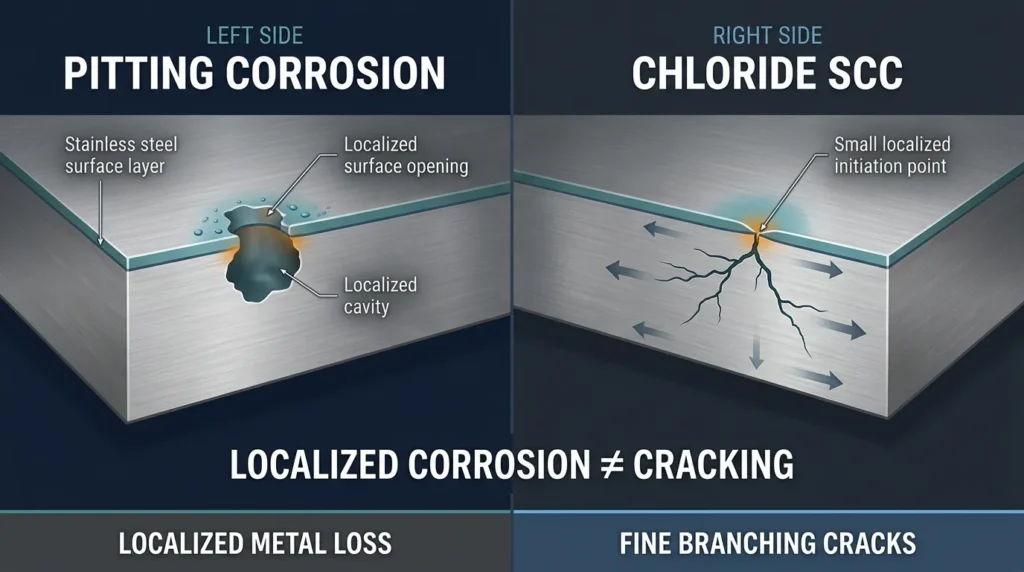
A pit or crevice can sometimes provide a favorable location for SCC initiation, but finding a pit does not automatically prove SCC. Likewise, chloride SCC should not automatically be called intergranular corrosion.
For related mechanisms, see our Pitting Corrosion in Stainless Steel, Intergranular Corrosion in Stainless Steel and Corrosion Under Pipe Support guides.
Where Does the Tensile Stress Come From?
The “stress” in stress corrosion cracking does not have to come only from internal pipe pressure. Potential contributors include welding residual stress, cold forming, bending, local fit-up stress, fabrication distortion, thermal expansion restraint, external loads and normal operating stresses.
This is why a piping component may remain susceptible even when the calculated operating stress appears modest. Fabrication history therefore matters.
Weld procedures, forming processes, dimensional control, alignment and project-specific heat-treatment requirements should be reviewed together with material selection. Do not assume that an arbitrary post-weld heat treatment is automatically an appropriate SCC solution for austenitic stainless steel. Any thermal treatment must be compatible with the alloy, product form, fabrication procedure and governing project requirements.
How Is Chloride Stress Corrosion Cracking Detected?
SCC can be difficult to identify because the cracks may be narrow and localized. Visual examination may identify staining, deposits, pits or visible surface-breaking cracks, but a normal-looking surface does not prove that cracking is absent.
Depending on the component, access and project requirements, inspection may involve surface examination methods, penetrant testing, qualified ultrasonic or electromagnetic techniques, metallographic examination or laboratory failure analysis. Wall-thickness measurement alone may not always characterize a tight crack-like defect.
The appropriate inspection method should be selected by qualified inspection personnel for the actual geometry and expected damage mechanism. If a crack is suspected, its significance should be evaluated under an approved engineering and inspection procedure before continued service or repair.
Need Help Reviewing Stainless Steel Material and Corrosion Requirements?
Send the material grade, pipe size and wall thickness, service fluid, chloride exposure, operating temperature, fabrication route, insulation conditions and required inspection documents. We can review the product and specification requirements before quotation.
How Can Chloride Stress Corrosion Cracking Risk Be Reduced?
The most reliable approach is to control the complete combination of environment, stress, material and inspection rather than relying on a single preventive measure.
Control Chloride Contamination and Moisture
Identify possible internal and external chloride sources during design, fabrication, storage, installation, commissioning and operation. Avoid unnecessary contamination and prevent water from remaining in locations where salts can concentrate.
Review Hydrotest and Cleaning Procedures
Confirm water chemistry, cleaning chemicals, rinsing, drainage and drying requirements for the selected stainless steel and project specification. Do not assume that any available water is automatically suitable for stainless steel commissioning.
Protect Insulated Stainless Steel Systems
Review insulation materials, water ingress, weather barriers, joints, penetrations and drainage. Where applicable, insulation qualification and chemistry requirements should be confirmed against the controlled project specification.
Select the Material for the Actual Environment
304L, 316L, higher-alloy austenitic grades and duplex stainless steels do not provide the same resistance in every environment. The required grade should be selected from real service conditions rather than from a generic corrosion-resistance ranking.
Control Fabrication and Residual Stress
Use approved welding, forming and installation procedures. Unnecessary cold work, forced alignment, poor fit-up and uncontrolled fabrication practices can introduce or increase local residual stresses.
Maintain Suitable Surface Condition
Protect stainless steel from contamination during handling and fabrication. Cleaning, pickling, passivation or other surface treatments should only be specified and performed using procedures suitable for the alloy, fabrication condition and project requirements.
Plan Inspection Around the Expected Damage Mechanism
High-risk locations may require more than routine external observation. Insulation interfaces, wet areas, chloride exposure, weld regions and inaccessible locations should be considered in the inspection strategy according to risk and consequence.
What Does ASTM G36 Tell You?
ASTM G36-24 is an active standard practice for evaluating the stress-corrosion-cracking resistance of metals and alloys in a boiling magnesium chloride solution. It is useful as an accelerated method for comparing relative susceptibility under defined laboratory conditions.
It should not be interpreted as a direct simulation of every piping environment. ASTM itself notes that materials that perform acceptably in hot chloride service may crack in the test and that correlation with service behavior may not always be possible.
The standard should therefore be used for its defined test purpose rather than as a substitute for project-specific materials engineering, a universal chloride limit or a universal operating-temperature limit.
What Should Be Included in a Stainless Steel Pipe RFQ?
Where chloride SCC may be relevant, a pipe RFQ or material review should provide more than the stainless steel grade alone.
- Service fluid and expected contaminants.
- Internal and external chloride exposure.
- Design and operating temperatures.
- Material grade and product specification.
- Pipe size and wall thickness.
- Manufacturing route where required.
- Fabrication and welding requirements.
- Insulation system and external environmental exposure.
- Cleaning and commissioning requirements.
- Hydrostatic test-water requirements.
- Inspection, testing and documentation requirements.
- Applicable piping code and project specification.
For stainless steel pipe procurement, the complete specification should connect material + dimensions + manufacturing route + environment + inspection + documentation. A material certificate proving the ordered grade does not by itself prove that the selected alloy is suitable for every chloride-containing service environment.
For product-form and ordering requirements, also review our ASTM A312 stainless steel pipe guide. For commercial product options, visit our stainless steel pipes category.
Frequently Asked Questions
Can 304 stainless steel develop chloride stress corrosion cracking?
Yes. Austenitic 304-family stainless steels can be susceptible when an unfavorable chloride-containing environment and sufficient tensile stress occur together.
Can 316L stainless steel develop chloride SCC?
Yes. 316L generally provides better resistance to some forms of chloride-related localized corrosion than 304L, but it is not universally immune to chloride stress corrosion cracking.
Does chloride SCC only occur above 60°C?
No single temperature should be treated as a universal lower boundary for all materials and chloride environments. Temperature is an important risk factor, but salt chemistry, chloride concentration, humidity, moisture, tensile stress, alloy composition and surface condition also matter.
Is chloride stress corrosion cracking the same as pitting?
No. Pitting produces localized cavities, while SCC produces cracks through the interaction of environment and tensile stress. A pit may sometimes become a crack-initiation site, but the two mechanisms are not the same.
Can hydrostatic test water cause chloride SCC?
Hydrostatic testing does not automatically cause SCC. However, unsuitable water chemistry, retained chloride-containing water and unfavorable drying or evaporation conditions can contribute to the environment needed for chloride-related corrosion. Follow the approved project testing and preservation procedure.
Does ASTM G36 predict stainless steel service life?
No. ASTM G36 is an accelerated laboratory practice used to evaluate relative SCC susceptibility under a defined boiling magnesium chloride environment. It is not a universal service-life test.
Can an SCC crack simply be repaired and returned to service?
A suspected SCC defect requires engineering assessment. The crack, surrounding material condition, extent of damage and environmental cause must be evaluated before an approved repair or replacement decision is made. Repairing the visible defect without correcting the underlying environment or stress condition can leave the original damage mechanism unresolved.
Review Stainless Steel Pipe Requirements Before Procurement
Chloride stress corrosion cracking is not controlled by material grade alone. Reliable selection requires the pipe material, chloride exposure, temperature, fabrication condition, residual and operating stresses, testing, insulation, cleaning and inspection requirements to be considered as one system.
Nonleak supplies stainless steel pipes for project applications and can support material, dimensional, manufacturing-route and technical-documentation review during the RFQ stage. You can also review our Quality Control process and Technical Documentation.
Final material selection, corrosion control, piping design and engineering approval should follow the governing code, approved project specification and responsible project engineer.
Official Technical References
- ASTM G36-24 — Standard Practice for Evaluating Stress-Corrosion-Cracking Resistance of Metals and Alloys in a Boiling Magnesium Chloride Solution
- ASTM C692-13(2023) — Standard Test Method for Evaluating the Influence of Thermal Insulations on External Stress Corrosion Cracking Tendency of Austenitic Stainless Steel
- ASTM C795-08(2023) — Standard Specification for Thermal Insulation for Use in Contact with Austenitic Stainless Steel
- AMPP / CORROSION — Low-Temperature Stress Corrosion Cracking of Stainless Steels in the Atmosphere in the Presence of Chloride Deposits
Use the standard editions and technical requirements specified by the actual project, purchase order and governing code.