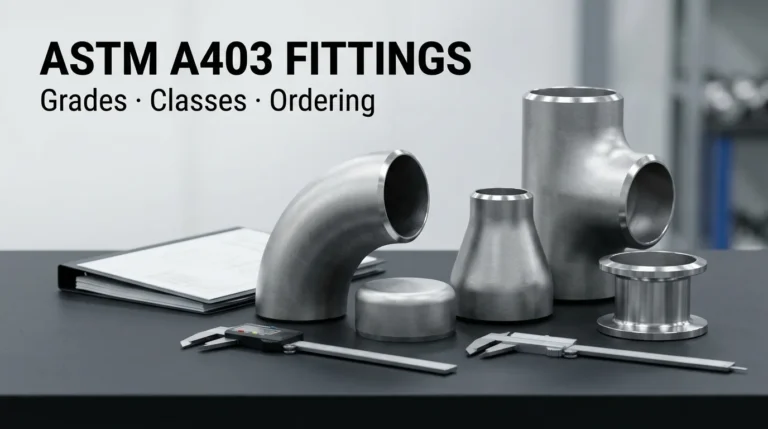
ASTM A403 is one of the principal material and product specifications used for wrought austenitic stainless steel piping fittings. A purchase description such as “ASTM A403 WP316L, 90° long-radius elbow, NPS 4, Schedule 40S” combines several separate decisions: the material grade, fitting type, dimensions, wall thickness, manufacturing class, examination level and documentation.
This guide explains what ASTM A403 stainless steel pipe fittings cover, how the specification works with ASTM A312 and ASME B16.9, what common grade and class designations mean, and what buyers should include in an RFQ. The controlled standard edition, governing piping code and approved project specification always take precedence over this general guide.
Quick answer: ASTM A403/A403M establishes material, manufacture, heat treatment, testing, workmanship and marking requirements for wrought austenitic stainless steel piping fittings. It does not by itself define the complete fitting geometry, pressure rating or project suitability. Buyers must also state the grade, product type, dimensional standard, nominal size, schedule or wall thickness, manufacturing class, end preparation, examination and certification requirements.
What Does ASTM A403 Cover?
ASTM A403/A403M applies to wrought austenitic stainless steel fittings intended for pressure-piping applications. Common purchases include butt-weld elbows, tees, reducers, crosses, caps and stub ends. Depending on the project and product form, the material specification may also be referenced together with other dimensional standards for wrought fittings.
The specification addresses key product requirements such as:
- permitted stainless steel grades and chemical composition;
- raw-material and manufacturing routes;
- heat treatment;
- mechanical-property requirements;
- workmanship and finish;
- product testing and weld examination;
- repair and supplementary requirements where permitted;
- marking, traceability and certification.
ASTM A403 is not a complete piping design document. It does not select the correct alloy for the fluid, determine the required wall thickness, calculate allowable pressure or establish the complete inspection plan for every project.
Which Stainless Steel Fittings Are Commonly Ordered to ASTM A403?
The standard is frequently used for factory-made wrought stainless steel fittings installed in process, utility, commercial and industrial piping. Typical product descriptions include:
- 45° and 90° butt-weld elbows;
- equal and reducing tees;
- concentric and eccentric reducers;
- crosses;
- pipe caps;
- lap-joint stub ends;
- special wrought fittings manufactured to an approved drawing.
For buyers specifying this fitting type, our lap joint stub end and flange guide explains how the ASTM material requirement works together with the stub-end geometry and matching backing flange.
The product name alone is not enough. “ASTM A403 elbow” does not identify the radius, nominal size, wall thickness, grade, manufacturing class or end preparation. These details must appear in the purchase order or approved data sheet.
How ASTM A403 Works with ASTM A312 and ASME B16.9
A stainless steel butt-weld fitting order normally relies on several standards working together. Each document has a different responsibility.
| Document | Main responsibility | What the purchaser must confirm |
|---|---|---|
| ASTM A403/A403M | Fitting material, manufacture, heat treatment, tests, workmanship and marking | Grade, class, supplementary examination and documentation |
| ASME B16.9 | Factory-made butt-weld fitting dimensions, tolerances and general dimensional requirements | Fitting type, size, radius or pattern and dimensional standard |
| ASTM A312/A312M | Austenitic stainless steel pipe material and product requirements | Matching pipe grade, NPS, schedule and manufacturing route |
| ASME B36.19M | Stainless steel pipe outside diameters and schedule wall thicknesses | Pipe size and schedule used at the fitting ends |
| ASME B16.25 | Butt-welding end preparation | Bevel details and project-specific weld-end requirements |
| Applicable piping code | System design, allowable conditions, fabrication, examination and testing | Which code and edition govern the installed system |
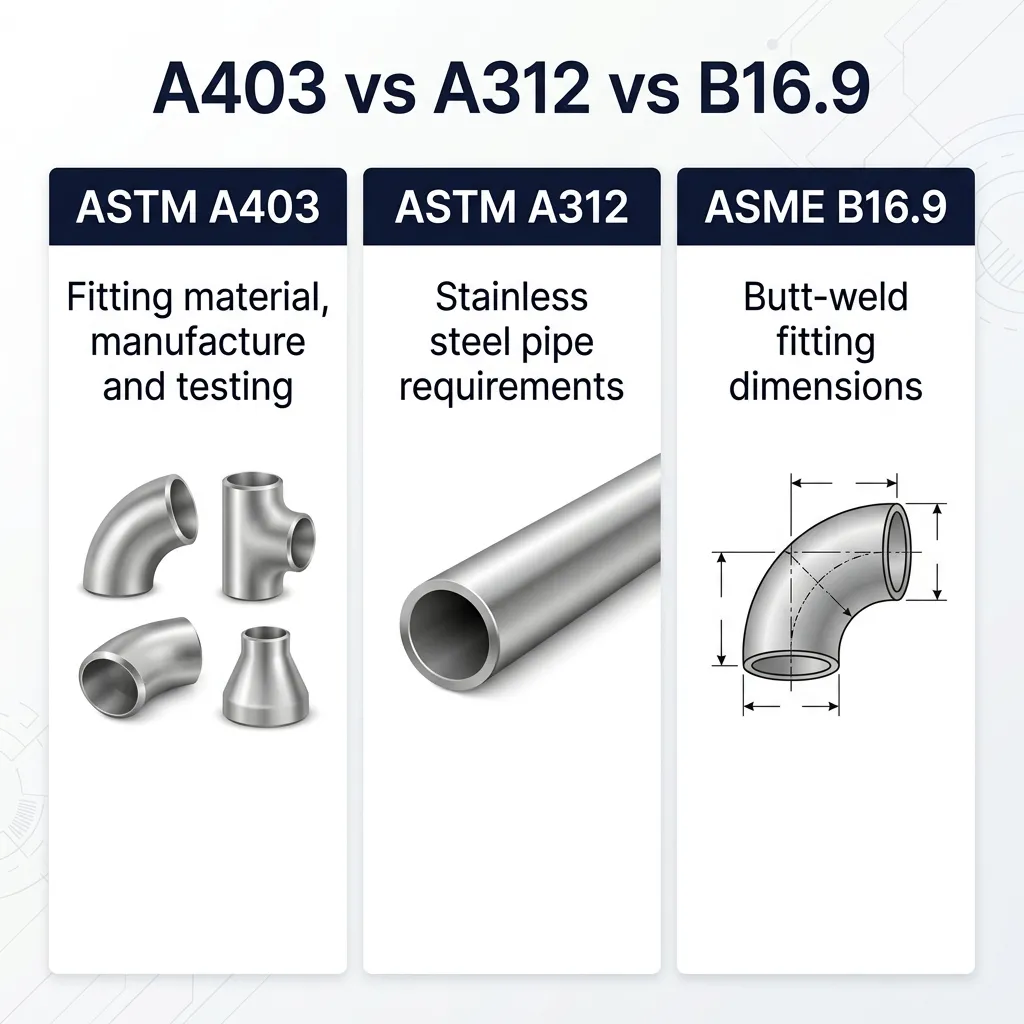
In simple terms, ASTM A403 tells the buyer what the fitting is made from and how the product must be manufactured and verified. ASME B16.9 tells the buyer what the factory-made butt-weld fitting must look like dimensionally. ASTM A312 governs the matching stainless steel pipe.
For more detail, see our guides to ASME B16.9 butt-weld fittings and ASTM A312 stainless steel pipe.
For the broader standards relationship behind these individual documents, see our ASTM vs ASME guide for piping projects, including how product specifications, dimensional standards and piping codes are combined in a complete RFQ.
For controlled wording and current editions, consult the ASTM standards catalog and the ASME Codes & Standards catalog.
Common ASTM A403 Grades
ASTM A403 includes several austenitic stainless steel grades. The most common commercial inquiries involve WP304, WP304L, WP316 and WP316L. The “WP” designation is part of the fitting grade identification; it is not a pressure class.
| Common grade | Typical selection reason | Selection limit |
|---|---|---|
| WP304 | General-purpose austenitic stainless steel for many water, utility and industrial services | May be unsuitable for chloride-rich or more aggressive environments |
| WP304L | Lower-carbon 304 grade frequently selected for welded piping systems | Low carbon does not remove the need to review corrosion and temperature conditions |
| WP316 | Molybdenum-bearing grade with improved resistance in many chloride-containing services | It can still suffer pitting, crevice corrosion and stress-corrosion cracking |
| WP316L | Lower-carbon 316 grade commonly specified for welded and corrosive-service piping | Service chemistry, temperature, surface condition and fabrication remain important |
The fitting grade should normally be compatible with the connected pipe and the project’s corrosion strategy. However, matching the grade name alone is not enough. The engineer must also consider weld filler metal, gasket materials, valves, cleaning chemicals, external exposure and operating temperature.
Our 304 vs 316 stainless steel pipe guide provides a broader material-selection comparison.
What Do the ASTM A403 Class Suffixes Mean?
Project documents and fitting markings may include a class suffix after the grade, such as WP316L-S or WP316L-WX. These class designations help identify the manufacturing route and, for welded fittings, the required weld examination.
| Common class suffix | General purchasing interpretation | Buyer check |
|---|---|---|
| S | Seamless fitting | Confirm whether seamless manufacture is mandatory or simply preferred |
| W | Welded fitting manufactured under the standard’s applicable weld requirements | Confirm the weld route and examination required by the project |
| WX | Welded fitting with radiographic examination of all welds as defined by the controlled specification | Confirm radiography, acceptance criteria and documentation |
| WU | Welded fitting with ultrasonic examination of all welds as defined by the controlled specification | Confirm ultrasonic procedure, acceptance criteria and reports |
The exact class wording, permitted manufacturing routes and examination requirements must be checked against the edition named in the purchase order. A buyer should not assume that “welded” automatically means lower quality or that “seamless” automatically means suitable for a more demanding service. The complete grade, class, dimensions, testing and quality records determine compliance.
Manufacture and Heat Treatment
Wrought fittings may be produced from seamless or welded pipe, plate, forgings or other permitted wrought starting material. Manufacturing can involve forming, pressing, forging, extrusion, bending, welding, machining and heat treatment, depending on the fitting type and class.
Heat treatment is important because forming and welding can change the stainless steel microstructure and corrosion behavior. The controlled ASTM A403 requirements specify the required treatment for each applicable grade and product route. Buyers should avoid replacing those requirements with a generic phrase such as “solution annealed” unless the purchase order clearly identifies the applicable standard, grade and required condition.
When additional corrosion testing, special heat treatment, hardness limits or grain-size controls are required, they should be stated before production. These are not automatically included in every standard fitting order.
Dimensions, Wall Thickness and Pressure Rating
ASTM A403 does not by itself provide a complete dimensional description. For butt-weld fittings, ASME B16.9 is commonly used for center-to-end dimensions, outside diameters, tolerances and fitting geometry. The connected pipe schedule or specified nominal wall thickness determines the required fitting-end wall.
A clear order should therefore state:
- fitting type and configuration;
- nominal pipe size or size combination;
- schedule or nominal wall thickness;
- radius or pattern where applicable;
- dimensional standard;
- bevel or other end preparation;
- any minimum wall or special tolerance requirement.
The WP prefix and S/W/WX/WU suffixes are not pressure classes. Factory-made butt-weld fittings are generally selected as part of a piping system under the applicable design code, based on material properties, wall thickness, dimensions, temperature, corrosion allowance and connected pipe. Do not treat an ASTM A403 grade designation as a standalone pressure rating.
Testing, Examination and Supplementary Requirements
ASTM A403 compliance involves more than checking the alloy name. The standard includes requirements for chemical composition, mechanical properties, heat treatment, workmanship and product examination. The exact testing route depends on the grade, class, starting material, fitting construction and purchase order.
Additional project requirements may include:
- positive material identification;
- intergranular-corrosion testing;
- additional radiographic or ultrasonic examination;
- dye-penetrant examination of surfaces;
- hardness or ferrite checks where technically applicable;
- third-party inspection;
- special dimensional inspection reports;
- special cleaning, pickling or passivation;
- country-of-origin or project-specific traceability;
- additional material-test-report content.
These requirements should be specified during the RFQ stage. Adding them after the fittings have been manufactured may be impossible or may require retesting, new production or a revised delivery schedule.
Marking, Traceability and Material Test Reports
Fitting markings and documentation should allow the delivered item to be matched to the purchase order and manufacturing records. Depending on size, product form and project requirements, buyers commonly verify:
- manufacturer identification;
- ASTM A403/A403M designation;
- grade and class, such as WP316L-S or WP316L-WX;
- nominal size and schedule or wall thickness;
- heat number or traceability reference;
- fitting type where it is not visually obvious;
- applicable inspection or certification marks required by the order.
The material test report should be reviewed against the purchase description, not filed without checking. Confirm the heat number, grade, chemical composition, mechanical results, heat treatment, applicable examination records and compliance statement. If piece-level traceability is required after cutting, machining or site fabrication, the project should define how identification will be transferred and controlled.
Nonleak’s quality control page explains the broader inspection and traceability approach used for stainless steel piping products.
ASTM A403 vs ASTM A234 vs ASTM A182
These standards can all appear in piping procurement, but they cover different product and material families.
| Specification | Typical product focus | Common procurement distinction |
|---|---|---|
| ASTM A403/A403M | Wrought austenitic stainless steel piping fittings | Commonly used for stainless steel butt-weld elbows, tees, reducers and related fittings |
| ASTM A234/A234M | Wrought carbon steel and alloy steel piping fittings for specified temperature service | Do not substitute for stainless steel A403 grades merely because dimensions are similar |
| ASTM A182/A182M | Forged or rolled alloy and stainless steel flanges, forged fittings, valves and parts | Commonly associated with forged socket-weld or threaded fittings and flanges rather than wrought butt-weld fittings |
The correct specification depends on the product form, manufacturing route, material family and project code. Similar alloy chemistry does not make two product specifications interchangeable.
ASTM A403 Fittings RFQ Checklist
A complete RFQ reduces technical clarification and helps suppliers quote equivalent products. Include the following information:
- Standard and edition: ASTM A403/A403M and the project-required edition.
- Grade: for example, WP304L or WP316L.
- Class: S, W, WX, WU or another permitted requirement stated by the project.
- Fitting type: elbow, tee, reducer, cross, cap, stub end or special fitting.
- Configuration: angle, radius, equal/reducing pattern, concentric/eccentric form or drawing reference.
- Size: NPS or size combination for reducing fittings.
- Wall: schedule or nominal wall thickness.
- Dimensional standard: for example, the applicable ASME or project drawing.
- Ends: bevel details or special end preparation.
- Quantity: number of pieces for each size and configuration.
- Testing and NDE: standard requirements plus any PMI, corrosion, surface or volumetric examination.
- Documentation: material test report, NDE reports, inspection certificate and traceability level.
- Surface and cleaning: finish, pickling, passivation or contamination-control requirements.
- Packing: end protection, separation of grades, export packing and labeling.
- Project code and service: governing piping code, design conditions and any client specification.
An illustrative purchase description might read:
ASTM A403/A403M WP316L-S, ASME B16.9, 90° long-radius elbow, NPS 4, Schedule 40S, beveled ends, material test report and project-specified inspection required.
The example is for structure only. The final order description must be reviewed against the controlled standards, design code and project data sheet.
Frequently Asked Questions
Is ASTM A403 a stainless steel grade?
No. ASTM A403 is a product and material specification for wrought austenitic stainless steel piping fittings. The fitting grade is stated separately, such as WP304L or WP316L.
What is the difference between ASTM A403 and ASME B16.9?
ASTM A403 primarily governs fitting material, manufacture, heat treatment, tests and marking. ASME B16.9 primarily governs the dimensions and tolerances of factory-made butt-weld fittings.
What does WP316L mean?
WP316L identifies an austenitic stainless steel fitting grade based on low-carbon 316 chemistry and the requirements of ASTM A403. It does not indicate the fitting size, wall thickness, class or pressure rating.
What is the difference between WP316L-S and WP316L-W?
The suffix identifies the manufacturing class. S generally indicates seamless manufacture, while W identifies a welded class under the controlled specification. The required weld examination must be confirmed from the purchase order and applicable edition.
Is an ASTM A403 fitting automatically ASME B16.9 compliant?
No. The purchase order should state both requirements when both are needed. ASTM A403 and ASME B16.9 have different responsibilities.
Does ASTM A403 define the pressure rating?
Not by itself. Pressure suitability depends on the complete piping design, material properties, temperature, fitting and pipe wall thickness, corrosion allowance and governing code.
Can WP304L fittings be connected to TP304L pipe?
They are commonly paired, but the project must still verify material compatibility, dimensions, wall thickness, welding procedure, filler metal and service conditions.
For the welding-document side of that review, see our butt-weld pipe WPS guide, including WPS vs PQR, qualification scope and project checks.
Does WP316L mean the fitting cannot corrode?
No. WP316L offers improved resistance in many environments, but chloride concentration, temperature, crevices, surface condition, fabrication and cleaning can still cause corrosion.
Are PMI and third-party inspection included automatically?
Not necessarily. Additional PMI, third-party inspection and special reports should be stated in the RFQ and purchase order.
Should the standard year be included in the order?
Yes, when the project requires a specific edition. The purchaser should identify the applicable edition rather than assuming the supplier and client are using the same revision.
Specify the Fitting, Not Only the Standard Number
A reliable ASTM A403 order identifies the complete fitting: material grade, class, type, dimensions, wall thickness, end preparation, examination, documentation and project requirements. This prevents suppliers from quoting different products under the same short description.
Explore Nonleak stainless steel butt-weld fittings, review our technical documentation, or send your fitting list, standard, grade, size, schedule, quantity and inspection requirements through our contact page.
Technical note: This article is a general purchasing guide. It does not reproduce or replace the controlled text of ASTM, ASME, the governing piping code or the approved project specification.