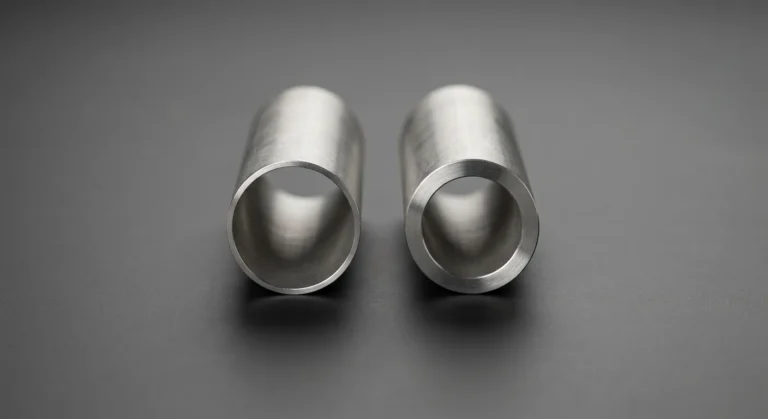
Schedule 10 vs Schedule 40 is a common comparison when engineers, contractors and buyers need to choose a pipe wall thickness for a project.
For the same nominal pipe size in the applicable dimensional series, Schedule 40 generally has a thicker wall than Schedule 10. Because the outside diameter remains associated with the nominal pipe size, increasing the wall thickness normally reduces the available inside diameter and increases the amount of metal in each length of pipe.
That does not mean Schedule 40 is automatically the better choice.
The correct schedule depends on the required dimensions, material grade, design conditions, joining method, applicable standards and project specification.
If you need the individual schedule guides first, review our Schedule 10 stainless steel pipe and Schedule 40 stainless steel pipe references.
What Is the Difference Between Schedule 10 and Schedule 40?
The main difference between Schedule 10 and Schedule 40 pipe is wall thickness.
For the same NPS in the corresponding dimensional series, the outside diameter is normally the same while the nominal wall thickness changes.
This produces several practical differences:
| Comparison | Schedule 10 | Schedule 40 |
|---|---|---|
| Outside diameter at same NPS | Same dimensional OD | Same dimensional OD |
| Wall thickness | Generally thinner | Generally thicker |
| Inside diameter | Generally larger | Generally smaller |
| Metal cross-section | Lower | Higher |
| Pipe weight | Generally lighter | Generally heavier |
| Handling load | Lower in comparable size and material | Higher in comparable size and material |
| Selection basis | Project requirements | Project requirements |
The important point is that schedule is a dimensional wall-thickness designation. It is not a material grade, joining method or complete pressure rating.
A buyer should therefore avoid treating the choice as simply “SCH10 means weak pipe” or “SCH40 means high-pressure pipe.” Those shortcuts leave out important engineering variables.
Schedule 10 vs Schedule 40 Wall Thickness
The difference becomes easier to understand when both schedules are compared at the same nominal pipe size.
A complete dimensional lookup is available in our pipe schedule chart. The smaller table below uses representative sizes only so this page can remain focused on comparison and selection instead of duplicating the full schedule reference.
Representative SCH10 vs SCH40 Dimensions
| NPS | DN | OD (mm) | SCH10 Wall (mm) | SCH40 Wall (mm) | Approx. SCH10 ID (mm) | Approx. SCH40 ID (mm) |
|---|---|---|---|---|---|---|
| 1″ | DN25 | 33.40 | 2.77 | 3.38 | 27.86 | 26.64 |
| 2″ | DN50 | 60.33 | 2.77 | 3.91 | 54.79 | 52.51 |
| 3″ | DN80 | 88.90 | 3.05 | 5.49 | 82.80 | 77.92 |
| 4″ | DN100 | 114.30 | 3.05 | 6.02 | 108.20 | 102.26 |
| 6″ | DN150 | 168.28 | 3.40 | 7.11 | 161.48 | 154.06 |
| 8″ | DN200 | 219.08 | 3.76 | 8.18 | 211.56 | 202.72 |
The approximate inside diameters above are calculated using:
ID ≈ OD − 2 × nominal wall thickness
They are useful for understanding the relationship between schedule and flow area, but final dimensional and hydraulic work should use controlled project data and the applicable dimensional standard.
For additional sizes and schedules, download the full stainless steel pipe schedule table.
How Wall Thickness Changes Inside Diameter
A common source of confusion is the assumption that selecting a heavier schedule makes the entire pipe larger. For a given nominal size, that is generally not what happens.
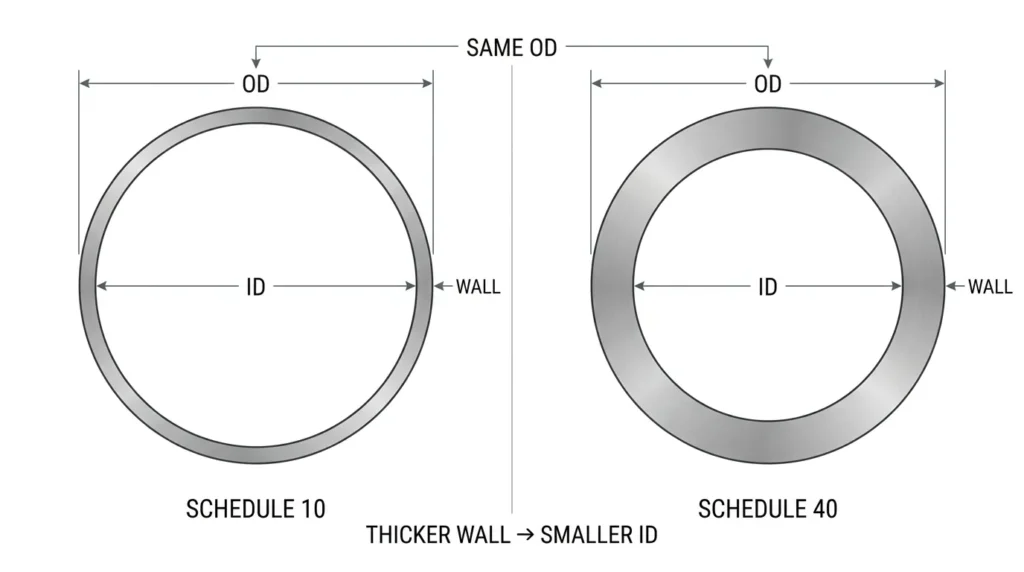
The outside diameter follows the dimensional series for that nominal pipe size. Additional wall thickness therefore grows primarily toward the inside of the pipe.
Same NPS + same OD + thicker wall = smaller ID.
This can matter when engineers evaluate:
- available flow area;
- flow velocity;
- pressure loss;
- equipment connections;
- cleaning requirements;
- hydraulic calculations;
- fitting and joint requirements.
For a broader explanation of NPS, DN, outside diameter and inside diameter, see our stainless steel pipe dimensions guide.
The schedule should therefore not be selected independently of the hydraulic design. A project that changes from SCH10 to SCH40 while keeping the same NPS may also change the available internal flow area. Whether that difference is important depends on the system flow rate, pipe size, length, fittings and overall hydraulic design.
How SCH10 vs SCH40 Affects Pipe Weight and Installation
Because Schedule 40 normally contains more metal than Schedule 10 at the same nominal size and material, it is generally heavier per unit length.
That difference can affect more than material quantity.
Handling
Larger or longer heavier-wall pipe sections may require additional consideration for lifting, moving and positioning during fabrication and installation.
Supports
Pipe supports are not selected only from the word “Schedule,” but pipe self-weight is one of the loads that may need to be considered when a support layout is designed.
The complete support design may also need to account for:
- fluid weight;
- insulation;
- valves and fittings;
- thermal movement;
- vibration;
- concentrated loads;
- support spacing;
- building or structural interfaces.
Fabrication
Wall thickness can affect fabrication planning, particularly where the pipe is welded.
For butt-weld construction, the actual pipe wall, end preparation, joint design and qualified welding procedure should all match the project requirements.
Transportation and Material Quantity
A heavier wall generally means more stainless steel is required for a comparable length of pipe.
That can influence:
- shipment weight;
- material handling;
- fabrication effort;
- installation planning;
- total material cost.
However, it is not accurate to state that Schedule 10 is always the cheaper option. Actual project cost depends on size, grade, quantity, manufacturing route, availability, fabrication, logistics and supplier conditions.
Does Schedule 40 Have a Higher Pressure Rating Than Schedule 10?
A thicker wall can provide more wall section for pressure design under otherwise comparable conditions, but Schedule 40 is not a pressure rating.
The schedule number alone cannot tell you the allowable working pressure of a piping system.
Pressure capability can depend on factors such as:
- material grade;
- allowable material properties at design temperature;
- actual pipe dimensions;
- manufacturing tolerances;
- corrosion or erosion allowance;
- governing piping code;
- joint design;
- fittings and valves;
- connection method;
- weld quality;
- external loads;
- cyclic service;
- project-specific design factors.
This is why a generic statement such as “Schedule 40 equals a specific PSI value” is not a reliable engineering rule.
The same schedule can be used across different pipe sizes and materials while their allowable design conditions differ substantially.
Use schedule as part of the dimensional specification, then use the applicable engineering method, material data, piping code and project conditions to determine the allowable design limits.
SCH10 vs SCH10S and SCH40 vs SCH40S
For stainless steel procurement, another important question is whether the project actually means:
- SCH10 or SCH10S;
- SCH40 or SCH40S.
The “S” suffix is associated with the stainless-steel pipe dimensional series and should not be treated as a decorative suffix or automatically removed from a purchase description.
Some schedule wall thicknesses coincide between related dimensional series, while others do not.
That means a buyer should not automatically assume:
SCH10 = SCH10S at every NPS
or:
SCH40 = SCH40S at every NPS.
A clear RFQ should identify:
- NPS or DN;
- schedule designation;
- required nominal wall thickness where necessary;
- applicable dimensional standard;
- material grade;
- pipe product specification.
For stainless steel piping, the applicable stainless-steel dimensional standard and the actual project specification should always be checked before final procurement.
Schedule 10 vs Schedule 40 for Stainless Steel Pipe
The schedule comparison answers only one part of a stainless steel pipe specification.
A complete stainless steel pipe selection must also answer several other questions.
What Material Is Required?
Examples may include 304, 304L, 316 or 316L, depending on the project specification, service environment and design requirements.
What Product Specification Applies?
For many austenitic stainless steel piping applications, ASTM A312 stainless steel pipe may be relevant.
ASTM A312 and pipe schedule do not perform the same job.
| Requirement | Main Question |
|---|---|
| Pipe product specification | What pipe product, grade, manufacture, testing and product requirements apply? |
| Dimensional standard | What NPS, OD and schedule or wall dimensions apply? |
| Project piping code and specification | What design, fabrication, examination and acceptance rules govern the installed system? |
The buyer may therefore need all three layers of information.
Writing only “316 stainless steel, SCH40” may still leave important questions unanswered.
The quotation may also need to identify:
- pipe manufacturing route;
- length;
- end condition;
- surface requirements;
- testing;
- documentation;
- quantity;
- connection method.
Nonleak’s stainless steel pipes section provides the commercial product entry point for pipe inquiries.
When Should You Consider Schedule 10?
Schedule 10 may be considered when the required engineering and project conditions permit a lighter wall.
Potential reasons for considering it can include:
- the project specification calls for SCH10 or SCH10S;
- the calculated design requires only the corresponding lighter wall;
- reducing pipe self-weight is beneficial;
- a larger internal flow area at the same NPS is useful;
- the required fitting and connection system is compatible;
- the selected material and wall satisfy the governing design requirements.
This does not mean Schedule 10 is automatically appropriate for every water, HVAC or low-pressure system.
The application name alone is not enough to select wall thickness.
A water line, for example, can operate under very different pressures, temperatures, installation conditions and code requirements from another water line.
The final schedule should therefore be confirmed from the approved design rather than from a generic application list.
When Should You Consider Schedule 40?
Schedule 40 may be considered when the design or project specification requires a heavier wall than Schedule 10.
Potential reasons include:
- SCH40 or SCH40S is explicitly specified;
- the engineering calculation requires the corresponding wall;
- the project has mechanical or fabrication requirements that favor a heavier wall;
- component or connection requirements call for the selected wall thickness;
- the material and wall combination satisfies the governing project design.
Again, a heavier schedule is not automatically “better.”
Selecting a heavier wall than necessary may add:
- pipe weight;
- material use;
- handling requirements;
- fabrication demands;
- cost.
The objective is not to select the highest schedule available. The objective is to select the pipe specification that satisfies the actual project requirement.
Can Schedule 10 and Schedule 40 Be Used in the Same Piping System?
Potentially, but not simply because both pipes share a nominal size.
A piping system can contain components with different wall requirements, but the transition must be technically compatible with the design, connection method and project documents.
Outside Diameter
For the same NPS in the corresponding dimensional series, the OD may match even though the wall thickness differs.
Joining Method
The effect of a wall change depends on how the pipes are joined.
For welded piping, joint preparation, fit-up and welding procedure requirements may need review.
For mechanical or press connection systems, use only pipe dimensions and wall ranges that the fitting and tool system is designed and approved to accept.
Fittings
A fitting must match the pipe size, dimensional system, material and connection requirements.
Do not assume that OD alone proves complete compatibility.
Hydraulic Effect
A wall change alters ID and can therefore affect the local flow area.
Project Approval
The final configuration must remain consistent with the approved drawings, calculations, specifications and governing code.
So the better question is not simply “Can SCH10 connect to SCH40?”
It is:
Does the proposed transition satisfy the dimensional, joint, hydraulic and project requirements of this specific system?
What Should Buyers Check Before Choosing SCH10 or SCH40?
Before choosing between Schedule 10 and Schedule 40, confirm the complete technical context.
1. Nominal Pipe Size
State the required NPS or DN. Schedule without size is incomplete because wall thickness changes with pipe size.
2. Actual Wall Thickness
Do not rely on the schedule name alone where the project requires a controlled wall value.
3. Schedule Suffix
For stainless steel pipe, confirm whether the requirement is SCH10, SCH10S, SCH40 or SCH40S.
4. Material Grade
The schedule does not identify whether the pipe is 304L, 316L or another material.
5. Product Specification
Identify the applicable pipe product specification.
6. Dimensional Standard
Confirm the dimensional series required by the drawing or specification.
7. Design Pressure and Temperature
These belong in the engineering selection process rather than being inferred from the schedule number.
8. Corrosion Allowance or Environmental Conditions
Where required by the project, loss of effective wall thickness must be considered separately.
9. Joining Method
Confirm whether the line will use butt welding, press-fit, socket welding or another approved connection system.
10. Fitting Compatibility
Pipe and fittings must work together as a system, not merely share a nominal size.
11. Documentation
Depending on the project, the supplier may need to provide material certificates, inspection records, traceability or other submittal documents.
Need Help Comparing SCH10 and SCH40 for a Project?
If your drawing or specification contains multiple pipe sizes or unclear schedule requirements, Nonleak can review the basic pipe selection and quotation information before supply.
Please provide the NPS/DN, required wall or schedule, stainless steel grade, applicable standard, design conditions, quantity and relevant project documents.
What Should Be Included in a Pipe RFQ?
A useful RFQ should allow the supplier to identify the pipe without guessing what the schedule description means.
| RFQ Item | Information to Provide |
|---|---|
| Product | Stainless steel pipe |
| Size | NPS / DN |
| Outside diameter | Where specifically controlled |
| Wall | SCH10 / SCH10S / SCH40 / SCH40S or specified wall thickness |
| Material | Exact required grade |
| Product specification | ASTM A312/A312M or other project requirement |
| Dimensional standard | Applicable ASME B36 series or project standard |
| Manufacturing route | Welded, seamless or other specified route |
| Ends | Plain, beveled or project-specific |
| Length | Standard, fixed or cut length |
| Service | Medium and environment |
| Design conditions | Pressure and temperature where required |
| Quantity | Pieces, total length or BOM quantity |
| Documentation | MTR, traceability, inspection or project-required records |
For supporting installation and specification information, review our Technical Documentation section.
A clear RFQ reduces the risk of receiving a quotation for the correct nominal size but the wrong wall, material, manufacturing route or documentation package.
Schedule 10 vs Schedule 40 FAQ
Is Schedule 40 thicker than Schedule 10?
For the same NPS in the corresponding dimensional series, Schedule 40 is generally thicker-wall than Schedule 10. Always verify the actual nominal wall thickness for the required pipe size and dimensional standard.
Do Schedule 10 and Schedule 40 have the same outside diameter?
For the same NPS within the corresponding dimensional series, they generally use the same outside diameter while wall thickness changes. This is why the thicker-wall Schedule 40 normally has a smaller inside diameter.
Which has a larger inside diameter, SCH10 or SCH40?
For the same NPS and OD, SCH10 generally has the larger inside diameter because its wall is thinner.
Is Schedule 40 stronger than Schedule 10?
Schedule 40 provides a thicker wall in the usual same-size comparison, but overall mechanical suitability cannot be determined from schedule alone. Material, temperature, manufacturing requirements, loads, corrosion allowance, joining and the governing design requirements must also be considered.
Is Schedule 40 always better than Schedule 10?
No. A heavier wall is not automatically the better engineering choice. The correct pipe is the one that satisfies the project requirements without unnecessary material, weight or fabrication burden.
Is Schedule 10 only for low-pressure piping?
No universal rule should classify all SCH10 piping as low pressure. Schedule is a dimensional designation rather than a stand-alone pressure class.
Is Schedule 10 the same as Schedule 10S?
Do not automatically treat SCH10 and SCH10S as identical across every nominal size. Confirm the applicable dimensional standard and nominal wall thickness.
Is Schedule 40 the same as Schedule 40S?
Not automatically. Some dimensions may coincide, but differences can exist depending on the size and dimensional series. State the correct designation in the purchase order.
Can SCH10 and SCH40 use the same fittings?
The same nominal pipe size may share the same outside diameter, but that alone does not prove full fitting compatibility. The fitting must also be suitable for the pipe wall, connection method, material and specific system requirements.
Does a higher schedule mean a higher pressure rating?
A thicker wall can affect pressure design, but schedule itself is not a complete pressure rating. Allowable design conditions must be determined from the complete pipe specification and governing engineering requirements.
Need Schedule 10 or Schedule 40 Stainless Steel Pipe?
Send us your required pipe size, schedule or nominal wall thickness, material grade, quantity and project specification.
Nonleak can review the requested pipe dimensions, product requirements and documentation needs before quotation.
Technical Note: This article is a general dimensional, procurement and selection guide. It does not replace the controlled text of applicable ASME or ASTM standards, the governing piping code, approved engineering calculations or the project specification.